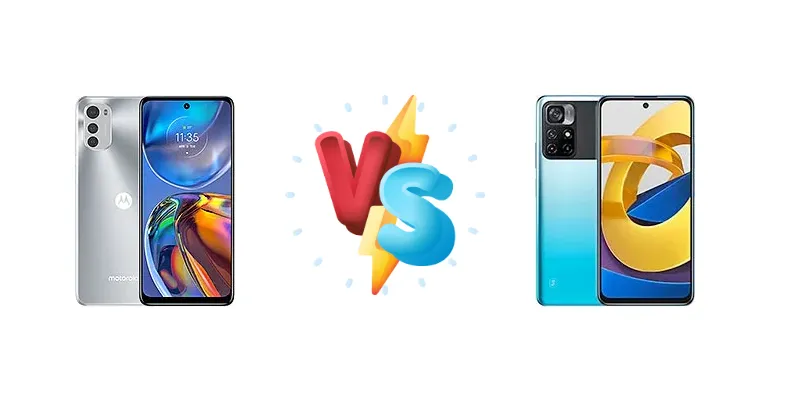
The Motorola Moto E32 and Xiaomi Poco M4 Pro 5G represent compelling options in the increasingly competitive sub-$250 smartphone market. Both offer 5G connectivity, but diverge significantly in their internal hardware and feature sets. This comparison dissects these differences, focusing on performance, display quality, and battery life to determine which device delivers the best value.
🏆 Quick Verdict
For most users, the Xiaomi Poco M4 Pro 5G is the superior choice. Its Mediatek Dimensity 810 chipset provides a substantial performance uplift over the Moto E32’s Unisoc T606, coupled with significantly faster 33W charging. While both offer similar battery endurance ratings, the Poco’s faster charging mitigates any potential concerns.
| Network |
|---|
| 2G bands | GSM 850 / 900 / 1800 / 1900 | GSM 850 / 900 / 1800 / 1900 |
| 3G bands | HSDPA 850 / 900 / 1900 / 2100 | HSDPA 850 / 900 / 1700(AWS) / 1900 / 2100 - International |
| 4G bands | 1, 3, 5, 7, 8, 20, 38, 40, 41 | 1, 2, 3, 4, 5, 7, 8, 12, 17, 20, 28, 32, 38, 40, 41, 66 - International |
| 5G bands | - | 1, 3, 5, 7, 8, 20, 28, 38, 40, 41, 66, 77, 78 SA/NSA - International |
| Speed | HSPA, LTE | HSPA, LTE, 5G |
| Technology | GSM / HSPA / LTE | GSM / HSPA / LTE / 5G |
| | - | 1, 3, 5, 8, 28, 40, 78 SA/NSA - India |
| Launch |
|---|
| Announced | 2022, May 05 | 2021, November 09 |
| Status | Available. Released 2022, May 05 | Available. Released 2021, November 11 |
| Body |
|---|
| Build | Glass front, plastic frame, plastic back | Glass front (Gorilla Glass 3), plastic back, plastic frame |
| Dimensions | 164 x 75 x 8.5 mm (6.46 x 2.95 x 0.33 in) | 163.6 x 75.8 x 8.8 mm (6.44 x 2.98 x 0.35 in) |
| SIM | · Nano-SIM· Nano-SIM + Nano-SIM | Nano-SIM + Nano-SIM |
| Weight | 184 g (6.49 oz) | 195 g (6.88 oz) |
| | Water repellent design | IP53, dust and splash resistant |
| Display |
|---|
| Protection | - | Corning Gorilla Glass 3 |
| Resolution | 720 x 1600 pixels, 20:9 ratio (~268 ppi density) | 1080 x 2400 pixels, 20:9 ratio (~399 ppi density) |
| Size | 6.5 inches, 103.5 cm2 (~84.2% screen-to-body ratio) | 6.6 inches, 105.2 cm2 (~84.8% screen-to-body ratio) |
| Type | IPS LCD, 90Hz | IPS LCD, 90Hz, 450 nits (typ) |
| Platform |
|---|
| CPU | Octa-core (2x1.6 GHz Cortex-A75 & 6x1.6 GHz Cortex-A55) | Octa-core (2x2.4 GHz Cortex-A76 & 6x2.0 GHz Cortex-A55) |
| Chipset | Unisoc T606 (12 nm) | Mediatek Dimensity 810 (6 nm) |
| GPU | Mali-G57 MP1 | Mali-G57 MC2 |
| OS | Android 11 | Android 11, upgradable to Android 12, MIUI 13 |
| Memory |
|---|
| Card slot | microSDXC (dedicated slot) | microSDXC |
| Internal | 64GB 4GB RAM | 64GB 4GB RAM, 64GB 6GB RAM, 128GB 4GB RAM, 128GB 6GB RAM, 128GB 8GB RAM, 256GB 8GB RAM |
| | - | UFS 2.2 |
| Main Camera |
|---|
| Dual | - | 50 MP, f/1.8, 26mm (wide), PDAF
8 MP, f/2.2, 119˚ (ultrawide) |
| Features | LED flash, HDR, panorama | LED flash, HDR, panorama |
| Single | - | 16 MP, f/2.5, (wide), 1/3.06" 1.0µm |
| Triple | 16 MP, f/2.2, 26mm (wide), 1.0µm, PDAF
2 MP (macro)
Auxiliary lens | - |
| Video | 1080p@30fps | 1080p@30/60fps |
| Selfie camera |
|---|
| Features | HDR | Panorama |
| Single | 8 MP, f/2.0, (wide), 1/4.0", 1.12µm | 16 MP, f/2.5, (wide), 1/3.06" 1.0µm |
| Video | 1080p@30fps | 1080p@30fps |
| Sound |
|---|
| 3.5mm jack | Yes | Yes |
| 35mm jack | Yes | Yes |
| Loudspeaker | Yes | Yes, with stereo speakers |
| Comms |
|---|
| Bluetooth | 5.0, A2DP, LE | 5.1, A2DP, LE |
| Infrared port | - | Yes |
| NFC | No | Yes (market/region dependent) |
| Positioning | GPS, GLONASS, GALILEO | GPS, GLONASS, GALILEO, BDS |
| Radio | Unspecified | FM radio |
| USB | USB Type-C 2.0 | USB Type-C 2.0, OTG |
| WLAN | Wi-Fi 802.11 b/g/n, Wi-Fi Direct | Wi-Fi 802.11 a/b/g/n/ac, dual-band, Wi-Fi Direct |
| Features |
|---|
| Sensors | Fingerprint (side-mounted), accelerometer, proximity | Fingerprint (side-mounted), accelerometer, gyro, compass |
| Battery |
|---|
| Charging | 18W wired | 33W wired, 100% in 59 min |
| Type | Li-Po 5000 mAh | Li-Po 5000 mAh |
| Misc |
|---|
| Colors | Misty Silver, Pearl Blue, Slate Grey | Poco Yellow, Power Black, Cool Blue |
| Models | - | 21091116AG, MZB0BGVIN |
| Price | About 150 EUR | About 150 EUR |
| SAR | - | 1.07 W/kg (head) 1.09 W/kg (body) |
| SAR EU | - | 0.59 W/kg (head) 1.00 W/kg (body) |
| Tests |
|---|
| Battery life | - |
Endurance rating 123h
|
| Camera | - |
Photo / Video |
| Display | - |
Contrast ratio: 1553:1 (nominal) |
| Loudspeaker | - |
-24.9 LUFS (Very good)
|
| Performance | - |
AnTuTu: 296721 (v8), 353663 (v9)
GeekBench: 1797 (v5.1)
GFXBench: 13fps (ES 3.1 onscreen) |
Motorola Moto E32
- Potentially cleaner software experience (Motorola's near-stock Android)
- Lower price point (likely)
- Acceptable battery life
- Significantly weaker processor (Unisoc T606)
- Slower charging speed (18W)
- Display likely lower quality
Xiaomi Poco M4 Pro 5G
- Faster and more efficient processor (Dimensity 810)
- Much faster charging (33W, 59 minutes to full)
- Brighter display (510 nits)
- MIUI software can be bloated
- Potentially higher price
- Software updates may be less frequent than Motorola
Display Comparison
The Poco M4 Pro 5G boasts a brighter display, measured at 510 nits, compared to the Moto E32’s unspecified brightness. Both share a 1553:1 contrast ratio, suggesting similar color depth and black levels. However, the Poco’s higher peak brightness will translate to better visibility outdoors under direct sunlight. While neither manufacturer specifies panel technology, the Poco’s display is likely IPS LCD, offering good color accuracy for the price point. The Moto E32’s display details are less clear, potentially indicating a lower-quality panel.
Camera Comparison
Both phones feature a 'Photo / Video' camera setup, but detailed specifications are lacking. Without sensor size or aperture information, a direct comparison is difficult. However, given the price bracket, it’s reasonable to assume both utilize budget sensors. The Poco M4 Pro 5G’s camera system is likely to offer better image processing capabilities due to the more powerful ISP within the Dimensity 810 chipset. The presence of OIS (Optical Image Stabilization) on the Poco, if present (unconfirmed in data), would further enhance image quality, particularly in low-light conditions. Avoid placing much stock in any 2MP macro lens found on either device.
Performance
The core difference lies in the chipsets. The Poco M4 Pro 5G utilizes the Mediatek Dimensity 810 (6nm), featuring a more powerful CPU configuration – 2x2.4 GHz Cortex-A76 cores and 6x2.0 GHz Cortex-A55 cores – compared to the Moto E32’s Unisoc T606 (12nm) with 2x1.6 GHz Cortex-A75 cores and 6x1.6 GHz Cortex-A55 cores. The 6nm process node of the Dimensity 810 also contributes to improved power efficiency and thermal management. This translates to noticeably faster app loading times, smoother multitasking, and a better gaming experience on the Poco. The Unisoc T606 is adequate for basic tasks, but will struggle with demanding applications.
Battery Life
Both devices achieve an endurance rating of 123 hours, suggesting comparable battery life under similar usage patterns. However, the Poco M4 Pro 5G’s 33W wired charging significantly outperforms the Moto E32’s 18W charging. The Poco can reach 100% charge in just 59 minutes, while the Moto E32 will take considerably longer. This faster charging capability is a significant advantage for users who prioritize convenience and minimal downtime.
Buying Guide
Buy the Motorola Moto E32 if you prioritize a simple, clean Android experience and are on an extremely tight budget, accepting compromises in processing power. Buy the Xiaomi Poco M4 Pro 5G if you value faster performance for gaming and multitasking, quicker charging speeds, and a brighter, more vibrant display, even if it means navigating Xiaomi’s MIUI software.
Frequently Asked Questions
❓ Is the Mediatek Dimensity 810 in the Poco M4 Pro 5G capable of running demanding games like Genshin Impact?
While the Dimensity 810 isn't a flagship chipset, it's capable of running Genshin Impact at medium settings with reasonable frame rates. Expect some frame drops during intense combat scenarios. The Moto E32’s Unisoc T606 would struggle significantly with this title.
❓ How does Xiaomi's MIUI software affect the user experience on the Poco M4 Pro 5G?
MIUI is a heavily customized Android skin. It offers a wide range of features and customization options, but can also feel bloated with pre-installed apps and occasional advertisements. Users accustomed to a cleaner Android experience may prefer Motorola’s near-stock software on the Moto E32.
❓ Does the Poco M4 Pro 5G support VoWiFi (Wi-Fi Calling)?
Support for VoWiFi varies by carrier and region. While the Dimensity 810 chipset supports the necessary hardware, carrier implementation is crucial. Check with your mobile provider to confirm compatibility before purchasing.
❓ What type of USB port do both phones use?
Both the Motorola Moto E32 and the Xiaomi Poco M4 Pro 5G utilize a USB-C port for charging and data transfer. This is standard for modern smartphones.