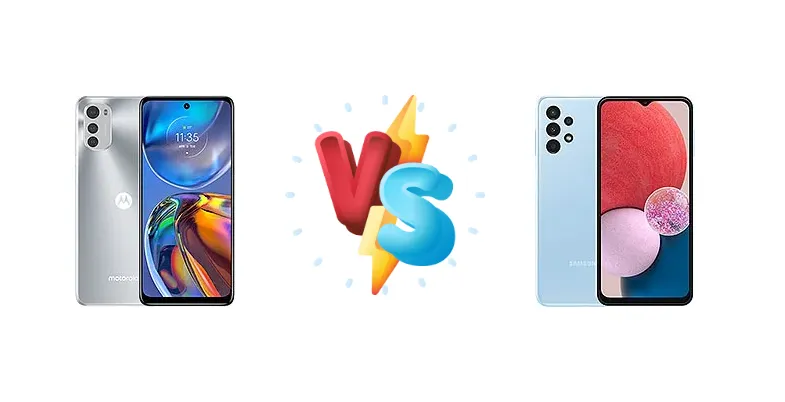
The Motorola Moto E32 and Samsung Galaxy A13 (SM-A137) represent the fiercely competitive sub-$150 smartphone market. Both aim to deliver essential smartphone functionality at an accessible price, but they take different approaches to achieving this. This comparison dissects their core components to reveal which device offers the best value for your money.
🏆 Quick Verdict
For the average user prioritizing responsiveness and occasional gaming, the Samsung Galaxy A13 is the better choice. Its Mediatek Helio G80 chipset, with slightly higher clocked Cortex-A75 cores, provides a noticeable performance advantage over the Moto E32’s Unisoc T606. However, the Moto E32 offers a more efficient charging solution.
| Network |
|---|
| 2G bands | GSM 850 / 900 / 1800 / 1900 | GSM 850 / 900 / 1800 / 1900 |
| 3G bands | HSDPA 850 / 900 / 1900 / 2100 | HSDPA 850 / 900 / 2100 |
| 4G bands | 1, 3, 5, 7, 8, 20, 38, 40, 41 | 1, 3, 5, 7, 8, 20, 28, 38, 40, 41 |
| Speed | HSPA, LTE | HSPA, LTE |
| Technology | GSM / HSPA / LTE | GSM / HSPA / LTE |
| Launch |
|---|
| Announced | 2022, May 05 | 2022, June |
| Status | Available. Released 2022, May 05 | Available. Released 2022, July |
| Body |
|---|
| Build | Glass front, plastic frame, plastic back | Glass front (Gorilla Glass 5), plastic frame, plastic back |
| Dimensions | 164 x 75 x 8.5 mm (6.46 x 2.95 x 0.33 in) | 165.1 x 76.4 x 8.8 mm (6.5 x 3.01 x 0.35 in) |
| SIM | · Nano-SIM· Nano-SIM + Nano-SIM | · Nano-SIM· Nano-SIM + Nano-SIM |
| Weight | 184 g (6.49 oz) | 195 g (6.88 oz) |
| | Water repellent design | - |
| Display |
|---|
| Protection | - | Corning Gorilla Glass 5 |
| Resolution | 720 x 1600 pixels, 20:9 ratio (~268 ppi density) | 1080 x 2408 pixels, 20:9 ratio (~400 ppi density) |
| Size | 6.5 inches, 103.5 cm2 (~84.2% screen-to-body ratio) | 6.6 inches, 104.9 cm2 (~83.2% screen-to-body ratio) |
| Type | IPS LCD, 90Hz | PLS LCD |
| Platform |
|---|
| CPU | Octa-core (2x1.6 GHz Cortex-A75 & 6x1.6 GHz Cortex-A55) | Octa-core (2x2.0 GHz Cortex-A75 & 6x1.8 GHz Cortex-A55) |
| Chipset | Unisoc T606 (12 nm) | Mediatek MT6769V/CU Helio G80 (12 nm) |
| GPU | Mali-G57 MP1 | Mali-G52 MC2 |
| OS | Android 11 | Android 12, upgradable to Android 14, One UI 6.1 |
| Memory |
|---|
| Card slot | microSDXC (dedicated slot) | microSDXC (dedicated slot) |
| Internal | 64GB 4GB RAM | 32GB 3GB RAM, 32GB 4GB RAM, 64GB 4GB RAM, 128GB 4GB RAM |
| | - | eMMC 5.1 |
| Main Camera |
|---|
| Features | LED flash, HDR, panorama | LED flash, panorama, HDR |
| Quad | - | 50 MP, f/1.8, (wide), PDAF
5 MP, f/2.2, 123˚ (ultrawide), 1/5.0", 1.12µm
2 MP (macro)
Auxiliary lens |
| Single | - | 8 MP, f/2.2, (wide) |
| Triple | 16 MP, f/2.2, 26mm (wide), 1.0µm, PDAF
2 MP (macro)
Auxiliary lens | - |
| Video | 1080p@30fps | 1080p@30fps |
| Selfie camera |
|---|
| Features | HDR | - |
| Single | 8 MP, f/2.0, (wide), 1/4.0", 1.12µm | 8 MP, f/2.2, (wide) |
| Video | 1080p@30fps | 1080p@30fps |
| Sound |
|---|
| 3.5mm jack | Yes | Yes |
| 35mm jack | Yes | Yes |
| Loudspeaker | Yes | Yes |
| Comms |
|---|
| Bluetooth | 5.0, A2DP, LE | 5.2, A2DP, LE |
| NFC | No | Yes |
| Positioning | GPS, GLONASS, GALILEO | GPS, GLONASS, GALILEO, BDS |
| Radio | Unspecified | No |
| USB | USB Type-C 2.0 | USB Type-C 2.0, OTG |
| WLAN | Wi-Fi 802.11 b/g/n, Wi-Fi Direct | Wi-Fi 802.11 a/b/g/n/ac, dual-band, Wi-Fi Direct |
| Features |
|---|
| Sensors | Fingerprint (side-mounted), accelerometer, proximity | Fingerprint (side-mounted), accelerometer, compass |
| | - | Virtual proximity sensing |
| Battery |
|---|
| Charging | 18W wired | 15W wired |
| Type | Li-Po 5000 mAh | Li-Po 5000 mAh |
| Misc |
|---|
| Colors | Misty Silver, Pearl Blue, Slate Grey | Black, White, Blue |
| Models | - | SM-A137F, SM-A137F/DSN, SM-A137F/DS |
| Price | About 150 EUR | About 180 EUR |
| SAR EU | - | 0.35 W/kg (head) 1.22 W/kg (body) |
Motorola Moto E32
- Faster charging (18W)
- Potentially better battery efficiency with Unisoc T606
- Likely more affordable
- Slower CPU performance
- Less capable GPU for gaming
- Potentially less refined software experience
Samsung Galaxy A13 (SM-A137)
- Faster CPU and GPU performance
- Better for gaming and multitasking
- Samsung’s One UI offers a feature-rich experience
- Slower charging (15W)
- Potentially shorter battery life under heavy load
- May be slightly more expensive
Display Comparison
Neither device boasts a standout display. Both likely utilize LCD panels, common in this price bracket. While specific details like peak brightness and color gamut coverage are unavailable, the focus here is on core performance. Bezels are expected to be relatively substantial on both, impacting the overall screen-to-body ratio. Color accuracy will likely be standard for the segment, prioritizing power efficiency over color fidelity.
Camera Comparison
Both phones likely feature a multi-camera setup, but the quality will be heavily dependent on software processing. Without specific sensor details, it’s difficult to make a definitive judgment. The presence of a 2MP macro camera on both is largely a marketing tactic, offering limited practical benefit. Image processing will likely favor vibrant colors and smoothed details on the Samsung, while Motorola tends towards a more natural, albeit potentially less polished, look. The A13's slightly better processing power may allow for faster image capture and processing.
Performance
The core difference lies in the chipsets. The Samsung Galaxy A13’s Mediatek Helio G80 features 2x2.0 GHz Cortex-A75 cores and 6x1.8 GHz Cortex-A55 cores, while the Motorola Moto E32 uses the Unisoc T606 with 2x1.6 GHz Cortex-A75 cores and 6x1.6 GHz Cortex-A55 cores. The higher clock speeds on the A13’s A75 cores translate to a tangible performance boost in CPU-intensive tasks and gaming. While both are 12nm chips, the Helio G80’s architecture is optimized for gaming, offering a slight GPU advantage. RAM configurations are likely similar, but the chipset difference is the dominant factor.
Battery Life
Battery capacity is not specified, but both phones likely house batteries in the 4000-5000 mAh range. The Samsung Galaxy A13 offers 15W wired charging, while the Motorola Moto E32 supports 18W wired charging. While the wattage difference isn’t massive, the Moto E32 *should* achieve a slightly faster 0-100% charge time. However, the more power-hungry Helio G80 in the A13 will likely drain the battery faster during intensive use, potentially negating the charging advantage.
Buying Guide
Buy the Motorola Moto E32 if you prioritize a potentially longer-lasting battery life due to the more efficient Unisoc chipset and value a slightly faster charging experience. Buy the Samsung Galaxy A13 (SM-A137) if you need a phone that feels more responsive for everyday tasks and can handle light gaming with a bit more headroom, even if it means slightly less efficient power consumption.
Frequently Asked Questions
❓ Will the Helio G80 in the Galaxy A13 overheat during prolonged gaming sessions?
The Helio G80 is a capable chip, but it's not known for exceptional thermal performance. While it won't likely reach critical temperatures, expect some throttling after 30-45 minutes of demanding games. The plastic build of both phones doesn't aid in heat dissipation.
❓ Is the 18W charging on the Moto E32 significantly faster than the 15W on the Galaxy A13 in real-world use?
The difference is noticeable, but not dramatic. Expect the Moto E32 to charge roughly 10-15% faster, translating to around 20-30 minutes saved for a full charge. The actual time will depend on the charger and cable used.
❓ How does the software experience differ between Motorola’s near-stock Android and Samsung’s One UI?
Motorola offers a cleaner, near-stock Android experience with minimal bloatware. Samsung’s One UI is more feature-rich, with added customization options and pre-installed apps. One UI can feel more polished, but also more resource-intensive.
❓ Can the Galaxy A13 handle popular games like PUBG Mobile or Call of Duty Mobile at playable frame rates?
The Galaxy A13 can run PUBG Mobile and Call of Duty Mobile, but you’ll likely need to stick to medium graphics settings and moderate frame rates (around 30-40fps) for a smooth experience. The Helio G80 provides enough power for casual gaming, but don’t expect flagship-level performance.