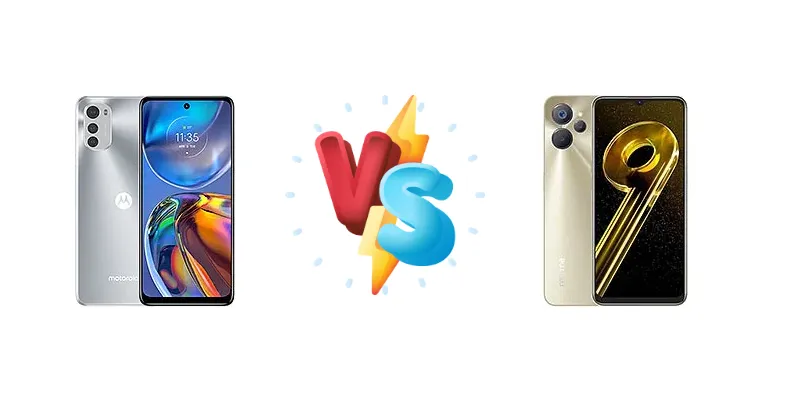
The sub-$200 smartphone market is fiercely competitive, and the Motorola Moto E32 and Realme 9i 5G represent compelling options for budget-conscious consumers. While both aim to deliver essential smartphone functionality, they diverge significantly in their core processing power and overall performance capabilities. This comparison dissects these differences to determine which device offers the best value.
🏆 Quick Verdict
For the average user prioritizing responsiveness and future-proofing, the Realme 9i 5G is the clear winner. Its Mediatek Dimensity 810 chipset, built on a more efficient 6nm process, delivers substantially better performance than the Motorola Moto E32’s Unisoc T606, making it a more capable all-rounder.
| Network |
|---|
| 2G bands | GSM 850 / 900 / 1800 / 1900 | GSM 850 / 900 / 1800 / 1900 |
| 3G bands | HSDPA 850 / 900 / 1900 / 2100 | HSDPA 850 / 900 / 1700(AWS) / 1900 / 2100 |
| 4G bands | 1, 3, 5, 7, 8, 20, 38, 40, 41 | 1, 2, 3, 4, 5, 7, 8, 19, 20, 28, 34, 38, 39, 40, 41 |
| 5G bands | - | 1, 5, 7, 8, 28, 41, 77, 78 SA/NSA |
| Speed | HSPA, LTE | HSPA, LTE, 5G |
| Technology | GSM / HSPA / LTE | GSM / HSPA / LTE / 5G |
| Launch |
|---|
| Announced | 2022, May 05 | 2022, August 18 |
| Status | Available. Released 2022, May 05 | Available. Released 2022, August 24 |
| Body |
|---|
| Build | Glass front, plastic frame, plastic back | - |
| Dimensions | 164 x 75 x 8.5 mm (6.46 x 2.95 x 0.33 in) | 164.4 x 75.1 x 8.1 mm (6.47 x 2.96 x 0.32 in) |
| SIM | · Nano-SIM· Nano-SIM + Nano-SIM | Nano-SIM + Nano-SIM |
| Weight | 184 g (6.49 oz) | 187 g (6.60 oz) |
| | Water repellent design | - |
| Display |
|---|
| Protection | - | Panda Glass |
| Resolution | 720 x 1600 pixels, 20:9 ratio (~268 ppi density) | 1080 x 2408 pixels, 20:9 ratio (~400 ppi density) |
| Size | 6.5 inches, 103.5 cm2 (~84.2% screen-to-body ratio) | 6.6 inches, 104.9 cm2 (~85.0% screen-to-body ratio) |
| Type | IPS LCD, 90Hz | IPS LCD, 90Hz, 400 nits (typ) |
| Platform |
|---|
| CPU | Octa-core (2x1.6 GHz Cortex-A75 & 6x1.6 GHz Cortex-A55) | Octa-core (2x2.4 GHz Cortex-A76 & 6x2.0 GHz Cortex-A55) |
| Chipset | Unisoc T606 (12 nm) | Mediatek Dimensity 810 (6 nm) |
| GPU | Mali-G57 MP1 | Mali-G57 MC2 |
| OS | Android 11 | Android 12, upgradable to Android 13, Realme UI 4.0 |
| Memory |
|---|
| Card slot | microSDXC (dedicated slot) | microSDXC (dedicated slot) |
| Internal | 64GB 4GB RAM | 64GB 4GB RAM, 128GB 4GB RAM, 128GB 6GB RAM |
| | - | UFS 2.2 |
| Main Camera |
|---|
| Features | LED flash, HDR, panorama | LED flash, HDR, panorama |
| Single | - | 8 MP, f/2.0, 27mm (wide) |
| Triple | 16 MP, f/2.2, 26mm (wide), 1.0µm, PDAF
2 MP (macro)
Auxiliary lens | 50 MP, f/1.8, 26mm (wide), 1/2.76", 0.64µm, PDAF
Unspecified MP, 46mm (telephoto)
2 MP (macro) |
| Video | 1080p@30fps | 1080p@30fps |
| Selfie camera |
|---|
| Features | HDR | HDR, panorama |
| Single | 8 MP, f/2.0, (wide), 1/4.0", 1.12µm | 8 MP, f/2.0, 27mm (wide) |
| Video | 1080p@30fps | 1080p@30fps |
| Sound |
|---|
| 3.5mm jack | Yes | Yes |
| 35mm jack | Yes | Yes |
| Loudspeaker | Yes | Yes |
| Comms |
|---|
| Bluetooth | 5.0, A2DP, LE | 5.2, A2DP, LE |
| NFC | No | No |
| Positioning | GPS, GLONASS, GALILEO | GPS, GLONASS, GALILEO, BDS |
| Radio | Unspecified | No |
| USB | USB Type-C 2.0 | USB Type-C 2.0, OTG |
| WLAN | Wi-Fi 802.11 b/g/n, Wi-Fi Direct | Wi-Fi 802.11 a/b/g/n/ac, dual-band |
| Features |
|---|
| Sensors | Fingerprint (side-mounted), accelerometer, proximity | Fingerprint (side-mounted), accelerometer, proximity, compass |
| Battery |
|---|
| Charging | 18W wired | 18W wired |
| Type | Li-Po 5000 mAh | 5000 mAh |
| Misc |
|---|
| Colors | Misty Silver, Pearl Blue, Slate Grey | Soulful Blue, Rocking Black, Gold |
| Models | - | RMX3612 |
| Price | About 150 EUR | About 180 EUR |
Motorola Moto E32
- Clean Android experience (typically)
- Potentially lower price point
- Simple and straightforward interface
- Significantly weaker processor
- Less efficient chipset
- Limited gaming capabilities
Realme 9i 5G
- Faster and more efficient processor
- 5G connectivity
- Better multitasking performance
- Realme UI can be cluttered
- Potentially more bloatware
- May be slightly more expensive
Display Comparison
Neither device boasts a standout display. Both likely utilize LCD panels, a common cost-saving measure in this segment. However, details like peak brightness and color gamut coverage are missing. The Realme 9i 5G’s advantage lies in its potential for a higher refresh rate (often found in this series), which would translate to smoother scrolling and animations, a feature absent in the Moto E32’s specifications. Bezels are likely comparable, reflecting the budget nature of both phones.
Camera Comparison
Without detailed sensor information, a direct camera comparison is difficult. However, it’s safe to assume both phones feature basic camera setups geared towards casual photography. The Realme 9i 5G likely benefits from Mediatek’s image signal processor (ISP), which generally offers better noise reduction and dynamic range compared to Unisoc’s ISP. The presence of a 5G modem in the 9i 5G suggests a more modern overall platform, potentially extending to improved image processing capabilities. The common inclusion of a 2MP macro lens on both devices is largely a marketing tactic and offers limited practical benefit.
Performance
The core difference lies in the chipsets. The Realme 9i 5G’s Mediatek Dimensity 810 (6nm) significantly outperforms the Motorola Moto E32’s Unisoc T606 (12nm). The 6nm process node allows for greater transistor density and improved power efficiency, resulting in less heat generation and sustained performance. The Dimensity 810’s CPU, with 2x2.4 GHz Cortex-A76 cores, is demonstrably faster than the Moto E32’s 2x1.6 GHz Cortex-A75 cores. This translates to quicker app loading times, smoother multitasking, and a more enjoyable gaming experience. While both have 6x Cortex-A55 efficiency cores, the Dimensity 810’s superior architecture provides a noticeable edge.
Battery Life
Both devices feature 18W wired charging, suggesting comparable charging speeds – approximately 2-3 hours for a full charge. Battery capacity is not specified, but given the price point, both likely house batteries in the 5000mAh range. The Dimensity 810’s superior power efficiency, however, gives the Realme 9i 5G a potential advantage in battery life. Users can expect to get more screen-on time from the 9i 5G despite potentially having a similar battery capacity, due to the more efficient chipset.
Buying Guide
Buy the Motorola Moto E32 if you prioritize simplicity and a clean Android experience, and your usage is limited to basic tasks like calls, texts, and light social media. Buy the Realme 9i 5G if you demand smoother multitasking, enjoy mobile gaming, and want the benefits of 5G connectivity without breaking the bank. The 9i 5G is the better choice for users who anticipate needing more processing power over the lifespan of the device.
Frequently Asked Questions
❓ Will the Unisoc T606 in the Moto E32 struggle with demanding apps like Instagram or Facebook?
The Unisoc T606 is a basic processor. While it can handle these apps, you may experience noticeable lag or slowdowns when multitasking or using features like Stories or Reels. The Realme 9i 5G’s Dimensity 810 will provide a much smoother experience with these apps.
❓ Does the Realme 9i 5G get noticeably warmer during extended gaming sessions?
The Dimensity 810 is more efficient than the Unisoc T606, meaning it generates less heat under load. However, being a budget chipset, some thermal throttling is still possible during prolonged gaming. It's unlikely to become uncomfortably hot, but performance may dip slightly after extended play.
❓ Is the 5G connectivity on the Realme 9i 5G actually useful if I don't live in a 5G area?
Even without immediate 5G access, the 9i 5G’s 5G modem provides future-proofing. It also often includes improved 4G LTE capabilities, potentially resulting in faster and more reliable 4G speeds compared to the Moto E32.