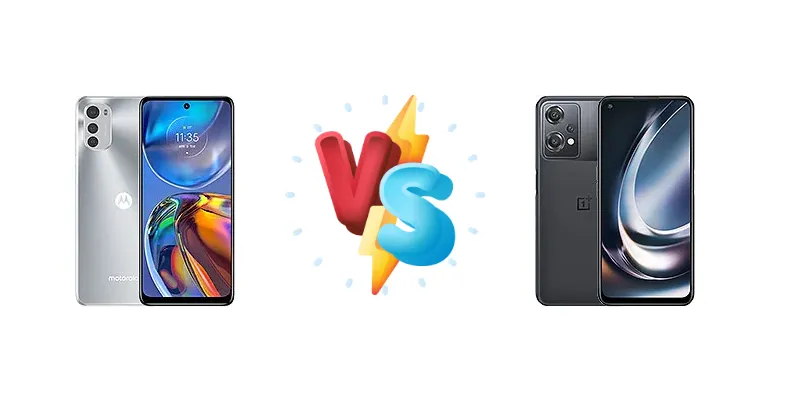
The Motorola Moto E32 and OnePlus Nord CE 2 Lite 5G represent compelling options in the increasingly competitive budget 5G smartphone market. While both aim to deliver 5G connectivity at an accessible price point, they take fundamentally different approaches to achieving this, primarily through their chipset choices. This comparison dissects those differences, focusing on real-world performance implications for the average user.
🏆 Quick Verdict
For most users, the OnePlus Nord CE 2 Lite 5G is the superior choice. Its Snapdragon 695, built on a more efficient 6nm process, delivers noticeably faster performance and smoother multitasking compared to the Moto E32’s Unisoc T606. The faster 33W charging also significantly improves usability, offsetting the slightly smaller battery capacity.
| Network |
|---|
| 2G bands | GSM 850 / 900 / 1800 / 1900 | GSM 850 / 900 / 1800 / 1900 |
| 3G bands | HSDPA 850 / 900 / 1900 / 2100 | HSDPA 800 / 850 / 900 / 1700(AWS) / 1900 / 2100 |
| 4G bands | 1, 3, 5, 7, 8, 20, 38, 40, 41 | 1, 2, 3, 4, 5, 7, 8, 12, 13, 17, 18, 19, 20, 26, 28, 38, 39, 40, 41, 66 - Europe |
| 5G bands | - | 1, 3, 5, 7, 8, 20, 28, 38, 40, 41, 66, 77, 78 SA/NSA - Europe |
| Speed | HSPA, LTE | HSPA, LTE, 5G |
| Technology | GSM / HSPA / LTE | GSM / HSPA / LTE / 5G |
| Launch |
|---|
| Announced | 2022, May 05 | 2022, April 28 |
| Status | Available. Released 2022, May 05 | Available. Released 2022, April 30 |
| Body |
|---|
| Build | Glass front, plastic frame, plastic back | Glass front, plastic frame, plastic back |
| Dimensions | 164 x 75 x 8.5 mm (6.46 x 2.95 x 0.33 in) | 164.3 x 75.6 x 8.5 mm (6.47 x 2.98 x 0.33 in) |
| SIM | · Nano-SIM· Nano-SIM + Nano-SIM | Nano-SIM + Nano-SIM |
| Weight | 184 g (6.49 oz) | 195 g (6.88 oz) |
| | Water repellent design | - |
| Display |
|---|
| Resolution | 720 x 1600 pixels, 20:9 ratio (~268 ppi density) | 1080 x 2412 pixels, 20:9 ratio (~401 ppi density) |
| Size | 6.5 inches, 103.5 cm2 (~84.2% screen-to-body ratio) | 6.59 inches, 104.5 cm2 (~84.1% screen-to-body ratio) |
| Type | IPS LCD, 90Hz | IPS LCD, 120Hz |
| Platform |
|---|
| CPU | Octa-core (2x1.6 GHz Cortex-A75 & 6x1.6 GHz Cortex-A55) | Octa-core (2x2.2 GHz Kryo 660 Gold & 6x1.7 GHz Kryo 660 Silver) |
| Chipset | Unisoc T606 (12 nm) | Qualcomm SM6375 Snapdragon 695 5G (6 nm) |
| GPU | Mali-G57 MP1 | Adreno 619 |
| OS | Android 11 | Android 12, upgradable to Android 13, OxygenOS 13 |
| Memory |
|---|
| Card slot | microSDXC (dedicated slot) | microSDXC (uses shared SIM slot) |
| Internal | 64GB 4GB RAM | 128GB 6GB RAM, 128GB 8GB RAM |
| Main Camera |
|---|
| Features | LED flash, HDR, panorama | LED flash, HDR, panorama |
| Triple | 16 MP, f/2.2, 26mm (wide), 1.0µm, PDAF
2 MP (macro)
Auxiliary lens | 64 MP, f/1.7, 26mm (wide), 0.7µm, PDAF
2 MP (macro)
Auxiliary lens |
| Video | 1080p@30fps | 1080p@30fps |
| Selfie camera |
|---|
| Features | HDR | HDR |
| Single | 8 MP, f/2.0, (wide), 1/4.0", 1.12µm | 16 MP, f/2.0, (wide), 1/3.0", 1.0µm |
| Video | 1080p@30fps | 1080p@30fps |
| Sound |
|---|
| 3.5mm jack | Yes | Yes |
| 35mm jack | Yes | Yes |
| Loudspeaker | Yes | Yes |
| Comms |
|---|
| Bluetooth | 5.0, A2DP, LE | 5.2, A2DP, LE, aptX HD |
| NFC | No | Yes (market/region dependent) |
| Positioning | GPS, GLONASS, GALILEO | GPS, GLONASS, GALILEO, BDS, QZSS |
| Radio | Unspecified | Unspecified |
| USB | USB Type-C 2.0 | USB Type-C 2.0, OTG |
| WLAN | Wi-Fi 802.11 b/g/n, Wi-Fi Direct | Wi-Fi 802.11 a/b/g/n/ac, dual-band, Wi-Fi Direct |
| Features |
|---|
| Sensors | Fingerprint (side-mounted), accelerometer, proximity | Fingerprint (side-mounted), accelerometer, gyro, proximity, compass |
| Battery |
|---|
| Charging | 18W wired | 33W wired |
| Type | Li-Po 5000 mAh | Li-Po 5000 mAh |
| Misc |
|---|
| Colors | Misty Silver, Pearl Blue, Slate Grey | Black Dusk, Blue Tide |
| Models | - | CPH2381, CPH2409 |
| Price | About 150 EUR | About 220 EUR |
| SAR | - | 1.19 W/kg (head) 0.71 W/kg (body) |
Motorola Moto E32
- Most affordable option
- Acceptable for basic tasks
- Potentially longer software support (Motorola's recent commitment)
- Significantly slower performance
- Slower charging speeds
- Less efficient chipset
OnePlus Nord CE 2 Lite 5G
- Faster and more responsive performance
- Significantly faster charging (33W)
- More efficient chipset (6nm)
- Slightly higher price
- Potential for more bloatware (OnePlus history)
- May not receive as many software updates as Motorola
Display Comparison
Neither device boasts a standout display. While specific panel details (like peak brightness in nits) are unavailable, the focus here is on the underlying processing power impacting UI smoothness. The Moto E32’s Unisoc T606 will likely struggle to consistently deliver 60Hz refresh rates in demanding apps, whereas the Snapdragon 695 in the Nord CE 2 Lite has headroom for a smoother experience. Bezels are expected to be comparable given the price bracket, and color accuracy is unlikely to be a key differentiator.
Camera Comparison
Without detailed sensor information, a direct camera comparison is difficult. However, the chipset plays a crucial role in image processing. The Snapdragon 695’s ISP (Image Signal Processor) is significantly more capable than the Unisoc T606’s, resulting in better noise reduction, dynamic range, and overall image quality, particularly in low-light conditions. The presence of a more powerful ISP also allows for faster image processing and potentially more advanced features. It's reasonable to assume the Nord CE 2 Lite will deliver superior photo and video quality.
Performance
The core difference lies in the chipsets. The OnePlus Nord CE 2 Lite 5G’s Qualcomm Snapdragon 695 (6nm) is a significant upgrade over the Motorola Moto E32’s Unisoc T606 (12nm). The 6nm process node translates to better power efficiency and reduced thermal throttling, meaning sustained performance is higher. The Snapdragon 695’s Kryo 660 Gold cores, clocked at 2.2 GHz, offer a substantial CPU performance advantage over the Cortex-A75 cores in the Moto E32 (1.6 GHz). This difference will be most noticeable in app launch times, multitasking, and demanding games. While both phones likely feature similar RAM configurations, the faster chipset will allow the Nord CE 2 Lite to utilize that RAM more effectively.
Battery Life
The Motorola Moto E32 features 18W wired charging, while the OnePlus Nord CE 2 Lite 5G steps up to 33W. This charging speed difference is substantial. While battery capacity isn’t specified, the faster charging on the Nord CE 2 Lite mitigates any potential disadvantage from a slightly smaller battery. A 0-100% charge on the Nord CE 2 Lite will likely take under an hour, while the Moto E32 will require considerably longer, impacting daily usability.
Buying Guide
Buy the Motorola Moto E32 if you prioritize absolute affordability and are primarily focused on basic smartphone tasks like calls, texts, and light social media use. Its lower price point makes it ideal for first-time smartphone buyers or those on a very tight budget. Buy the OnePlus Nord CE 2 Lite 5G if you value performance, faster charging, and a more responsive user experience. It’s the better option for users who enjoy mobile gaming, streaming video, or frequently switch between apps.
Frequently Asked Questions
❓ Will the Unisoc T606 in the Moto E32 struggle with graphically intensive games like PUBG Mobile?
Yes, the Unisoc T606 is a relatively low-end chipset. While PUBG Mobile may be playable at low settings, expect significant frame drops and stuttering, especially during intense action. The Snapdragon 695 in the Nord CE 2 Lite will provide a much smoother gaming experience.
❓ How much faster is the 33W charging on the Nord CE 2 Lite compared to the 18W charging on the Moto E32 in real-world use?
The 33W charging on the Nord CE 2 Lite can realistically cut charging times by 30-50% compared to the Moto E32’s 18W charging. Expect a full charge in under an hour with the Nord CE 2 Lite, while the Moto E32 will likely take over 2 hours.
❓ Does the Snapdragon 695 in the Nord CE 2 Lite support carrier aggregation for improved 5G speeds?
Yes, the Snapdragon 695 supports carrier aggregation, which allows it to combine multiple 5G channels for faster and more reliable 5G speeds, provided your carrier supports it. The Unisoc T606’s 5G capabilities are less well-defined and may not offer the same level of performance.