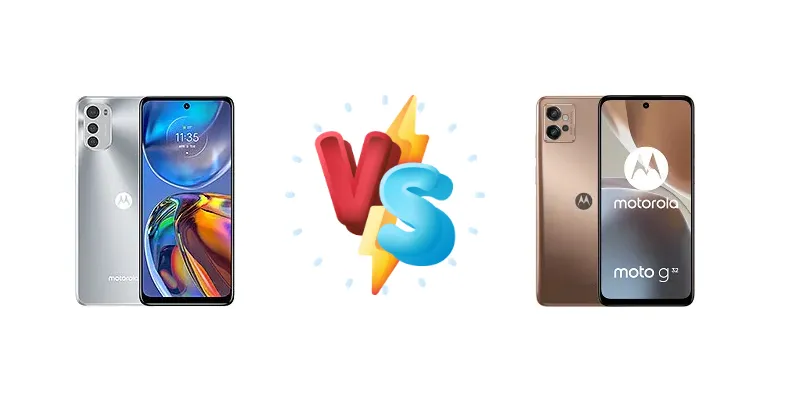
Motorola's budget lineup offers compelling options, but choosing between the Moto E32 and Moto G32 can be tricky. Both phones aim to deliver value, but they differ significantly in key areas. This comprehensive comparison will help you decide which one best suits your needs and budget.
🏆 Quick Verdict
The Moto G32 is the clear winner. Its Snapdragon 680 chipset offers significantly better performance, faster charging (30W vs 18W), and a more efficient 6nm process. While the E32 might be slightly cheaper, the G32's overall improvements make it the better investment.
| Network |
|---|
| 2G bands | GSM 850 / 900 / 1800 / 1900 | GSM 850 / 900 / 1800 / 1900 |
| 3G bands | HSDPA 850 / 900 / 1900 / 2100 | HSDPA 850 / 900 / 1900 / 2100 |
| 4G bands | 1, 3, 5, 7, 8, 20, 38, 40, 41 | 1, 3, 5, 7, 8, 20, 28, 38, 40, 41 |
| Speed | HSPA, LTE | HSPA, LTE |
| Technology | GSM / HSPA / LTE | GSM / HSPA / LTE |
| Launch |
|---|
| Announced | 2022, May 05 | 2022, July 28 |
| Status | Available. Released 2022, May 05 | Available. Released 2022, August 16 |
| Body |
|---|
| Build | Glass front, plastic frame, plastic back | Glass front, plastic frame, plastic back |
| Dimensions | 164 x 75 x 8.5 mm (6.46 x 2.95 x 0.33 in) | 161.8 x 73.8 x 8.5 mm (6.37 x 2.91 x 0.33 in) |
| SIM | · Nano-SIM· Nano-SIM + Nano-SIM | · Nano-SIM· Nano-SIM + Nano-SIM |
| Weight | 184 g (6.49 oz) | 184 g (6.49 oz) |
| | Water repellent design | Water-repellent design |
| Display |
|---|
| Resolution | 720 x 1600 pixels, 20:9 ratio (~268 ppi density) | 1080 x 2400 pixels, 20:9 ratio (~405 ppi density) |
| Size | 6.5 inches, 103.5 cm2 (~84.2% screen-to-body ratio) | 6.5 inches, 102.0 cm2 (~85.4% screen-to-body ratio) |
| Type | IPS LCD, 90Hz | IPS LCD, 90Hz |
| Platform |
|---|
| CPU | Octa-core (2x1.6 GHz Cortex-A75 & 6x1.6 GHz Cortex-A55) | Octa-core (4x2.4 GHz Kryo 265 Gold & 4x1.9 GHz Kryo 265 Silver) |
| Chipset | Unisoc T606 (12 nm) | Qualcomm SM6225 Snapdragon 680 4G (6 nm) |
| GPU | Mali-G57 MP1 | Adreno 610 |
| OS | Android 11 | Android 12, upgradable to Android 13 |
| Memory |
|---|
| Card slot | microSDXC (dedicated slot) | microSDXC (dedicated slot) |
| Internal | 64GB 4GB RAM | 64GB 4GB RAM, 128GB 4GB RAM, 128GB 6GB RAM, 128GB 8GB RAM, 256GB 8GB RAM |
| Main Camera |
|---|
| Features | LED flash, HDR, panorama | LED flash, HDR, panorama |
| Triple | 16 MP, f/2.2, 26mm (wide), 1.0µm, PDAF
2 MP (macro)
Auxiliary lens | 50 MP, f/1.8 (wide), 1/2.76", 0.64µm, PDAF
8 MP, f/2.2, 118˚ (ultrawide), 1/4.0", 1.12µm
2 MP, f/2.4, (macro/depth) |
| Video | 1080p@30fps | 1080p@30fps |
| Selfie camera |
|---|
| Features | HDR | - |
| Single | 8 MP, f/2.0, (wide), 1/4.0", 1.12µm | 16 MP, f/2.4, (wide), 1.0µm |
| Video | 1080p@30fps | 1080p@30fps |
| Sound |
|---|
| 3.5mm jack | Yes | Yes |
| 35mm jack | Yes | Yes |
| Loudspeaker | Yes | Yes, with stereo speakers |
| Comms |
|---|
| Bluetooth | 5.0, A2DP, LE | 5.2, A2DP, LE |
| NFC | No | Yes (market/region dependent) |
| Positioning | GPS, GLONASS, GALILEO | GPS, GLONASS, GALILEO |
| Radio | Unspecified | FM radio |
| USB | USB Type-C 2.0 | USB Type-C 2.0 |
| WLAN | Wi-Fi 802.11 b/g/n, Wi-Fi Direct | Wi-Fi 802.11 a/b/g/n/ac, dual-band, Wi-Fi Direct |
| Features |
|---|
| Sensors | Fingerprint (side-mounted), accelerometer, proximity | Fingerprint (side-mounted), accelerometer, gyro, proximity, compass |
| Battery |
|---|
| Charging | 18W wired | 30W wired |
| Type | Li-Po 5000 mAh | Li-Po 5000 mAh |
| Misc |
|---|
| Colors | Misty Silver, Pearl Blue, Slate Grey | Mineral Grey, Satin Silver, Rose Gold |
| Models | - | XT2235-2, XT2235-3 |
| Price | About 150 EUR | ₹ 8,990 |
Motorola Moto E32
- Large 6.6-inch display
- 90Hz refresh rate
- Decent battery life
- Affordable price
- Weak Unisoc T606 chipset
- Slow 18W charging
- Subpar camera performance
- Plastic build
Motorola Moto G32
- Powerful Snapdragon 680 chipset
- Fast 30W charging
- Improved camera performance
- More efficient 6nm process
- Sleek design
- Slightly higher price than E32
- Still a budget phone with some compromises
Display Comparison
Both phones feature a 6.6-inch FHD+ display with a 90Hz refresh rate, offering a smooth visual experience. However, the G32's panel is likely to be slightly brighter and more color-accurate due to the Snapdragon chipset's better image processing capabilities. The E32's display is adequate, but not exceptional.
Camera Comparison
Both phones feature a triple-camera setup, typically including a 50MP main sensor, an 8MP ultrawide, and a 2MP macro lens. The G32's Snapdragon chipset provides better image processing, resulting in more detailed and vibrant photos, especially in low light. The E32's camera is decent but lacks the same level of refinement.
Performance
This is where the G32 shines. The Snapdragon 680 is a substantial upgrade over the Unisoc T606. Expect noticeably faster app loading times, smoother multitasking, and better gaming performance on the G32. The E32 can feel sluggish at times, especially with demanding apps.
Battery Life
Both phones typically have a 5000mAh battery, offering all-day battery life. However, the G32's 30W fast charging significantly reduces charging times compared to the E32's 18W charging. This is a crucial advantage for users who value convenience.
Buying Guide
Who should buy the Motorola Moto E32? Users on a very tight budget who prioritize a large display and don't need high-end performance. Who should buy the Motorola Moto G32? Anyone seeking a reliable, well-rounded budget phone with better performance, faster charging, and a more modern chipset.
Frequently Asked Questions
❓ Is the Moto E32 worth buying?
The Moto E32 is a budget option, but the Moto G32 offers significantly better value for a small price increase. Consider the G32 unless your budget is extremely limited.
❓ Which chipset is better: Unisoc T606 or Snapdragon 680?
The Snapdragon 680 is considerably better. It offers superior performance, efficiency, and image processing capabilities compared to the Unisoc T606.