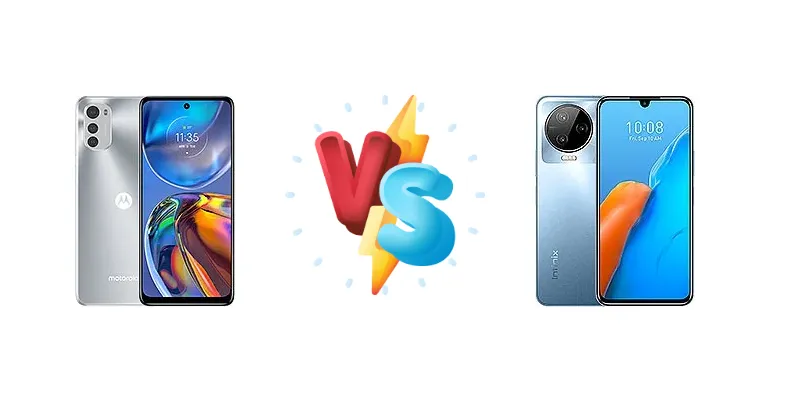
The Motorola Moto E32 and Infinix Note 12 (2023) represent compelling options in the ultra-budget smartphone space. While both aim to deliver essential smartphone functionality at an accessible price, they diverge significantly in their core hardware. This comparison focuses on the key differences – particularly the chipset and charging capabilities – to determine which device offers the best value for different user needs.
🏆 Quick Verdict
For the average user prioritizing performance and faster charging, the Infinix Note 12 (2023) is the clear winner. Its Mediatek Helio G99 chipset, built on a 6nm process, provides a substantial performance uplift over the Motorola Moto E32’s Unisoc T606, and the 33W charging significantly reduces downtime compared to the E32’s 18W.
| Network |
|---|
| 2G bands | GSM 850 / 900 / 1800 / 1900 | GSM 850 / 900 / 1800 / 1900 |
| 3G bands | HSDPA 850 / 900 / 1900 / 2100 | HSDPA 850 / 900 / 1700(AWS) / 1900 / 2100 |
| 4G bands | 1, 3, 5, 7, 8, 20, 38, 40, 41 | 1, 2, 3, 4, 5, 7, 8, 20, 28, 38, 40, 41 |
| Speed | HSPA, LTE | HSPA, LTE |
| Technology | GSM / HSPA / LTE | GSM / HSPA / LTE |
| | - | 1, 3, 5, 8, 38, 40, 41 |
| Launch |
|---|
| Announced | 2022, May 05 | 2022, October 06 |
| Status | Available. Released 2022, May 05 | Available. Released 2022, October 06 |
| Body |
|---|
| Build | Glass front, plastic frame, plastic back | Glass front, plastic frame, plastic back |
| Dimensions | 164 x 75 x 8.5 mm (6.46 x 2.95 x 0.33 in) | 164.4 x 76.5 x 7.8 mm (6.47 x 3.01 x 0.31 in) |
| SIM | · Nano-SIM· Nano-SIM + Nano-SIM | Nano-SIM + Nano-SIM |
| Weight | 184 g (6.49 oz) | 195 g (6.88 oz) |
| | Water repellent design | - |
| Display |
|---|
| Resolution | 720 x 1600 pixels, 20:9 ratio (~268 ppi density) | 1080 x 2400 pixels, 20:9 ratio (~393 ppi density) |
| Size | 6.5 inches, 103.5 cm2 (~84.2% screen-to-body ratio) | 6.7 inches, 108.4 cm2 (~86.2% screen-to-body ratio) |
| Type | IPS LCD, 90Hz | AMOLED |
| Platform |
|---|
| CPU | Octa-core (2x1.6 GHz Cortex-A75 & 6x1.6 GHz Cortex-A55) | Octa-core (2x2.2 GHz Cortex-A76 & 6x2.0 GHz Cortex-A55) |
| Chipset | Unisoc T606 (12 nm) | Mediatek Helio G99 (6 nm) |
| GPU | Mali-G57 MP1 | Mali-G57 MC2 |
| OS | Android 11 | Android 12, XOS 10.6 |
| Memory |
|---|
| Card slot | microSDXC (dedicated slot) | microSDXC (dedicated slot) |
| Internal | 64GB 4GB RAM | 128GB 8GB RAM, 256GB 8GB RAM |
| Main Camera |
|---|
| Features | LED flash, HDR, panorama | Quad-LED flash, HDR, panorama |
| Single | - | 16 MP, (wide) |
| Triple | 16 MP, f/2.2, 26mm (wide), 1.0µm, PDAF
2 MP (macro)
Auxiliary lens | 50 MP, f/1.6, (wide), PDAF
Auxiliary lenses |
| Video | 1080p@30fps | 1440p@30fps |
| Selfie camera |
|---|
| Features | HDR | - |
| Single | 8 MP, f/2.0, (wide), 1/4.0", 1.12µm | 16 MP, (wide) |
| Video | 1080p@30fps | 1440p@30fps |
| Sound |
|---|
| 3.5mm jack | Yes | Yes |
| 35mm jack | Yes | Yes |
| Loudspeaker | Yes | Yes, with dual speakers |
| Comms |
|---|
| Bluetooth | 5.0, A2DP, LE | Yes |
| NFC | No | Yes |
| Positioning | GPS, GLONASS, GALILEO | GPS |
| Radio | Unspecified | FM radio |
| USB | USB Type-C 2.0 | USB Type-C 2.0, OTG |
| WLAN | Wi-Fi 802.11 b/g/n, Wi-Fi Direct | Wi-Fi 802.11 a/b/g/n/ac, dual-band |
| Features |
|---|
| Sensors | Fingerprint (side-mounted), accelerometer, proximity | Fingerprint (side-mounted), accelerometer, gyro, proximity, compass |
| | - | 24-bit/192kHz audio |
| Battery |
|---|
| Charging | 18W wired | 33W wired |
| Type | Li-Po 5000 mAh | 5000 mAh |
| Misc |
|---|
| Colors | Misty Silver, Pearl Blue, Slate Grey | Volcanic Grey, Tuscany Blue, Alpine White |
| Models | - | X676C |
| Price | About 150 EUR | About 220 EUR |
Motorola Moto E32
- Clean Android experience
- Reliable basic functionality
- Potentially more affordable
- Less powerful chipset
- Slower charging speed
- Limited multitasking capabilities
Infinix Note 12 (2023)
- More powerful Helio G99 chipset
- Faster 33W charging
- Better multitasking and gaming performance
- May have more bloatware
- Potentially slightly higher price
Display Comparison
Neither device boasts a standout display. While specific display specs (resolution, panel type) are absent, the focus here is on the underlying performance impact. The chipset's GPU will dictate the smoothness of scrolling and animations, and the Helio G99 in the Infinix Note 12 (2023) has a clear advantage. We can assume both utilize LCD panels given the price point, and neither is likely to offer high peak brightness or wide color gamut coverage.
Camera Comparison
Without detailed camera specifications, a direct comparison is limited. However, the chipset’s image signal processor (ISP) plays a crucial role. The Helio G99’s ISP is likely more advanced, enabling better noise reduction and dynamic range. While both phones likely feature a multi-camera setup, the processing power of the Infinix Note 12 (2023) will likely result in superior image quality, particularly in challenging lighting conditions. The presence of a 2MP macro camera on either device is largely a marketing feature with limited practical benefit.
Performance
The core differentiator lies in the chipsets. The Infinix Note 12 (2023) utilizes the Mediatek Helio G99, fabricated on a more efficient 6nm process. This translates to better thermal management and sustained performance compared to the Motorola Moto E32’s Unisoc T606, which is built on a larger 12nm node. The Helio G99’s CPU configuration – 2x2.2 GHz Cortex-A76 cores and 6x2.0 GHz Cortex-A55 cores – also represents a step up from the Moto E32’s 2x1.6 GHz Cortex-A75 and 6x1.6 GHz Cortex-A55 setup. This means faster app loading times, smoother multitasking, and a more responsive user experience on the Infinix.
Battery Life
Both devices likely feature batteries in the 5000mAh range, typical for this price segment. However, the Infinix Note 12 (2023) significantly outpaces the Moto E32 in charging speed with 33W wired charging versus 18W. This translates to a much faster 0-100% charge time, reducing downtime. While battery life will depend on usage patterns, the more efficient Helio G99 chipset in the Infinix Note 12 (2023) may also contribute to slightly longer battery endurance.
Buying Guide
Buy the Motorola Moto E32 if you need a reliably basic smartphone with a clean Android experience and prioritize simplicity over raw power. It’s ideal for users who primarily use their phone for calls, texts, and light social media. Buy the Infinix Note 12 (2023) if you prefer a more capable device for multitasking, gaming, and content consumption, and value faster charging to minimize interruptions. This phone is better suited for users who demand more from their smartphone.
Frequently Asked Questions
❓ Will the Helio G99 in the Infinix Note 12 (2023) overheat during prolonged gaming sessions?
The Helio G99’s 6nm process is designed for improved thermal efficiency compared to the Unisoc T606’s 12nm process. While some heat generation is inevitable during gaming, the G99 is less prone to significant throttling, allowing for more sustained performance. However, extended gaming at maximum settings will still likely result in some temperature increase.
❓ Is the 18W charging on the Motorola Moto E32 slow compared to modern standards?
Yes, 18W charging is relatively slow by today’s standards. Expect a full charge to take well over two hours. The Infinix Note 12 (2023)’s 33W charging is a significant improvement, reducing charge times considerably. This difference is particularly noticeable for users who frequently need to top up their battery throughout the day.
❓ How does the Unisoc T606 handle multitasking compared to the Helio G99?
The Unisoc T606 is a capable processor for basic tasks, but it will struggle with heavy multitasking. The Helio G99, with its more powerful CPU cores and improved architecture, offers a much smoother experience when switching between multiple apps or running demanding applications simultaneously.