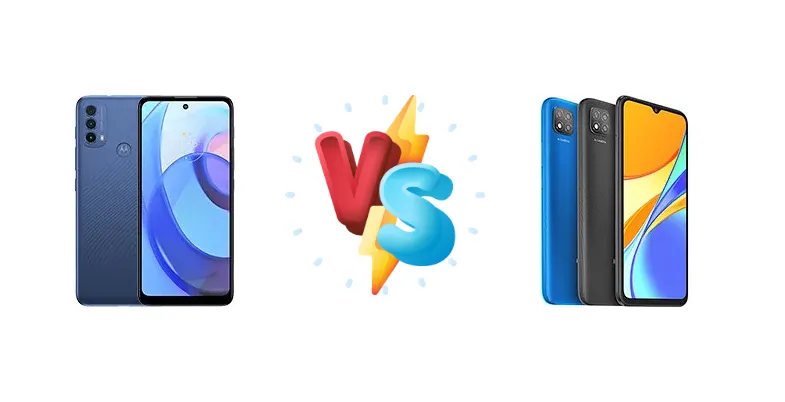
The Motorola Moto E30 and Xiaomi Redmi 9C NFC represent the extreme end of the smartphone price spectrum. Both aim to deliver essential smartphone functionality at a minimal cost, but they take different approaches under the hood. This comparison focuses on the core differences – specifically, the Unisoc T700 in the Moto E30 versus the MediaTek Helio G35 in the Redmi 9C NFC – and how those impact real-world performance and user experience.
🏆 Quick Verdict
For the average user prioritizing basic tasks and occasional social media, the Motorola Moto E30 edges out the Redmi 9C NFC. The Unisoc T700’s Cortex-A75 cores provide a noticeable performance boost in application loading and multitasking, making it a slightly smoother daily driver despite both phones sharing the same slow 10W charging.
| Network |
|---|
| 2G bands | GSM 850 / 900 / 1800 / 1900 | GSM 850 / 900 / 1800 / 1900 |
| 3G bands | HSDPA 850 / 900 / 1900 / 2100 | HSDPA 850 / 900 / 1700(AWS) / 1900 / 2100 |
| 4G bands | LTE | 1, 2, 3, 4, 5, 7, 8, 20, 38, 40 |
| Speed | HSPA 42.2/5.76 Mbps, LTE Cat4 150/50 Mbps | HSPA, LTE |
| Technology | GSM / HSPA / LTE | GSM / HSPA / LTE |
| Launch |
|---|
| Announced | 2021, November 03 | 2020, August 27. Released 2020, August 27 |
| Status | Available. Released 2021, November 03 | Discontinued |
| Body |
|---|
| Build | Glass front, plastic frame, plastic back | - |
| Dimensions | 165.1 x 75.6 x 9.1 mm (6.5 x 2.98 x 0.36 in) | 164.9 x 77.1 x 9 mm (6.49 x 3.04 x 0.35 in) |
| SIM | · Nano-SIM· Nano-SIM + Nano-SIM | Nano-SIM + Nano-SIM |
| Weight | 198 g (6.98 oz) | 196 g (6.91 oz) |
| | Water repellent design | - |
| Display |
|---|
| Resolution | 720 x 1600 pixels, 20:9 ratio (~270 ppi density) | 720 x 1600 pixels, 20:9 ratio (~269 ppi density) |
| Size | 6.5 inches, 102.0 cm2 (~81.7% screen-to-body ratio) | 6.53 inches, 102.9 cm2 (~81.0% screen-to-body ratio) |
| Type | IPS LCD, 90Hz | IPS LCD, 400 nits (typ) |
| Platform |
|---|
| CPU | Octa-core (2xX.x GHz Cortex-A75 & 6x1.8 GHz Cortex-A55) | Octa-core (4x2.3 GHz Cortex-A53 & 4x1.8 GHz Cortex-A53) |
| Chipset | Unisoc T700 | Mediatek MT6765G Helio G35 (12 nm) |
| GPU | Mali G52 | PowerVR GE8320 |
| OS | Android 11 (Go edition) | Android 10, MIUI 12 |
| Memory |
|---|
| Card slot | microSDXC (dedicated slot) | microSDXC (dedicated slot) |
| Internal | 32GB 2GB RAM | 32GB 2GB RAM, 32GB 3GB RAM, 64GB 2GB RAM, 64GB 3GB RAM, 128GB 3GB RAM, 128GB 4GB RAM |
| | eMMC 5.1 | eMMC 5.1 |
| Main Camera |
|---|
| Dual | - | 13 MP, f/2.2, 28mm (wide), 1.0µm, PDAF
2 MP (macro) |
| Features | LED flash, HDR, panorama | LED flash, HDR |
| Triple | 48 MP, f/1.8, 26mm (wide), 0.8µm, PDAF
2 MP (macro)
Auxiliary lens | - |
| Video | 1080p@30fps | 1080p@30fps |
| Selfie camera |
|---|
| Features | HDR | HDR |
| Single | 8 MP, f/2.0, 1/4.0", 1.12µm | 5 MP, f/2.2, (wide), 1.12µm |
| Video | 1080p@30fps | 1080p@30fps |
| Sound |
|---|
| 3.5mm jack | Yes | Yes |
| 35mm jack | Yes | Yes |
| Loudspeaker | Yes | Yes |
| Comms |
|---|
| Bluetooth | 5.0, A2DP, LE | 5.0, A2DP, LE |
| NFC | No | Yes |
| Positioning | GPS, GLONASS, GALILEO | GPS, GLONASS, BDS |
| Radio | No | FM radio |
| USB | USB Type-C 2.0 | microUSB 2.0, OTG |
| WLAN | Wi-Fi 802.11 a/b/g | Wi-Fi 802.11 b/g/n, Wi-Fi Direct |
| Features |
|---|
| Sensors | Fingerprint (rear-mounted), accelerometer, proximity | Fingerprint (rear-mounted), accelerometer, proximity |
| Battery |
|---|
| Charging | 10W wired | 10W wired |
| Type | Li-Po 5000 mAh | Li-Po 5000 mAh |
| Misc |
|---|
| Colors | Mineral gray, Digital blue | Midnight Gray, Sunshine Yellow, Twilight Blue |
| Models | XT2158-6 | M2006C3MNG |
| Price | About 160 EUR | About 100 EUR |
| SAR | - | 0.57 W/kg (head) 0.90 W/kg (body) |
| SAR EU | 0.26 W/kg (head) 1.29 W/kg (body) | 0.37 W/kg (head) 1.14 W/kg (body) |
Motorola Moto E30
- Potentially smoother performance due to Unisoc T700’s Cortex-A75 cores
- May offer slightly better power efficiency
- Clean Android experience (typically with Motorola)
- Slow 10W charging
- Likely limited RAM and storage
Xiaomi Redmi 9C NFC
- NFC support for contactless payments
- Established brand with wider support network
- Potentially more readily available
- Inferior chipset performance compared to Unisoc T700
- Slow 10W charging
- MIUI software can be resource-intensive
Display Comparison
Neither device boasts a standout display. Both likely utilize LCD panels, typical for this price point. Detailed specs like resolution and brightness are missing, but we can assume they are similar – likely 720p+ resolution. The focus here isn't on visual fidelity, but on basic usability. Bezels are expected to be substantial on both, maximizing screen real estate within a budget.
Camera Comparison
Camera performance is likely to be similar and underwhelming on both devices. Without detailed sensor information, it’s safe to assume both rely on basic sensors. The Redmi 9C NFC often includes a 13MP main sensor, while the Moto E30 likely features a similar resolution. Image processing will be the key differentiator, and neither is expected to excel in low-light conditions. Any additional sensors (depth, macro) are likely to be low-resolution and offer limited utility.
Performance
The core difference lies in the chipsets. The Motorola Moto E30’s Unisoc T700 features a heterogeneous core configuration: two Cortex-A75 cores clocked at an unspecified frequency, paired with six Cortex-A55 cores at 1.8 GHz. This is a significant advantage over the Xiaomi Redmi 9C NFC’s MediaTek Helio G35, which uses four Cortex-A53 cores clocked at 2.3 GHz and another four Cortex-A53 cores at 1.8 GHz. While the Helio G35’s cores are clocked higher, the A75 cores in the Unisoc T700 offer substantially better single-core performance, translating to snappier app launches and smoother multitasking. The Helio G35’s all-A53 configuration will struggle more with demanding applications. Both phones likely feature limited RAM (likely 2-4GB) and eMMC storage, further bottlenecking performance.
Battery Life
Both the Motorola Moto E30 and Xiaomi Redmi 9C NFC are equipped with 10W wired charging, a significant drawback in today’s market. Battery capacity is not specified, but both likely hover around the 5000mAh mark. This means a full charge will take a considerable amount of time – likely over 3 hours. Real-world battery life will depend heavily on usage, but both should be capable of lasting a full day with moderate use. The Unisoc T700’s potentially better efficiency *could* translate to slightly longer battery life, but the difference will likely be minimal.
Buying Guide
Buy the Motorola Moto E30 if you need a phone that feels a bit more responsive for everyday tasks like browsing and app switching. Its chipset architecture offers a slight advantage in performance. Buy the Xiaomi Redmi 9C NFC if NFC functionality is a must-have and you prioritize a slightly more established brand ecosystem, but be prepared for a potentially less fluid user experience, especially when multitasking.
Frequently Asked Questions
❓ Will the Unisoc T700 in the Moto E30 handle popular games like PUBG Mobile?
While the Unisoc T700 is an improvement over the Helio G35, don't expect a high-end gaming experience. PUBG Mobile will likely be playable at low settings and frame rates. The limited RAM and eMMC storage will also contribute to stuttering and lag.
❓ Is the NFC on the Redmi 9C NFC useful for more than just payments?
Yes, NFC has several uses beyond contactless payments. It can be used for quickly pairing with Bluetooth devices, sharing files with other NFC-enabled phones (Android Beam), and interacting with NFC tags for automation tasks.
❓ How much does software optimization matter on these phones?
Software optimization is *crucial* on these budget devices. Motorola's near-stock Android experience on the Moto E30 is generally lighter and more efficient than Xiaomi's MIUI on the Redmi 9C NFC. MIUI, while feature-rich, can consume more resources and impact performance.
❓ Can I expect software updates on either of these phones?
Software update support is limited on both devices. Motorola typically provides one major Android update, while Xiaomi may offer a slightly longer support window. However, don't expect frequent security patches or the latest Android versions.