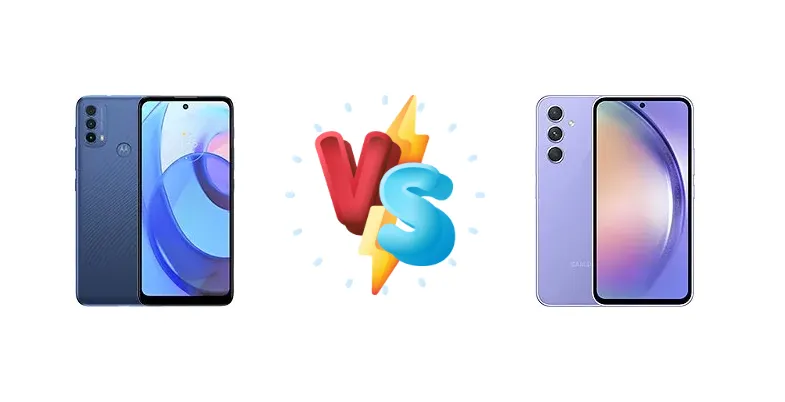
Choosing a new smartphone can be overwhelming, especially with so many options available. Today, we're pitting two popular contenders against each other: the budget-friendly Motorola Moto E30 and the mid-range powerhouse, the Samsung Galaxy A54. Let's dive into a detailed comparison to help you decide which one deserves your money.
🏆 Quick Verdict
The Samsung Galaxy A54 is the clear winner. While the Moto E30 offers affordability, the A54’s superior performance, stunning display, impressive camera, and significantly better battery life make it the more compelling choice for most users, despite the higher price.
| Network |
|---|
| 2G bands | GSM 850 / 900 / 1800 / 1900 | GSM 850 / 900 / 1800 / 1900 |
| 3G bands | HSDPA 850 / 900 / 1900 / 2100 | HSDPA 850 / 900 / 1700(AWS) / 1900 / 2100 |
| 4G bands | LTE | 1, 2, 3, 4, 5, 7, 8, 12, 17, 20, 26, 28, 32, 38, 40, 41, 66 - International |
| 5G bands | - | 1, 3, 7, 8, 20, 28, 38, 40, 41, 77, 78 SA/NSA/Sub6 - International |
| Speed | HSPA 42.2/5.76 Mbps, LTE Cat4 150/50 Mbps | HSPA, LTE, 5G |
| Technology | GSM / HSPA / LTE | GSM / HSPA / LTE / 5G |
| | - | 25, 41, 66, 71 SA/NSA/Sub6/mmWave - USA |
| Launch |
|---|
| Announced | 2021, November 03 | 2023, March 15 |
| Status | Available. Released 2021, November 03 | Available. Released 2023, March 24 |
| Body |
|---|
| Build | Glass front, plastic frame, plastic back | Glass front (Gorilla Glass 5), glass back (Gorilla Glass 5), plastic frame |
| Dimensions | 165.1 x 75.6 x 9.1 mm (6.5 x 2.98 x 0.36 in) | 158.2 x 76.7 x 8.2 mm (6.23 x 3.02 x 0.32 in) |
| SIM | · Nano-SIM· Nano-SIM + Nano-SIM | · Nano-SIM + eSIM· Nano-SIM + Nano-SIM |
| Weight | 198 g (6.98 oz) | 202 g (7.13 oz) |
| | Water repellent design | IP67 dust/water resistant (up to 1m for 30 min) |
| Display |
|---|
| Protection | - | Corning Gorilla Glass 5 |
| Resolution | 720 x 1600 pixels, 20:9 ratio (~270 ppi density) | 1080 x 2340 pixels, 19.5:9 ratio (~403 ppi density) |
| Size | 6.5 inches, 102.0 cm2 (~81.7% screen-to-body ratio) | 6.4 inches, 100.5 cm2 (~82.9% screen-to-body ratio) |
| Type | IPS LCD, 90Hz | Super AMOLED, 120Hz, HDR10+, 1000 nits (HBM) |
| Platform |
|---|
| CPU | Octa-core (2xX.x GHz Cortex-A75 & 6x1.8 GHz Cortex-A55) | Octa-core (4x2.4 GHz Cortex-A78 & 4x2.0 GHz Cortex-A55) |
| Chipset | Unisoc T700 | Exynos 1380 (5 nm) |
| GPU | Mali G52 | Mali-G68 MP5 |
| OS | Android 11 (Go edition) | Android 13, up to 4 major Android upgrades, One UI 7 |
| Memory |
|---|
| Card slot | microSDXC (dedicated slot) | microSDXC (uses shared SIM slot) |
| Internal | 32GB 2GB RAM | 128GB 4GB RAM, 128GB 6GB RAM, 128GB 8GB RAM, 256GB 6GB RAM, 256GB 8GB RAM |
| | eMMC 5.1 | - |
| Main Camera |
|---|
| Features | LED flash, HDR, panorama | LED flash, panorama, HDR |
| Single | - | 32 MP, f/2.2, 26mm (wide), 1/2.8", 0.8µm |
| Triple | 48 MP, f/1.8, 26mm (wide), 0.8µm, PDAF
2 MP (macro)
Auxiliary lens | 50 MP, f/1.8, 23mm (wide), 1/1.56", 1.0µm, PDAF, OIS
12 MP, f/2.2, 13mm, 123˚ (ultrawide), 1/3.X", 1.12µm
5 MP (macro) |
| Video | 1080p@30fps | 4K@30fps, 1080p@30/60fps, 720p@480fps, gyro-EIS |
| Selfie camera |
|---|
| Features | HDR | - |
| Single | 8 MP, f/2.0, 1/4.0", 1.12µm | 32 MP, f/2.2, 26mm (wide), 1/2.8", 0.8µm |
| Video | 1080p@30fps | 4K@30fps, 1080p@30/60fps |
| Sound |
|---|
| 3.5mm jack | Yes | No |
| 35mm jack | Yes | No |
| Loudspeaker | Yes | Yes, with stereo speakers |
| Comms |
|---|
| Bluetooth | 5.0, A2DP, LE | 5.3, A2DP, LE |
| NFC | No | Yes (market/region dependent) |
| Positioning | GPS, GLONASS, GALILEO | GPS, GLONASS, GALILEO, BDS |
| Radio | No | No |
| USB | USB Type-C 2.0 | USB Type-C 2.0, OTG |
| WLAN | Wi-Fi 802.11 a/b/g | Wi-Fi 802.11 a/b/g/n/ac/6, dual-band, Wi-Fi Direct |
| Features |
|---|
| Sensors | Fingerprint (rear-mounted), accelerometer, proximity | Fingerprint (under display, optical), accelerometer, gyro, compass, barometer (USA only) |
| | - | Virtual proximity sensing |
| Battery |
|---|
| Charging | 10W wired | 25W wired |
| Type | Li-Po 5000 mAh | 5000 mAh |
| Misc |
|---|
| Colors | Mineral gray, Digital blue | Lime, Graphite, Violet, White |
| Models | XT2158-6 | SM-A546V, SM-A546U, SM-A546U1, SM-A546B, SM-A546B/DS, SM-A546E, SM-A546E/DS, SM-A5460, SM-A546M, SM-A546M/DS, SM-A546W |
| Price | About 160 EUR | € 210.00 / $ 119.11 / £ 169.95 / ₹ 28,999 |
| SAR | - | 0.81 W/kg (head) 0.67 W/kg (body) |
| SAR EU | 0.26 W/kg (head) 1.29 W/kg (body) | 0.69 W/kg (head) 1.34 W/kg (body) |
| Tests |
|---|
| Battery life | - |
Endurance rating 119h
|
| Camera | - |
Photo / Video |
| Display | - |
Contrast ratio: Infinite (nominal) |
| Loudspeaker | - |
-26.6 LUFS (Good)
|
| Performance | - |
AnTuTu: 506678 (v9)
GeekBench: 2703 (v5.1), 2797 (v6)
GFXBench: 25fps (ES 3.1 onscreen) |
Motorola Moto E30
- Affordable
- Compact size
- Decent battery life for basic use
- Weak performance
- Low-resolution display
- Basic camera
- Slow charging
Samsung Galaxy A54
- Excellent performance
- Vibrant Super AMOLED display
- Impressive camera system
- Long battery life
- Fast charging (25W)
- Higher price
- Can be slightly bulky
Display Comparison
The Samsung Galaxy A54 boasts a significantly brighter display (980 nits) with an 'infinite' contrast ratio, offering vibrant colors and excellent visibility even in direct sunlight. The Moto E30's display is adequate but noticeably less impressive, lacking the same level of brightness and color accuracy. The A54's Super AMOLED technology provides a richer viewing experience.
Camera Comparison
The Galaxy A54's camera system is far superior, offering better image quality, more features, and improved video recording capabilities. The Moto E30's camera is functional but struggles in low-light conditions and produces less detailed images. The A54's image processing is also noticeably better.
Performance
The Exynos 1380 in the Galaxy A54 is a substantial upgrade over the Unisoc T700 in the Moto E30. The A54 handles demanding apps and games with ease, while the E30 can feel sluggish at times. The A54's Cortex-A78 cores provide a significant performance boost.
Battery Life
The Galaxy A54 excels in battery life, consistently delivering over 11 hours of active use and an endurance rating of 119 hours. The Moto E30's battery life is decent but falls short of the A54's longevity. The A54's efficient chipset contributes to its exceptional battery performance.
Buying Guide
The Motorola Moto E30 is ideal for users on a very tight budget who primarily need a basic phone for calls, texts, and light social media use. The Samsung Galaxy A54 is perfect for those seeking a well-rounded smartphone experience with a great camera, vibrant display, and long-lasting battery, even if it means spending a bit more.
Frequently Asked Questions
❓ Is the Moto E30 good for gaming?
The Moto E30 is not ideal for gaming. Its processor struggles with demanding games, resulting in lag and poor performance. The Galaxy A54 is a much better choice for gamers.
❓ Which phone has better software support?
Samsung generally provides longer software support and updates for its devices than Motorola. The Galaxy A54 will likely receive more Android updates and security patches over its lifespan.