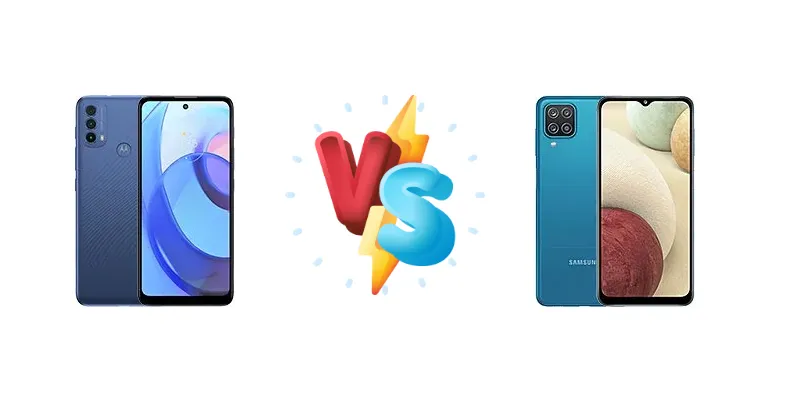
The Motorola Moto E30 and Samsung Galaxy A12 (India) represent two compelling options in the fiercely competitive sub-₹10,000 smartphone market. While both aim to deliver essential smartphone functionality at an accessible price, they take distinctly different approaches to achieving this, primarily through their chipset choices. This comparison dissects those differences to determine which device offers the best value.
🏆 Quick Verdict
For the average user prioritizing consistent performance and slightly faster charging, the Samsung Galaxy A12 (India) emerges as the better choice. Its Exynos 850, built on an 8nm process, provides a more refined experience than the Unisoc T700, despite the Moto E30's newer architecture.
| Network |
|---|
| 2G bands | GSM 850 / 900 / 1800 / 1900 | GSM 850 / 900 / 1800 / 1900 |
| 3G bands | HSDPA 850 / 900 / 1900 / 2100 | HSDPA 850 / 900 / 2100 |
| 4G bands | LTE | 1, 3, 5, 7, 8, 20, 28, 38, 40, 41 |
| Speed | HSPA 42.2/5.76 Mbps, LTE Cat4 150/50 Mbps | HSPA 42.2/5.76 Mbps, LTE Cat4 150/50 Mbps |
| Technology | GSM / HSPA / LTE | GSM / HSPA / LTE |
| Launch |
|---|
| Announced | 2021, November 03 | 2021, August 12 |
| Status | Available. Released 2021, November 03 | Available. Released 2021, August 12 |
| Body |
|---|
| Build | Glass front, plastic frame, plastic back | Glass front, plastic back, plastic frame |
| Dimensions | 165.1 x 75.6 x 9.1 mm (6.5 x 2.98 x 0.36 in) | 164 x 75.8 x 8.9 mm (6.46 x 2.98 x 0.35 in) |
| SIM | · Nano-SIM· Nano-SIM + Nano-SIM | · Nano-SIM· Nano-SIM + Nano-SIM |
| Weight | 198 g (6.98 oz) | 205 g (7.23 oz) |
| | Water repellent design | - |
| Display |
|---|
| Resolution | 720 x 1600 pixels, 20:9 ratio (~270 ppi density) | 720 x 1600 pixels, 20:9 ratio (~270 ppi density) |
| Size | 6.5 inches, 102.0 cm2 (~81.7% screen-to-body ratio) | 6.5 inches, 102.0 cm2 (~82.1% screen-to-body ratio) |
| Type | IPS LCD, 90Hz | PLS LCD |
| Platform |
|---|
| CPU | Octa-core (2xX.x GHz Cortex-A75 & 6x1.8 GHz Cortex-A55) | Octa-core (4x2.0 GHz Cortex-A55 & 4x2.0 GHz Cortex-A55) |
| Chipset | Unisoc T700 | Exynos 850 (8 nm) |
| GPU | Mali G52 | Mali-G52 |
| OS | Android 11 (Go edition) | Android 11, upgradable to Android 13, One UI 5.1 |
| Memory |
|---|
| Card slot | microSDXC (dedicated slot) | microSDXC (dedicated slot) |
| Internal | 32GB 2GB RAM | 64GB 4GB RAM, 128GB 4GB RAM, 128GB 6GB RAM |
| | eMMC 5.1 | eMMC 5.1 |
| Main Camera |
|---|
| Features | LED flash, HDR, panorama | LED flash, panorama, HDR |
| Quad | - | 48 MP, f/2.0, 26mm (wide), AF
5 MP, f/2.2, 123˚ (ultrawide)
2 MP (macro)
Auxiliary lens |
| Triple | 48 MP, f/1.8, 26mm (wide), 0.8µm, PDAF
2 MP (macro)
Auxiliary lens | - |
| Video | 1080p@30fps | 1080p@30fps |
| Selfie camera |
|---|
| Features | HDR | - |
| Single | 8 MP, f/2.0, 1/4.0", 1.12µm | 8 MP, f/2.2 |
| Video | 1080p@30fps | 1080p@30fps |
| Sound |
|---|
| 3.5mm jack | Yes | Yes |
| 35mm jack | Yes | Yes |
| Loudspeaker | Yes | Yes |
| Comms |
|---|
| Bluetooth | 5.0, A2DP, LE | 5.0, A2DP, LE |
| NFC | No | No |
| Positioning | GPS, GLONASS, GALILEO | GPS, GLONASS, GALILEO, BDS |
| Radio | No | FM radio, RDS, recording |
| USB | USB Type-C 2.0 | USB Type-C 2.0 |
| WLAN | Wi-Fi 802.11 a/b/g | Wi-Fi 802.11 b/g/n, Wi-Fi Direct |
| Features |
|---|
| Sensors | Fingerprint (rear-mounted), accelerometer, proximity | Fingerprint (side-mounted), accelerometer |
| | - | Virtual proximity sensing |
| Battery |
|---|
| Charging | 10W wired | 15W wired |
| Type | Li-Po 5000 mAh | Li-Po 5000 mAh |
| Misc |
|---|
| Colors | Mineral gray, Digital blue | Black, Blue, White |
| Models | XT2158-6 | SM-A127F, SM-A127F/DS |
| Price | About 160 EUR | About 160 EUR |
| SAR | - | 0.79 W/kg (head) |
| SAR EU | 0.26 W/kg (head) 1.29 W/kg (body) | - |
Motorola Moto E30
- Newer Unisoc T700 processor architecture
- Potentially lower price point
- Large battery capacity (estimated)
- Slower 10W charging
- Unisoc’s less mature manufacturing process
- Limited software support compared to Samsung
Samsung Galaxy A12 (India)
- More efficient Exynos 850 chipset (8nm)
- Faster 15W charging
- Samsung’s refined software experience
- Older CPU architecture (all Cortex-A55)
- Potentially higher price
- 720p display resolution
Display Comparison
Neither device boasts a standout display. Specifications are unavailable for the Moto E30's display, but given its price point, it likely features a 720p LCD panel. The Galaxy A12 (India) also utilizes a 720p LCD. The key difference lies in the processing behind the display; Samsung's experience in display technology likely results in slightly better color calibration and viewing angles. However, both will struggle in direct sunlight.
Camera Comparison
Both phones feature basic camera setups. Details on the Moto E30’s camera are limited, but it’s safe to assume a primary sensor around 13MP. The Galaxy A12 (India) typically features a 50MP main sensor, offering a potential advantage in detail capture, especially in good lighting conditions. However, image processing plays a crucial role, and Samsung’s software is generally more refined. The inclusion of a 2MP macro lens on both devices is largely a marketing gimmick and offers minimal practical benefit. The larger sensor on the Galaxy A12 will likely perform better in low light.
Performance
The core of the difference lies in the chipsets. The Motorola Moto E30’s Unisoc T700 utilizes a Cortex-A75 and A55 configuration, suggesting a focus on efficiency and burst performance. However, Unisoc’s manufacturing process is less mature than Samsung’s. The Samsung Galaxy A12 (India) features the Exynos 850, fabricated on an 8nm process. While its CPU consists entirely of Cortex-A55 cores, the 8nm process and Samsung’s optimization provide a more consistent and stable performance profile. This translates to smoother multitasking and less noticeable lag in everyday tasks. The Exynos 850’s GPU is also likely to offer a better gaming experience, even if both phones are limited to low-medium settings.
Battery Life
The Moto E30 and Galaxy A12 both feature large batteries, aiming for all-day battery life. While specific mAh ratings are unavailable for the E30, the Galaxy A12 typically packs a 5000mAh battery. The Galaxy A12 also supports 15W wired charging, while the Moto E30 is limited to 10W. This means the Galaxy A12 will recharge significantly faster, reducing downtime. The efficiency of the Exynos 850, combined with the 5000mAh battery, provides a slight edge in overall battery endurance.
Buying Guide
Buy the Motorola Moto E30 if you prioritize a newer processor architecture and are comfortable with potentially longer charging times. It's a good fit for users who primarily use their phone for basic tasks like calling, texting, and light social media. Buy the Samsung Galaxy A12 (India) if you value a more established chipset with proven performance, slightly faster 15W charging, and a generally smoother user experience, even if it means sacrificing the latest processor design.
Frequently Asked Questions
❓ Does the Unisoc T700 in the Moto E30 overheat during prolonged gaming sessions?
While the Unisoc T700 is designed for efficiency, its thermal management capabilities are less proven than the Exynos 850. Expect some throttling during extended gaming, potentially leading to frame rate drops. The Galaxy A12’s 8nm Exynos 850 is better equipped to handle sustained loads.
❓ Is the 50MP camera on the Galaxy A12 (India) a significant upgrade over the Moto E30’s camera?
Yes, the larger sensor size on the Galaxy A12’s 50MP camera allows it to capture more light and detail, especially in well-lit conditions. Samsung’s image processing algorithms further enhance image quality, resulting in more vibrant and sharper photos compared to the Moto E30’s likely 13MP sensor.
❓ How long does it take to fully charge each phone from 0%?
With its 15W charging, the Samsung Galaxy A12 (India) will take approximately 2.5 - 3 hours to fully charge. The Motorola Moto E30, limited to 10W charging, will likely take 3.5 - 4 hours to reach 100%.
❓ Can the Galaxy A12 (India) handle games like PUBG Mobile at playable frame rates?
The Galaxy A12 (India) can run PUBG Mobile, but you’ll need to stick to low or medium graphics settings to maintain a stable frame rate. Expect some occasional stuttering, but it’s generally playable. The Moto E30 will likely struggle more with consistent performance in PUBG Mobile.