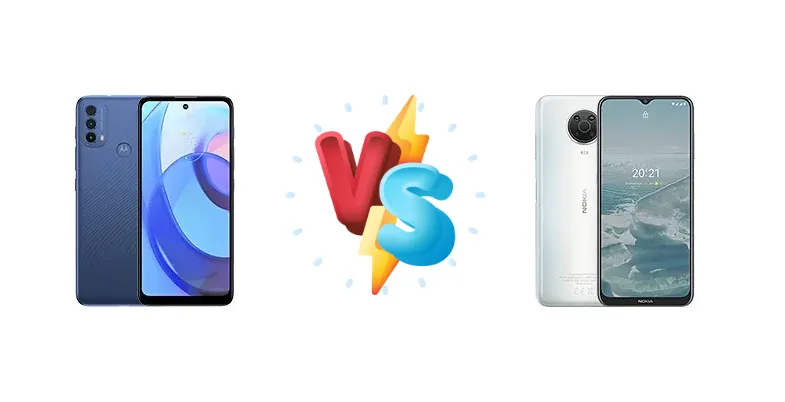
The Motorola Moto E30 and Nokia G20 represent the ultra-budget end of the smartphone spectrum, targeting users prioritizing affordability. However, beneath the similar price points lie significant differences in chipset architecture and overall performance. This comparison dissects these differences to determine which device delivers the best experience for everyday tasks and light usage.
🏆 Quick Verdict
For most users, the Motorola Moto E30 emerges as the slightly better choice. Its Unisoc T700 chipset, featuring Cortex-A75 cores, provides a noticeable performance edge over the Nokia G20’s Helio G35, particularly in multitasking and app loading times, despite both phones sharing the same 10W charging.
| Network |
|---|
| 2G bands | GSM 850 / 900 / 1800 / 1900 | GSM 850 / 900 / 1800 / 1900 |
| 3G bands | HSDPA 850 / 900 / 1900 / 2100 | HSDPA 850 / 900 / 1900 / 2100 - International |
| 4G bands | LTE | 1, 3, 5, 7, 8, 20, 28, 38, 40, 41 - International |
| Speed | HSPA 42.2/5.76 Mbps, LTE Cat4 150/50 Mbps | HSPA 42.2/5.76 Mbps, LTE Cat4 150/50 Mbps |
| Technology | GSM / HSPA / LTE | GSM / HSPA / LTE |
| | - | 1, 2, 3, 4, 5, 7, 8, 12, 17, 28, 66 - LATAM |
| Launch |
|---|
| Announced | 2021, November 03 | 2021, April 08 |
| Status | Available. Released 2021, November 03 | Available. Released 2021, May 17 |
| Body |
|---|
| Build | Glass front, plastic frame, plastic back | - |
| Dimensions | 165.1 x 75.6 x 9.1 mm (6.5 x 2.98 x 0.36 in) | 164.9 x 76 x 9.2 mm (6.49 x 2.99 x 0.36 in) |
| SIM | · Nano-SIM· Nano-SIM + Nano-SIM | · Nano-SIM· Nano-SIM + Nano-SIM |
| Weight | 198 g (6.98 oz) | 197 g (6.95 oz) |
| | Water repellent design | Splash protection |
| Display |
|---|
| Resolution | 720 x 1600 pixels, 20:9 ratio (~270 ppi density) | 720 x 1600 pixels, 20:9 ratio (~269 ppi density) |
| Size | 6.5 inches, 102.0 cm2 (~81.7% screen-to-body ratio) | 6.52 inches, 102.6 cm2 (~81.9% screen-to-body ratio) |
| Type | IPS LCD, 90Hz | IPS LCD |
| Platform |
|---|
| CPU | Octa-core (2xX.x GHz Cortex-A75 & 6x1.8 GHz Cortex-A55) | Octa-core (4x2.3 GHz Cortex-A53 & 4x1.8 GHz Cortex-A53) |
| Chipset | Unisoc T700 | Mediatek MT6765G Helio G35 (12 nm) |
| GPU | Mali G52 | PowerVR GE8320 |
| OS | Android 11 (Go edition) | Android 11, upgradable to Android 13 |
| Memory |
|---|
| Card slot | microSDXC (dedicated slot) | microSDXC (dedicated slot) |
| Internal | 32GB 2GB RAM | 64GB 4GB RAM, 128GB 4GB RAM |
| | eMMC 5.1 | - |
| Main Camera |
|---|
| Features | LED flash, HDR, panorama | LED flash, HDR, panorama |
| Quad | - | 48 MP, f/1.8, (wide), PDAF
5 MP, (ultrawide)
2 MP (macro)
Auxiliary lens |
| Single | - | 8 MP, (wide) |
| Triple | 48 MP, f/1.8, 26mm (wide), 0.8µm, PDAF
2 MP (macro)
Auxiliary lens | - |
| Video | 1080p@30fps | 1080p@30fps |
| Selfie camera |
|---|
| Features | HDR | - |
| Single | 8 MP, f/2.0, 1/4.0", 1.12µm | 8 MP, (wide) |
| Video | 1080p@30fps | 1080p@30fps |
| Sound |
|---|
| 3.5mm jack | Yes | Yes |
| 35mm jack | Yes | Yes |
| Loudspeaker | Yes | Yes |
| Comms |
|---|
| Bluetooth | 5.0, A2DP, LE | 5.0, A2DP, LE |
| NFC | No | Yes (market/region dependent) |
| Positioning | GPS, GLONASS, GALILEO | GPS, GLONASS, BDS |
| Radio | No | FM radio |
| USB | USB Type-C 2.0 | USB Type-C 2.0, OTG |
| WLAN | Wi-Fi 802.11 a/b/g | Wi-Fi 802.11 b/g/n |
| Features |
|---|
| Sensors | Fingerprint (rear-mounted), accelerometer, proximity | Fingerprint (side-mounted), accelerometer, gyro, proximity |
| Battery |
|---|
| Charging | 10W wired | 10W wired |
| Type | Li-Po 5000 mAh | Li-Po 5050 mAh |
| Misc |
|---|
| Colors | Mineral gray, Digital blue | Glacier, Night |
| Models | XT2158-6 | TA-1336, TA-1343, TA-1347, TA-1372, TA-1365 |
| Price | About 160 EUR | About 90 EUR |
| SAR | - | 1.01 W/kg (head) 1.02 W/kg (body) |
| SAR EU | 0.26 W/kg (head) 1.29 W/kg (body) | 0.49 W/kg (head) 1.13 W/kg (body) |
Motorola Moto E30
- More powerful chipset (Unisoc T700)
- Superior CPU architecture (Cortex-A75 cores)
- Potentially better power efficiency
- Motorola’s software update track record is less consistent than Nokia’s
- 10W charging is slow
Nokia G20
- Nokia’s reputation for software updates and build quality
- Potentially more durable construction
- Competitive price point
- Less powerful chipset (Helio G35)
- Older CPU architecture (Cortex-A53 cores)
- Slower overall performance
Display Comparison
Neither device boasts a standout display. Both likely utilize LCD panels, typical for this price bracket. The key difference lies under the hood: display driver efficiency. While specific display specs are unavailable, the Unisoc T700’s more modern architecture *may* offer slightly better power management for the display, potentially translating to marginally improved battery life during video playback. Bezels are expected to be substantial on both, and color accuracy will likely be standard for budget phones.
Camera Comparison
Camera performance on both devices is expected to be basic. Without detailed sensor information, it’s safe to assume both feature a primary sensor paired with auxiliary lenses of limited utility. The focus should be on daylight photography, as low-light performance will be significantly compromised. Image processing will likely be minimal on both, relying heavily on software algorithms to enhance images. The absence of Optical Image Stabilization (OIS) on either device means shaky hands will result in blurry photos. The G20 may benefit from Nokia’s image processing software, but the Unisoc T700’s ISP in the E30 could offer comparable results.
Performance
The core of the difference lies in the chipsets. The Motorola Moto E30’s Unisoc T700 utilizes a combination of 2x Cortex-A75 cores clocked at an unspecified frequency and 6x Cortex-A55 cores at 1.8 GHz. This configuration provides a significant advantage over the Nokia G20’s MediaTek Helio G35, which employs 4x Cortex-A53 cores at 2.3 GHz and another 4x Cortex-A53 cores at 1.8 GHz. The A75 cores in the E30 are architecturally superior to the A53 cores in the G20, offering better single-core performance and improved efficiency. While the G35’s higher clock speed on its A53 cores might show a slight advantage in *some* benchmarks, the E30 will feel snappier in real-world usage due to the more capable core design. Both phones will struggle with demanding games, but the E30 will likely handle less intensive titles with greater stability.
Battery Life
Both the Moto E30 and Nokia G20 are equipped with 10W wired charging, indicating a similar charging experience – expect over 3 hours for a full charge. Battery capacity is not specified, but given the target market, both likely house batteries in the 4000-5000 mAh range. The Unisoc T700’s potentially more efficient architecture *could* translate to slightly longer battery life during moderate usage, offsetting any potential capacity differences. However, heavy users will likely need to top up both devices daily.
Buying Guide
Buy the Motorola Moto E30 if you need a phone that feels more responsive for daily tasks like browsing, social media, and light gaming. The Unisoc T700 offers a smoother experience. Buy the Nokia G20 if you prioritize a brand known for software update consistency and a potentially more durable build quality, accepting a trade-off in raw processing power. Both are excellent choices for first-time smartphone users or as reliable backup devices.
Frequently Asked Questions
❓ Will the Unisoc T700 in the Moto E30 handle popular social media apps like TikTok and Instagram smoothly?
Yes, the Unisoc T700’s Cortex-A75 cores are sufficiently powerful to run social media apps like TikTok and Instagram without significant lag. While it won’t offer a high-end experience, it will provide a usable and reasonably smooth experience for most users.
❓ Is the Helio G35 in the Nokia G20 capable of playing any mobile games?
The Helio G35 can handle less demanding 2D games and older 3D titles at low settings. However, it will struggle with graphically intensive games like PUBG or Call of Duty Mobile, even at the lowest settings. Expect significant frame rate drops and potential stuttering.
❓ How long will it take to fully charge both phones from 0%?
Given the 10W charging on both devices, expect a full charge to take approximately 3 to 4 hours. This is a standard charging speed for phones in this price range.
❓ Which phone is likely to receive more software updates?
Nokia generally has a better track record for providing software updates, even for its budget devices. Motorola’s update schedule is often less predictable. If long-term software support is a priority, the Nokia G20 is the safer bet.