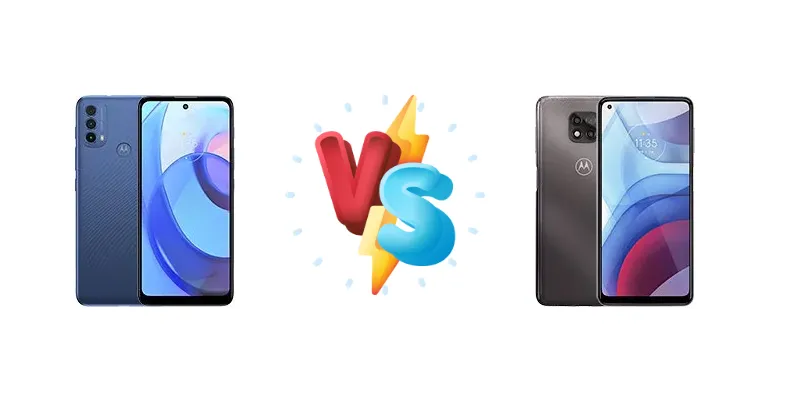
Motorola's budget lineup offers compelling options, but choosing between the Moto E30 and the Moto G Power (2021) requires understanding their core differences. The E30 aims for affordability with a Unisoc chipset, while the G Power prioritizes extended battery life powered by a Snapdragon processor. This comparison dives deep into the specs to reveal which phone delivers the best value.
🏆 Quick Verdict
For most users, the Motorola Moto G Power (2021) is the better choice. While the E30 is cheaper, the Snapdragon 662 offers a noticeable performance advantage in everyday tasks and light gaming, and the 15W charging significantly reduces downtime compared to the E30’s 10W charging.
| Network |
|---|
| 2G bands | GSM 850 / 900 / 1800 / 1900 | GSM 850 / 900 / 1800 / 1900 |
| 3G bands | HSDPA 850 / 900 / 1900 / 2100 | HSDPA 850 / 900 / 1700(AWS) / 1900 / 2100 |
| 4G bands | LTE | 1, 2, 3, 4, 5, 7, 8, 12, 13, 14, 17, 25, 26, 29, 30, 38, 41, 66, 71 |
| Speed | HSPA 42.2/5.76 Mbps, LTE Cat4 150/50 Mbps | HSPA, LTE |
| Technology | GSM / HSPA / LTE | GSM / CDMA / HSPA / EVDO / LTE |
| | - | CDMA2000 1xEV-DO |
| Launch |
|---|
| Announced | 2021, November 03 | 2021, January 08 |
| Status | Available. Released 2021, November 03 | Available. Released 2021, January 14 |
| Body |
|---|
| Build | Glass front, plastic frame, plastic back | Glass front, plastic back, plastic frame |
| Dimensions | 165.1 x 75.6 x 9.1 mm (6.5 x 2.98 x 0.36 in) | 165.3 x 75.9 x 9.5 mm (6.51 x 2.99 x 0.37 in) |
| SIM | · Nano-SIM· Nano-SIM + Nano-SIM | Nano-SIM |
| Weight | 198 g (6.98 oz) | 206.5 g (7.30 oz) |
| | Water repellent design | Water-repellent coating |
| Display |
|---|
| Resolution | 720 x 1600 pixels, 20:9 ratio (~270 ppi density) | 720 x 1600 pixels, 20:9 ratio (~266 ppi density) |
| Size | 6.5 inches, 102.0 cm2 (~81.7% screen-to-body ratio) | 6.6 inches, 105.2 cm2 (~83.8% screen-to-body ratio) |
| Type | IPS LCD, 90Hz | IPS LCD |
| Platform |
|---|
| CPU | Octa-core (2xX.x GHz Cortex-A75 & 6x1.8 GHz Cortex-A55) | Octa-core (4x2.0 GHz Kryo 260 Gold & 4x1.8 GHz Kryo 260 Silver) |
| Chipset | Unisoc T700 | Qualcomm SM6115 Snapdragon 662 (11 nm) |
| GPU | Mali G52 | Adreno 610 |
| OS | Android 11 (Go edition) | Android 10 |
| Memory |
|---|
| Card slot | microSDXC (dedicated slot) | microSDXC (dedicated slot) |
| Internal | 32GB 2GB RAM | 32GB 3GB RAM, 64GB 4GB RAM |
| | eMMC 5.1 | eMMC 5.1 |
| Main Camera |
|---|
| Features | LED flash, HDR, panorama | LED flash, HDR, panorama |
| Triple | 48 MP, f/1.8, 26mm (wide), 0.8µm, PDAF
2 MP (macro)
Auxiliary lens | 48 MP, f/1.7, (wide), 1/2.0", 0.8µm, PDAF
2 MP (macro)
Auxiliary lens |
| Video | 1080p@30fps | 1080p@30/60fps, gyro-EIS |
| Selfie camera |
|---|
| Features | HDR | HDR |
| Single | 8 MP, f/2.0, 1/4.0", 1.12µm | 8 MP, f/2.0, 1.12µm |
| Video | 1080p@30fps | 1080p@30fps, gyro-EIS |
| Sound |
|---|
| 3.5mm jack | Yes | Yes |
| 35mm jack | Yes | Yes |
| Loudspeaker | Yes | Yes |
| Comms |
|---|
| Bluetooth | 5.0, A2DP, LE | 5.0, A2DP, LE |
| NFC | No | No |
| Positioning | GPS, GLONASS, GALILEO | GPS, GLONASS, GALILEO |
| Radio | No | FM radio |
| USB | USB Type-C 2.0 | USB Type-C 2.0 |
| WLAN | Wi-Fi 802.11 a/b/g | Wi-Fi 802.11 a/b/g/n/ac, dual-band, Wi-Fi Direct |
| Features |
|---|
| Sensors | Fingerprint (rear-mounted), accelerometer, proximity | Fingerprint (side-mounted), accelerometer, gyro, proximity, compass, barometer |
| Battery |
|---|
| Charging | 10W wired | 15W wired |
| Type | Li-Po 5000 mAh | Li-Po 5000 mAh |
| Misc |
|---|
| Colors | Mineral gray, Digital blue | Flash Gray, Polar Silver |
| Models | XT2158-6 | - |
| Price | About 160 EUR | About 60 EUR |
| SAR EU | 0.26 W/kg (head) 1.29 W/kg (body) | - |
Motorola Moto E30
- Lower price point makes it very accessible.
- Unisoc T700 offers decent efficiency for basic tasks.
- Potentially longer battery life *per charge* due to chipset efficiency.
- Significantly slower performance compared to the Snapdragon 662.
- 10W charging is slow and inconvenient.
- Limited gaming capabilities.
Motorola Moto G Power (2021)
- Faster and more responsive performance with the Snapdragon 662.
- 15W charging reduces downtime.
- Better gaming experience thanks to the Adreno 610 GPU.
- Higher price compared to the Moto E30.
- May not offer significantly longer battery life than the E30 in real-world use.
- Still a budget device with compromises in build quality.
Display Comparison
Neither phone boasts a standout display. Both likely utilize LCD panels, common in this price bracket. The focus here isn't on visual fidelity, but practicality. While specific resolution and brightness data are unavailable, the G Power’s slightly larger size may offer a more immersive viewing experience. Bezels are expected to be substantial on both devices, reflecting their budget positioning. Color accuracy is unlikely to be a strong suit on either model.
Camera Comparison
Camera performance is likely to be similar, with both phones featuring basic camera setups. The Moto G Power (2021) may have a slight edge due to Qualcomm’s image signal processor (ISP), which generally offers better noise reduction and dynamic range. Expect both phones to struggle in low-light conditions. The inclusion of a 2MP macro lens on either device is largely a marketing gimmick, offering minimal practical benefit. Focusing on the main sensor’s megapixel count and aperture is more relevant, but specific details are unavailable.
Performance
The core difference lies in the chipsets. The Moto E30’s Unisoc T700, with its Cortex-A75 and A55 cores, is designed for efficiency but lags behind the Qualcomm Snapdragon 662 in raw processing power. The Snapdragon 662, built on an 11nm process, features Kryo 260 Gold and Silver cores, offering a more responsive experience for multitasking and app loading. The Snapdragon’s Adreno 610 GPU also provides a better gaming experience than the Unisoc’s integrated GPU. While both phones likely feature 3-4GB of RAM, the Snapdragon’s superior architecture will make better use of available memory.
Battery Life
The Moto G Power (2021) is named appropriately. While the exact battery capacity isn’t specified, Motorola’s ‘Power’ line is known for prioritizing battery life. The 15W charging is a significant advantage over the E30’s 10W charging; a full charge will take considerably less time on the G Power. The Unisoc T700 in the E30 is more power-efficient, potentially offsetting the charging speed difference to some extent, but the Snapdragon 662’s optimized power management and likely larger battery capacity in the G Power will still result in longer overall usage.
Buying Guide
Buy the Motorola Moto E30 if you absolutely need the lowest possible price and your usage is limited to basic tasks like calls, texts, and light social media. Buy the Motorola Moto G Power (2021) if you prioritize smoother performance, longer battery life between charges, and faster charging speeds, even if it means spending a bit more upfront.
Frequently Asked Questions
❓ Will the Unisoc T700 in the Moto E30 struggle with multitasking?
Yes, the Unisoc T700 is less powerful than the Snapdragon 662. While it can handle basic multitasking, expect slowdowns and lag when switching between multiple apps or running demanding applications. The G Power’s Snapdragon 662 offers a much smoother multitasking experience.
❓ How long will it take to fully charge the Moto E30 with its 10W charger?
With a 10W charger, expect the Moto E30 to take well over 3 hours to fully charge from 0%. This is significantly slower than the Moto G Power (2021), which can charge much faster with its 15W charging support. This makes the G Power a better choice for users who need to quickly top up their battery.
❓ Is the Moto G Power (2021) a good choice for mobile gaming?
The Moto G Power (2021) is capable of handling light to moderate mobile gaming. The Snapdragon 662 and Adreno 610 GPU can run popular titles at lower settings. However, don’t expect a high-end gaming experience. The Moto E30 will struggle with even less demanding games.
❓ Does either phone support fast charging standards like Quick Charge?
Neither phone explicitly advertises support for advanced fast charging standards like Quick Charge. The Moto G Power (2021)'s 15W charging is the fastest available on either device, but it's a proprietary implementation. Using a different charger may not result in significantly faster charging speeds.