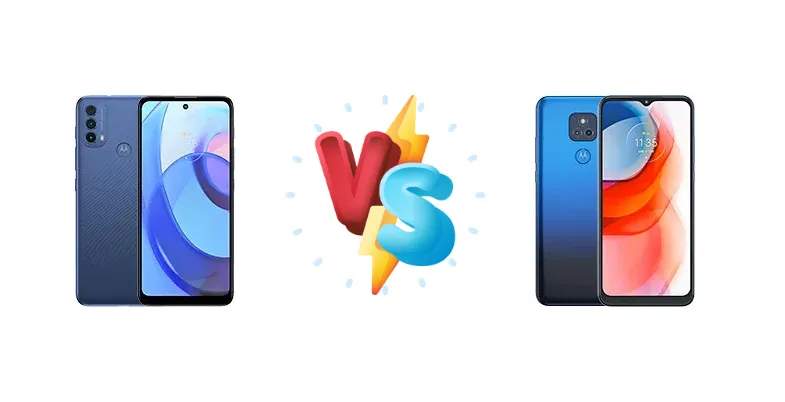
Motorola's budget lineup often presents a difficult choice: prioritize raw processing power or a more refined, established platform? The Moto E30, powered by the Unisoc T700, aims to undercut the competition with a newer chipset, while the Moto G Play (2021) relies on Qualcomm's Snapdragon 460. This comparison dissects the key differences to determine which phone delivers the best value for your money.
🏆 Quick Verdict
For most users, the Motorola Moto G Play (2021) is the better choice. While the Moto E30's Unisoc T700 offers a theoretical CPU advantage, the Snapdragon 460's optimized software support and proven efficiency provide a smoother, more consistent experience in everyday tasks and light gaming.
| Network |
|---|
| 2G bands | GSM 850 / 900 / 1800 / 1900 | GSM 850 / 900 / 1800 / 1900 |
| 3G bands | HSDPA 850 / 900 / 1900 / 2100 | HSDPA 850 / 900 / 1700(AWS) / 1900 / 2100 |
| 4G bands | LTE | 1, 2, 3, 4, 5, 7, 8, 12, 13, 17, 25, 26, 38, 41, 66, 71 |
| Speed | HSPA 42.2/5.76 Mbps, LTE Cat4 150/50 Mbps | HSPA, LTE |
| Technology | GSM / HSPA / LTE | GSM / CDMA / HSPA / LTE |
| | - | 2, 4, 5, 12, 14, 30, 66 |
| Launch |
|---|
| Announced | 2021, November 03 | 2021, January 08 |
| Status | Available. Released 2021, November 03 | Available. Released 2021, January 14 |
| Body |
|---|
| Build | Glass front, plastic frame, plastic back | Plastic frame, plastic back |
| Dimensions | 165.1 x 75.6 x 9.1 mm (6.5 x 2.98 x 0.36 in) | 166.6 x 76 x 9.4 mm (6.56 x 2.99 x 0.37 in) |
| SIM | · Nano-SIM· Nano-SIM + Nano-SIM | Nano-SIM |
| Weight | 198 g (6.98 oz) | 204 g (7.20 oz) |
| | Water repellent design | Water-repellent coating |
| Display |
|---|
| Resolution | 720 x 1600 pixels, 20:9 ratio (~270 ppi density) | 720 x 1600 pixels, 20:9 ratio (~270 ppi density) |
| Size | 6.5 inches, 102.0 cm2 (~81.7% screen-to-body ratio) | 6.5 inches, 102.0 cm2 (~80.6% screen-to-body ratio) |
| Type | IPS LCD, 90Hz | IPS LCD |
| Platform |
|---|
| CPU | Octa-core (2xX.x GHz Cortex-A75 & 6x1.8 GHz Cortex-A55) | Octa-core (4x1.8 GHz Kryo 240 & 4x1.6 GHz Kryo 240) |
| Chipset | Unisoc T700 | Qualcomm SM4250 Snapdragon 460 (11 nm) |
| GPU | Mali G52 | Adreno 610 |
| OS | Android 11 (Go edition) | Android 10 |
| Memory |
|---|
| Card slot | microSDXC (dedicated slot) | microSDXC (dedicated slot) |
| Internal | 32GB 2GB RAM | 32GB 3GB RAM |
| | eMMC 5.1 | eMMC 5.1 |
| Main Camera |
|---|
| Dual | - | 13 MP, f/2.0, (wide), 1/3.1", 1.12µm, PDAF
Auxiliary lens |
| Features | LED flash, HDR, panorama | LED flash, HDR, panorama |
| Triple | 48 MP, f/1.8, 26mm (wide), 0.8µm, PDAF
2 MP (macro)
Auxiliary lens | - |
| Video | 1080p@30fps | 1080p@30/60fps |
| Selfie camera |
|---|
| Features | HDR | HDR |
| Single | 8 MP, f/2.0, 1/4.0", 1.12µm | 5 MP, f/2.2, (wide), 1.12µm |
| Video | 1080p@30fps | 1080p@30fps |
| Sound |
|---|
| 3.5mm jack | Yes | Yes |
| 35mm jack | Yes | Yes |
| Loudspeaker | Yes | Yes |
| Comms |
|---|
| Bluetooth | 5.0, A2DP, LE | 5.0, A2DP, LE |
| NFC | No | No |
| Positioning | GPS, GLONASS, GALILEO | GPS, GLONASS, GALILEO |
| Radio | No | Unspecified |
| USB | USB Type-C 2.0 | USB Type-C 2.0 |
| WLAN | Wi-Fi 802.11 a/b/g | Wi-Fi 802.11 a/b/g/n/ac, dual-band, Wi-Fi Direct |
| Features |
|---|
| Sensors | Fingerprint (rear-mounted), accelerometer, proximity | Fingerprint (rear-mounted), accelerometer, proximity |
| Battery |
|---|
| Charging | 10W wired | 10W wired |
| Type | Li-Po 5000 mAh | Li-Po 5000 mAh |
| Misc |
|---|
| Colors | Mineral gray, Digital blue | Misty Blue |
| Models | XT2158-6 | XT2093-3, XT2093-7, XT2093-DL, XT2093DL |
| Price | About 160 EUR | About 60 EUR |
| SAR EU | 0.26 W/kg (head) 1.29 W/kg (body) | - |
Motorola Moto E30
- Potentially higher peak CPU performance due to Cortex-A75 cores
- May offer a lower price point
- Newer chipset architecture
- Unisoc chipset may have less optimized software support
- Potential for more thermal throttling under sustained load
- Likely inferior GPU performance
Motorola Moto G Play (2021)
- More efficient Snapdragon 460 chipset
- Better sustained performance and thermal management
- Qualcomm's optimized software and ISP
- Generally more reliable and stable experience
- Slightly lower peak CPU performance compared to the E30
- May be slightly more expensive
Display Comparison
Both devices lack detailed display specifications in the provided data, suggesting they target the entry-level market with basic LCD panels. However, given Motorola's typical approach, the G Play likely benefits from slightly better color calibration and viewing angles due to Qualcomm's image signal processor (ISP) integration. The absence of high refresh rates or HDR support is expected in this price bracket, making display quality a secondary consideration.
Camera Comparison
Without detailed camera specs, a direct comparison is difficult. However, both phones likely feature a primary camera and potentially a depth or macro sensor. The Snapdragon 460's ISP generally provides superior image processing capabilities, resulting in better dynamic range, noise reduction, and color accuracy. The Moto G Play is likely to produce more consistently pleasing photos, especially in challenging lighting conditions. The Unisoc T700's ISP is less mature, potentially leading to softer images and less accurate color reproduction.
Performance
The core difference lies in the chipsets. The Moto E30's Unisoc T700 utilizes a dual-cluster configuration with 2x Cortex-A75 cores for peak performance and 6x Cortex-A55 cores for efficiency. The Moto G Play (2021) employs the Qualcomm Snapdragon 460, featuring 4x Kryo 240 (based on Cortex-A73) and 4x Kryo 240 (based on Cortex-A53) cores. While the T700's A75 cores are individually more powerful than the A73 cores in the Snapdragon 460, the Snapdragon 460's 11nm process node offers better power efficiency and thermal management. This translates to more sustained performance under load, preventing significant throttling during extended gaming sessions. The Snapdragon's Adreno 610 GPU is also likely to outperform the T700's integrated GPU, providing a smoother gaming experience.
Battery Life
Both devices are equipped with 10W wired charging, indicating a focus on affordability over fast charging speeds. The actual battery capacity isn't specified, but given the target market, both are likely in the 4000-5000 mAh range. The Snapdragon 460's superior power efficiency gives the Moto G Play a slight edge in battery life, allowing it to potentially last longer on a single charge, despite any capacity differences.
Buying Guide
Buy the Motorola Moto E30 if you prioritize theoretical CPU performance and are comfortable with a potentially less polished software experience. This phone is best suited for users who primarily need a device for basic communication and light web browsing. Buy the Motorola Moto G Play (2021) if you value a more stable and optimized Android experience, slightly better sustained performance, and the backing of Qualcomm's established ecosystem. This is the better option for users who enjoy occasional gaming or multitasking.
Frequently Asked Questions
❓ Will the Unisoc T700 in the Moto E30 overheat during gaming?
The Unisoc T700 is likely to experience more thermal throttling than the Snapdragon 460 during prolonged gaming sessions. While it offers a theoretical CPU performance advantage, its less efficient architecture and potentially less sophisticated thermal management will lead to reduced clock speeds to prevent overheating, resulting in a less consistent gaming experience.
❓ Does the Moto G Play (2021) support software updates for security patches?
Motorola typically provides at least one major Android update and several years of security patches for its G Play series. While not as frequent as updates from Google or Samsung, the Snapdragon platform generally receives more consistent software support, ensuring the Moto G Play remains secure and functional for a longer period.
❓ Is the difference in performance between these two phones noticeable in everyday tasks?
While both phones can handle basic tasks like calling, texting, and browsing, the Snapdragon 460 in the Moto G Play provides a smoother and more responsive experience. The Unisoc T700 may exhibit occasional lag or stuttering, especially when multitasking or opening multiple apps.