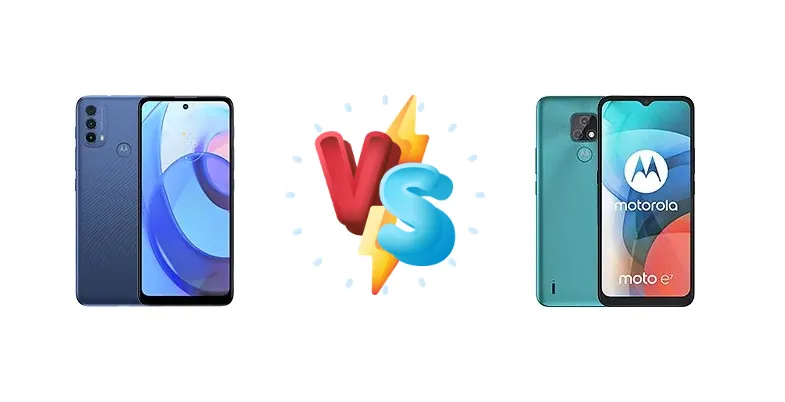
The Motorola Moto E series consistently delivers affordable smartphones, but choosing between models can be tricky. Today, we're pitting the Moto E30 against the Moto E7 to see which offers the best value for your money. Let's dive into a detailed comparison to help you make the right choice.
🏆 Quick Verdict
The Moto E7 edges out the E30 thanks to its slightly more powerful processor and generally better performance in everyday tasks. While the E30 boasts a newer chipset, the E7's Helio G25 provides a smoother experience. Both offer basic features at a budget price.
| Network |
|---|
| 2G bands | GSM 850 / 900 / 1800 / 1900 | GSM 850 / 900 / 1800 / 1900 |
| 3G bands | HSDPA 850 / 900 / 1900 / 2100 | HSDPA 850 / 900 / 1900 / 2100 - Europe, Asia |
| 4G bands | LTE | 1, 3, 5, 7, 8, 20, 38, 40, 41 - Europe |
| Speed | HSPA 42.2/5.76 Mbps, LTE Cat4 150/50 Mbps | HSPA 42.2/5.76 Mbps, LTE Cat4 150/50 Mbps |
| Technology | GSM / HSPA / LTE | GSM / HSPA / LTE |
| | - | 1, 2, 3, 5, 7, 8, 18, 19, 20, 26, 28, 38, 40, 41 - Asia |
| Launch |
|---|
| Announced | 2021, November 03 | 2020, November 24. Released 2020, December 09 |
| Status | Available. Released 2021, November 03 | Discontinued |
| Body |
|---|
| Build | Glass front, plastic frame, plastic back | Glass front, plastic frame, plastic back |
| Dimensions | 165.1 x 75.6 x 9.1 mm (6.5 x 2.98 x 0.36 in) | 164.9 x 75.7 x 8.9 mm (6.49 x 2.98 x 0.35 in) |
| SIM | · Nano-SIM· Nano-SIM + Nano-SIM | Nano-SIM + Nano-SIM |
| Weight | 198 g (6.98 oz) | 180 g (6.35 oz) |
| | Water repellent design | Water-repellent coating |
| Display |
|---|
| Resolution | 720 x 1600 pixels, 20:9 ratio (~270 ppi density) | 720 x 1600 pixels, 20:9 ratio (~269 ppi density) |
| Size | 6.5 inches, 102.0 cm2 (~81.7% screen-to-body ratio) | 6.5 inches, 102.8 cm2 (~82.3% screen-to-body ratio) |
| Type | IPS LCD, 90Hz | IPS LCD |
| Platform |
|---|
| CPU | Octa-core (2xX.x GHz Cortex-A75 & 6x1.8 GHz Cortex-A55) | Octa-core (4x2.0 GHz Cortex-A53 & 4x1.5 GHz Cortex-A53) |
| Chipset | Unisoc T700 | Mediatek MT6762G Helio G25 (12 nm) |
| GPU | Mali G52 | PowerVR GE8320 |
| OS | Android 11 (Go edition) | Android 10 |
| Memory |
|---|
| Card slot | microSDXC (dedicated slot) | microSDXC (uses shared SIM slot) |
| Internal | 32GB 2GB RAM | 32GB 2GB RAM, 64GB 2GB RAM, 64GB 4GB RAM |
| | eMMC 5.1 | eMMC 5.1 |
| Main Camera |
|---|
| Dual | - | 48 MP, f/1.7, 26mm (wide), 1/2.0", 0.8µm, PDAF
2 MP (macro) |
| Features | LED flash, HDR, panorama | LED flash, HDR, panorama |
| Triple | 48 MP, f/1.8, 26mm (wide), 0.8µm, PDAF
2 MP (macro)
Auxiliary lens | - |
| Video | 1080p@30fps | 1080p@30fps |
| Selfie camera |
|---|
| Features | HDR | HDR |
| Single | 8 MP, f/2.0, 1/4.0", 1.12µm | 5 MP, f/2.2 |
| Video | 1080p@30fps | 1080p@30fps |
| Sound |
|---|
| 3.5mm jack | Yes | Yes |
| 35mm jack | Yes | Yes |
| Loudspeaker | Yes | Yes |
| Comms |
|---|
| Bluetooth | 5.0, A2DP, LE | 5.0, A2DP, LE |
| NFC | No | No |
| Positioning | GPS, GLONASS, GALILEO | GPS, GLONASS, GALILEO |
| Radio | No | FM radio |
| USB | USB Type-C 2.0 | USB Type-C 2.0 |
| WLAN | Wi-Fi 802.11 a/b/g | Wi-Fi 802.11 b/g/n |
| Features |
|---|
| Sensors | Fingerprint (rear-mounted), accelerometer, proximity | Fingerprint (rear-mounted), accelerometer, proximity |
| Battery |
|---|
| Charging | 10W wired | 10W wired |
| Type | Li-Po 5000 mAh | Li-Po 4000 mAh |
| Misc |
|---|
| Colors | Mineral gray, Digital blue | Mineral Gray, Aqua Blue, Satin Coral |
| Models | XT2158-6 | - |
| Price | About 160 EUR | About 110 EUR |
| SAR EU | 0.26 W/kg (head) 1.29 W/kg (body) | - |
Motorola Moto E30
- Clean Android experience
- Slightly newer chipset
- Decent macro camera
- Lower performance compared to E7
- Less vibrant display (potentially)
- Slow charging (10W)
Motorola Moto E7
- Better performance (Helio G25)
- Potentially more vibrant display
- All-day battery life
- Older chipset
- Basic camera performance
- Slow charging (10W)
Display Comparison
Both phones feature a 6.5-inch HD+ display, offering decent viewing angles and adequate brightness for indoor use. However, the E7's display might appear slightly more vibrant due to potentially better color calibration, though this is often subtle.
Camera Comparison
The Moto E30 typically features a triple camera setup (13MP main, 2MP macro, 2MP depth) while the Moto E7 has a dual camera setup (13MP main, 2MP depth). Image quality is comparable in good lighting conditions, but both struggle in low light. The E30's macro lens offers a slight advantage for close-up shots.
Performance
The Moto E7's MediaTek Helio G25 generally outperforms the Unisoc T700 in the E30. While both are entry-level chipsets, the G25's architecture and slightly higher clock speeds translate to smoother app loading and navigation. The E30's newer chipset doesn't always equate to better real-world performance in this price range.
Battery Life
Both phones pack a 5000mAh battery, promising all-day battery life. However, the E7's more efficient processor might give it a slight edge in terms of longevity, especially with moderate usage.
Buying Guide
The Moto E30 is ideal for users prioritizing a clean Android experience and basic functionality. The Moto E7 is a better choice for those needing a bit more processing power for light gaming or multitasking.
Frequently Asked Questions
❓ Which phone has better gaming performance?
The Moto E7 generally offers better gaming performance due to its slightly more powerful Helio G25 chipset. However, neither phone is designed for demanding games.
❓ Is the Moto E30's newer chipset a significant advantage?
Not necessarily. While the Unisoc T700 is newer, the Helio G25 in the Moto E7 is often more efficient and provides a smoother user experience in real-world usage.