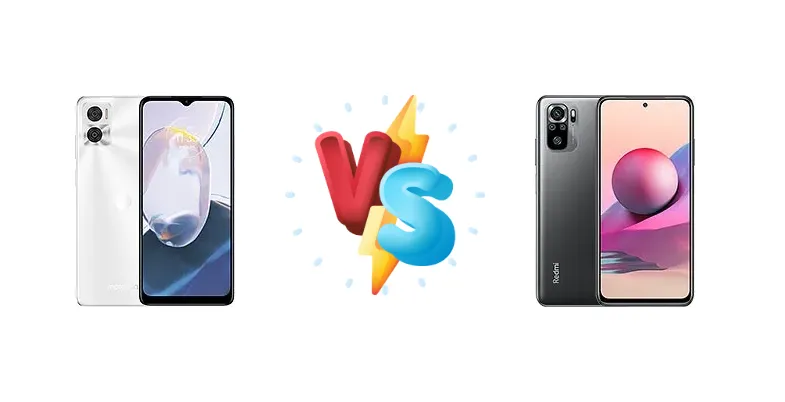
Looking for a reliable smartphone without breaking the bank? The Motorola Moto E22i and Xiaomi Redmi Note 10S are popular contenders in the budget phone arena. But which one offers the best value for your money? Let's dive into a detailed comparison.
🏆 Quick Verdict
The Xiaomi Redmi Note 10S is the clear winner. While the Moto E22i offers a clean Android experience, the Redmi Note 10S boasts a significantly faster processor, better camera, faster charging, and a more vibrant display, making it the superior choice for most users.
| Network |
|---|
| 2G bands | GSM 850 / 900 / 1800 / 1900 | GSM 850 / 900 / 1800 / 1900 |
| 3G bands | HSDPA 850 / 900 / 2100 | HSDPA 850 / 900 / 1700(AWS) / 1900 / 2100 |
| 4G bands | 1, 3, 5, 7, 8, 20, 38, 40, 41 | 1, 2, 3, 4, 5, 7, 8, 20, 28, 38, 40, 41 |
| Speed | HSPA 42.2/5.76 Mbps, LTE Cat4 150/50 Mbps | HSPA, LTE |
| Technology | GSM / HSPA / LTE | GSM / HSPA / LTE |
| Launch |
|---|
| Announced | 2022, September 16 | 2021, March 04 |
| Status | Available. Released 2022, October 11 | Available. Released 2021, April 28 |
| Body |
|---|
| Build | Glass front, plastic frame, plastic back | - |
| Dimensions | 163.6 x 74.7 x 8 mm (6.44 x 2.94 x 0.31 in) | 160.5 x 74.5 x 8.3 mm (6.32 x 2.93 x 0.33 in) |
| SIM | Nano-SIM + Nano-SIM | Nano-SIM + Nano-SIM |
| Weight | 169 g (5.96 oz) | 178.8 g (6.31 oz) |
| | Water-repellent coating | IP53, dust and splash resistant |
| Display |
|---|
| Protection | - | Corning Gorilla Glass 3 |
| Resolution | 720 x 1600 pixels, 20:9 ratio (~270 ppi density) | 1080 x 2400 pixels, 20:9 ratio (~409 ppi density) |
| Size | 6.5 inches, 102.0 cm2 (~83.5% screen-to-body ratio) | 6.43 inches, 99.8 cm2 (~83.5% screen-to-body ratio) |
| Type | IPS LCD, 90Hz | AMOLED, 450 nits (typ), 1100 nits (peak) |
| Platform |
|---|
| CPU | Octa-core (4x2.3 GHz Cortex-A53 & 4x1.8 GHz Cortex-A53) | Octa-core (2x2.05 GHz Cortex-A76 & 6x2.0 GHz Cortex-A55) |
| Chipset | Mediatek MT6765V/CB Helio G37 (12 nm) | Mediatek MT6785V/CD Helio G95 (12 nm) |
| GPU | PowerVR GE8320 | Mali-G76 MC4 |
| OS | Android 12 (Go edition) | Android 11, upgradable to Android 13, MIUI 14 |
| Memory |
|---|
| Card slot | microSDXC (dedicated slot) | microSDXC (dedicated slot) |
| Internal | 32GB 2GB RAM, 64GB 2GB RAM | 64GB 4GB RAM, 64GB 6GB RAM, 128GB 4GB RAM, 128GB 6GB RAM, 128GB 8GB RAM |
| | eMMC 5.1 | UFS 2.2 |
| Main Camera |
|---|
| Dual | 16 MP, f/2.2, (wide), 1.0µm, PDAF
Auxiliary lens | - |
| Features | LED flash, HDR, panorama | LED flash, HDR, panorama |
| Quad | - | 64 MP, f/1.8, 26mm (wide), 1/1.97", 0.7µm, PDAF
8 MP, f/2.2, 118˚ (ultrawide), 1/4.0", 1.12µm
2 MP (macro)
Auxiliary lens |
| Single | - | 13 MP, f/2.5, (wide), 1/3.06", 1.12µm |
| Video | 1080p@30fps | 4K@30fps, 1080p@30/60/120fps, 720p@960fps |
| Selfie camera |
|---|
| Features | HDR | HDR |
| Single | 5 MP, f/2.4, 1/5.0", 1.12µm | 13 MP, f/2.5, (wide), 1/3.06", 1.12µm |
| Video | 1080p@30fps | 1080p@30fps |
| Sound |
|---|
| 3.5mm jack | Yes | Yes |
| 35mm jack | Yes | Yes |
| Loudspeaker | Yes, with stereo speakers | Yes, with stereo speakers |
| | - | 24-bit/192kHz audio |
| Comms |
|---|
| Bluetooth | 5.0, A2DP, LE | 5.1, A2DP, LE |
| Infrared port | - | Yes |
| NFC | No | Yes (market/region dependent) |
| Positioning | GPS, GLONASS, GALILEO | GPS, GLONASS, GALILEO, BDS |
| Radio | FM radio | FM radio |
| USB | USB Type-C 2.0 | USB Type-C 2.0 |
| WLAN | Wi-Fi 802.11 a/b/g/n/ac, dual-band | Wi-Fi 802.11 a/b/g/n/ac, dual-band, Wi-Fi Direct |
| Features |
|---|
| Sensors | Fingerprint (side-mounted), accelerometer, proximity | Fingerprint (side-mounted), accelerometer, gyro, compass |
| | - | Virtual proximity sensing |
| Battery |
|---|
| Charging | 10W wired | 33W wired |
| Type | Li-Po 4020 mAh | Li-Po 5000 mAh |
| Misc |
|---|
| Colors | Graphite Gray, Winter White | Deep Sea Blue (Ocean Blue), Shadow Black (Onyx Gray), (Frost White) Pebble White |
| Models | - | M2101K7BG, M2101K7BI, M2101K7BNY, M2101K7BL |
| Price | About 90 EUR | € 101.48 / £ 135.82 / ₹ 13,999 |
| SAR | - | 1.07 W/kg (head) 0.81 W/kg (body) |
| SAR EU | - | 0.60 W/kg (head) 0.90 W/kg (body) |
Motorola Moto E22i
- Clean Android experience
- Minimal bloatware
- Decent battery life
- Affordable price
- Slow processor
- Mediocre camera
- Slow charging
- Lower quality display
Xiaomi Redmi Note 10S
- Fast processor
- Excellent camera
- Fast charging
- Vibrant AMOLED display
- 120Hz refresh rate
- MIUI software can be cluttered
- Slightly more expensive than the Moto E22i
Display Comparison
The Redmi Note 10S features a 6.43-inch Super AMOLED display with a 120Hz refresh rate, offering vibrant colors and smooth scrolling. The Moto E22i has a 6.5-inch IPS LCD display with a standard 60Hz refresh rate. The Redmi Note 10S's display is noticeably superior in terms of color accuracy, brightness, and smoothness.
Camera Comparison
The Redmi Note 10S boasts a versatile quad-camera system with a 108MP main sensor, delivering detailed and vibrant photos. The Moto E22i's 13MP main camera is decent in good lighting but struggles in low-light conditions. The Redmi Note 10S also offers better video recording capabilities.
Performance
The Redmi Note 10S's Helio G95 chipset and dual Cortex-A76 cores provide a significant performance boost over the Moto E22i's Helio G37. Expect smoother multitasking, faster app loading times, and better gaming performance on the Redmi Note 10S. The Moto E22i is adequate for basic tasks but struggles with demanding applications.
Battery Life
Both phones offer a respectable battery life, but the Redmi Note 10S's 33W fast charging significantly reduces charging times. The Moto E22i's 10W charging is considerably slower.
Buying Guide
Who should buy the Motorola Moto E22i? Users prioritizing a pure Android experience, minimal bloatware, and a very basic smartphone for calls, texts, and light browsing. Who should buy the Xiaomi Redmi Note 10S? Users seeking a more powerful phone with a better camera, faster charging, and a more immersive display for media consumption and gaming.
Frequently Asked Questions
❓ Is the Moto E22i good for gaming?
The Moto E22i is not ideal for demanding games due to its slower processor. It can handle basic games, but expect lag and reduced performance.
❓ Which phone has better software support?
Motorola is known for providing timely Android updates, while Xiaomi's MIUI can be more inconsistent. However, both offer reasonable support.
❓ What is the difference between AMOLED and IPS LCD?
AMOLED displays offer better contrast, more vibrant colors, and deeper blacks compared to IPS LCD displays. They are generally considered superior for media consumption.