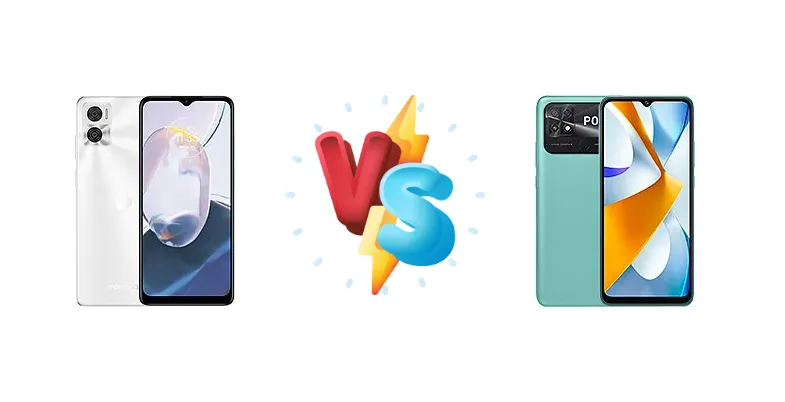
The sub-$150 smartphone market is fiercely competitive. Both the Motorola Moto E22i and the Xiaomi Poco C40 aim to deliver essential smartphone functionality at an incredibly accessible price point. However, they take different approaches to achieving this, particularly in their core processing power and charging capabilities. This comparison dissects those differences to determine which device offers the best value.
🏆 Quick Verdict
For most users, the Xiaomi Poco C40 emerges as the better choice. While the Moto E22i benefits from a slightly more established brand reputation, the Poco C40’s faster JLQ JR510 chipset and significantly quicker 18W charging provide a more responsive user experience and reduce downtime, making it the more practical option.
| Network |
|---|
| 2G bands | GSM 850 / 900 / 1800 / 1900 | GSM 850 / 900 / 1800 / 1900 |
| 3G bands | HSDPA 850 / 900 / 2100 | HSDPA 850 / 900 / 1700(AWS) / 1900 / 2100 |
| 4G bands | 1, 3, 5, 7, 8, 20, 38, 40, 41 | 1, 2, 3, 4, 5, 7, 8, 20, 28, 38, 40, 41 |
| Speed | HSPA 42.2/5.76 Mbps, LTE Cat4 150/50 Mbps | HSPA, LTE |
| Technology | GSM / HSPA / LTE | GSM / HSPA / LTE |
| Launch |
|---|
| Announced | 2022, September 16 | 2022, June 06 |
| Status | Available. Released 2022, October 11 | Available. Released 2022, June 17 |
| Body |
|---|
| Build | Glass front, plastic frame, plastic back | - |
| Dimensions | 163.6 x 74.7 x 8 mm (6.44 x 2.94 x 0.31 in) | 169.6 x 76.6 x 9.2 mm (6.68 x 3.02 x 0.36 in) |
| SIM | Nano-SIM + Nano-SIM | Nano-SIM + Nano-SIM |
| Weight | 169 g (5.96 oz) | 204 g (7.20 oz) |
| | Water-repellent coating | Dust & splash resistant |
| Display |
|---|
| Protection | - | Corning Gorilla Glass |
| Resolution | 720 x 1600 pixels, 20:9 ratio (~270 ppi density) | 720 x 1650 pixels (~268 ppi density) |
| Size | 6.5 inches, 102.0 cm2 (~83.5% screen-to-body ratio) | 6.71 inches, 106.5 cm2 (~82.0% screen-to-body ratio) |
| Type | IPS LCD, 90Hz | IPS LCD, 400 nits |
| Platform |
|---|
| CPU | Octa-core (4x2.3 GHz Cortex-A53 & 4x1.8 GHz Cortex-A53) | Octa-core (4x2.0 GHz Cortex-A55 & 4x1.5 GHz Cortex-A55) |
| Chipset | Mediatek MT6765V/CB Helio G37 (12 nm) | JLQ JR510 (11 nm) |
| GPU | PowerVR GE8320 | Mali-G57 MC1 |
| OS | Android 12 (Go edition) | Android 11, MIUI 13 for POCO |
| Memory |
|---|
| Card slot | microSDXC (dedicated slot) | microSDXC |
| Internal | 32GB 2GB RAM, 64GB 2GB RAM | 32GB 2GB RAM, 32GB 3GB RAM, 32GB 4GB RAM, 64GB 4GB RAM |
| | eMMC 5.1 | - |
| Main Camera |
|---|
| Dual | 16 MP, f/2.2, (wide), 1.0µm, PDAF
Auxiliary lens | 13 MP, f/2.2, (wide), PDAF
Auxiliary lens |
| Features | LED flash, HDR, panorama | LED flash, HDR, panorama |
| Single | - | 5 MP, f/2.2 |
| Video | 1080p@30fps | 1080p@30fps |
| Selfie camera |
|---|
| Features | HDR | HDR |
| Single | 5 MP, f/2.4, 1/5.0", 1.12µm | 5 MP, f/2.2 |
| Video | 1080p@30fps | 1080p@30fps |
| Sound |
|---|
| 3.5mm jack | Yes | Yes |
| 35mm jack | Yes | Yes |
| Loudspeaker | Yes, with stereo speakers | Yes |
| Comms |
|---|
| Bluetooth | 5.0, A2DP, LE | 5.0, A2DP, LE |
| Infrared port | - | Yes |
| NFC | No | Yes (market/region dependent) |
| Positioning | GPS, GLONASS, GALILEO | GPS, GLONASS, GALILEO, BDS |
| Radio | FM radio | FM radio |
| USB | USB Type-C 2.0 | USB Type-C 2.0 |
| WLAN | Wi-Fi 802.11 a/b/g/n/ac, dual-band | Wi-Fi 802.11 a/b/g/n/ac, dual-band, Wi-Fi Direct |
| Features |
|---|
| Sensors | Fingerprint (side-mounted), accelerometer, proximity | Fingerprint (rear-mounted), accelerometer, proximity |
| Battery |
|---|
| Charging | 10W wired | 18W wired |
| Type | Li-Po 4020 mAh | Li-Po 6000 mAh |
| Misc |
|---|
| Colors | Graphite Gray, Winter White | Power Black, Coral Green, Poco Yellow |
| Models | - | 220333QPG |
| Price | About 90 EUR | About 110 EUR |
Motorola Moto E22i
- Established Motorola brand reputation
- Potentially more readily available in certain markets
- Adequate for basic smartphone tasks
- Older Mediatek Helio G37 chipset
- Slow 10W charging
- Less responsive user experience
Xiaomi Poco C40
- More modern JLQ JR510 chipset
- Faster 18W charging
- Smoother multitasking and app loading
- Less well-known Xiaomi/Poco brand
- Potential for more pre-installed bloatware
- Long-term software support may be limited
Display Comparison
Neither device boasts a standout display. Both are likely to feature LCD panels, typical for this price bracket. Specifics like resolution and brightness are not provided, but we can assume they are similar – around 720p+ and adequate for indoor use. The focus here isn’t on visual fidelity, but on basic functionality. Bezels are likely to be substantial on both, maximizing screen real estate within a compact form factor.
Camera Comparison
Camera performance is likely to be similar on both devices, leaning towards basic functionality. Without sensor size or aperture information, it’s difficult to make definitive claims. However, the inclusion of a dedicated night mode or advanced image processing on either device is unlikely. Expect acceptable results in good lighting conditions, but struggles in low light. The presence of a 2MP macro camera on both is largely a marketing tactic, offering limited practical benefit due to the low resolution and lack of optical image stabilization.
Performance
The core difference lies in the chipsets. The Poco C40’s JLQ JR510 (11nm) represents a more modern architecture than the Moto E22i’s Mediatek Helio G37 (12nm). While both are octa-core, the JR510 utilizes Cortex-A55 cores across the board, offering improved efficiency and performance compared to the G37’s mix of A53 cores. The G37’s higher clock speeds (2.3GHz vs 2.0GHz) are offset by the older core design. This translates to snappier app launches and smoother multitasking on the Poco C40. The 11nm process node of the JR510 also contributes to better thermal management, potentially reducing throttling during sustained use.
Battery Life
Both phones likely house batteries in the 5000mAh range, common for budget devices. However, the Poco C40’s 18W wired charging is a significant advantage over the Moto E22i’s 10W charging. This means the Poco C40 can replenish its battery much faster, reducing downtime. While battery life will be comparable in typical usage, the faster charging speed makes the Poco C40 more convenient for users who frequently need to top up their device.
Buying Guide
Buy the Motorola Moto E22i if you prioritize a familiar brand and are primarily focused on basic communication tasks like calls, texts, and light social media use. Its Helio G37 chipset is adequate for these scenarios. Buy the Xiaomi Poco C40 if you value a more fluid user experience, faster app loading times, and quicker charging, even if it means opting for a less well-known brand. The JR510 chipset offers a noticeable performance uplift for everyday tasks.
Frequently Asked Questions
❓ Will the Poco C40 struggle with demanding games like PUBG Mobile?
While the JLQ JR510 is an improvement over the Helio G37, it's still a budget chipset. PUBG Mobile will likely be playable at lower graphics settings and frame rates. Expect some stuttering and frame drops during intense action. The Moto E22i would likely perform similarly, if not worse.
❓ Does the Poco C40 support fast charging protocols like Quick Charge or Power Delivery?
The Poco C40 supports 18W charging, but it's unlikely to support proprietary fast charging protocols like Qualcomm's Quick Charge or USB Power Delivery. It will charge fastest with a compatible 18W charger (sold separately). Using a standard 5W charger will significantly increase charging time.
❓ How does the software experience differ between the Moto E22i and the Poco C40?
The Moto E22i typically runs a near-stock version of Android with minimal bloatware, offering a cleaner user experience. The Poco C40 runs Xiaomi's MIUI, which is heavily customized and includes a significant amount of pre-installed apps and features. While MIUI offers more customization options, it can also feel cluttered and resource-intensive.
❓ Which phone is likely to receive more software updates?
Motorola generally provides more consistent software updates, including security patches, for its budget devices compared to Xiaomi. However, both phones are likely to receive limited long-term software support, typically one major Android version update and a few years of security patches.