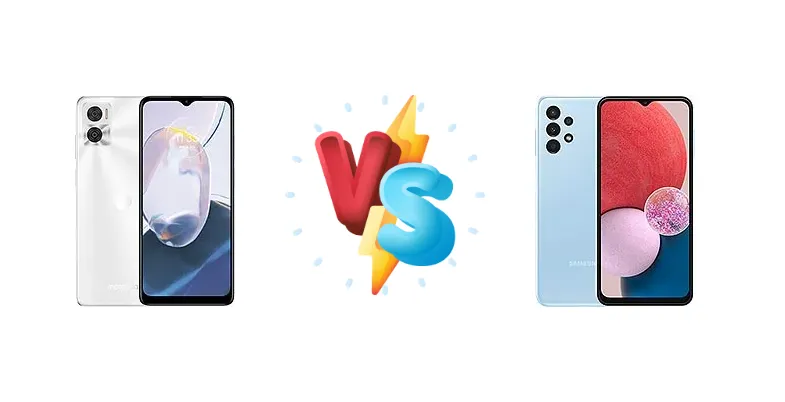
The Motorola Moto E22i and Samsung Galaxy A13 represent the fiercely competitive sub-$150 smartphone market. Both aim to deliver essential smartphone functionality at an accessible price, but they achieve this with different approaches to chipset selection and feature prioritization. This comparison dissects their core specifications to determine which device offers the best value for budget-conscious consumers.
🏆 Quick Verdict
For most users, the Samsung Galaxy A13 emerges as the better choice. Its Helio G80 chipset, featuring Cortex-A75 performance cores, provides a noticeable performance advantage over the Moto E22i’s Helio G37, making it more suitable for multitasking and moderately demanding apps. While the E22i is cheaper, the A13’s slightly faster charging and superior processing power justify the price difference.
| Network |
|---|
| 2G bands | GSM 850 / 900 / 1800 / 1900 | GSM 850 / 900 / 1800 / 1900 |
| 3G bands | HSDPA 850 / 900 / 2100 | HSDPA 850 / 900 / 2100 |
| 4G bands | 1, 3, 5, 7, 8, 20, 38, 40, 41 | 1, 3, 5, 7, 8, 20, 28, 38, 40, 41 |
| Speed | HSPA 42.2/5.76 Mbps, LTE Cat4 150/50 Mbps | HSPA, LTE |
| Technology | GSM / HSPA / LTE | GSM / HSPA / LTE |
| Launch |
|---|
| Announced | 2022, September 16 | 2022, June |
| Status | Available. Released 2022, October 11 | Available. Released 2022, July |
| Body |
|---|
| Build | Glass front, plastic frame, plastic back | Glass front (Gorilla Glass 5), plastic frame, plastic back |
| Dimensions | 163.6 x 74.7 x 8 mm (6.44 x 2.94 x 0.31 in) | 165.1 x 76.4 x 8.8 mm (6.5 x 3.01 x 0.35 in) |
| SIM | Nano-SIM + Nano-SIM | · Nano-SIM· Nano-SIM + Nano-SIM |
| Weight | 169 g (5.96 oz) | 195 g (6.88 oz) |
| | Water-repellent coating | - |
| Display |
|---|
| Protection | - | Corning Gorilla Glass 5 |
| Resolution | 720 x 1600 pixels, 20:9 ratio (~270 ppi density) | 1080 x 2408 pixels, 20:9 ratio (~400 ppi density) |
| Size | 6.5 inches, 102.0 cm2 (~83.5% screen-to-body ratio) | 6.6 inches, 104.9 cm2 (~83.2% screen-to-body ratio) |
| Type | IPS LCD, 90Hz | PLS LCD |
| Platform |
|---|
| CPU | Octa-core (4x2.3 GHz Cortex-A53 & 4x1.8 GHz Cortex-A53) | Octa-core (2x2.0 GHz Cortex-A75 & 6x1.8 GHz Cortex-A55) |
| Chipset | Mediatek MT6765V/CB Helio G37 (12 nm) | Mediatek MT6769V/CU Helio G80 (12 nm) |
| GPU | PowerVR GE8320 | Mali-G52 MC2 |
| OS | Android 12 (Go edition) | Android 12, upgradable to Android 14, One UI 6.1 |
| Memory |
|---|
| Card slot | microSDXC (dedicated slot) | microSDXC (dedicated slot) |
| Internal | 32GB 2GB RAM, 64GB 2GB RAM | 32GB 3GB RAM, 32GB 4GB RAM, 64GB 4GB RAM, 128GB 4GB RAM |
| | eMMC 5.1 | eMMC 5.1 |
| Main Camera |
|---|
| Dual | 16 MP, f/2.2, (wide), 1.0µm, PDAF
Auxiliary lens | - |
| Features | LED flash, HDR, panorama | LED flash, panorama, HDR |
| Quad | - | 50 MP, f/1.8, (wide), PDAF
5 MP, f/2.2, 123˚ (ultrawide), 1/5.0", 1.12µm
2 MP (macro)
Auxiliary lens |
| Single | - | 8 MP, f/2.2, (wide) |
| Video | 1080p@30fps | 1080p@30fps |
| Selfie camera |
|---|
| Features | HDR | - |
| Single | 5 MP, f/2.4, 1/5.0", 1.12µm | 8 MP, f/2.2, (wide) |
| Video | 1080p@30fps | 1080p@30fps |
| Sound |
|---|
| 3.5mm jack | Yes | Yes |
| 35mm jack | Yes | Yes |
| Loudspeaker | Yes, with stereo speakers | Yes |
| Comms |
|---|
| Bluetooth | 5.0, A2DP, LE | 5.2, A2DP, LE |
| NFC | No | Yes |
| Positioning | GPS, GLONASS, GALILEO | GPS, GLONASS, GALILEO, BDS |
| Radio | FM radio | No |
| USB | USB Type-C 2.0 | USB Type-C 2.0, OTG |
| WLAN | Wi-Fi 802.11 a/b/g/n/ac, dual-band | Wi-Fi 802.11 a/b/g/n/ac, dual-band, Wi-Fi Direct |
| Features |
|---|
| Sensors | Fingerprint (side-mounted), accelerometer, proximity | Fingerprint (side-mounted), accelerometer, compass |
| | - | Virtual proximity sensing |
| Battery |
|---|
| Charging | 10W wired | 15W wired |
| Type | Li-Po 4020 mAh | Li-Po 5000 mAh |
| Misc |
|---|
| Colors | Graphite Gray, Winter White | Black, White, Blue |
| Models | - | SM-A137F, SM-A137F/DSN, SM-A137F/DS |
| Price | About 90 EUR | About 180 EUR |
| SAR EU | - | 0.35 W/kg (head) 1.22 W/kg (body) |
Motorola Moto E22i
- Lower price point makes it highly accessible.
- Simple and straightforward user experience.
- Potentially longer software support from Motorola (though not guaranteed).
- Inferior chipset performance compared to the Galaxy A13.
- Slower charging speed.
- Likely less refined camera image processing.
Samsung Galaxy A13 (SM-A137)
- More powerful Helio G80 chipset for smoother performance.
- Faster 15W wired charging.
- Samsung’s brand recognition and potential software features.
- Slightly higher price than the Moto E22i.
- May include more pre-installed bloatware.
- Potentially less frequent software updates compared to Motorola.
Display Comparison
Neither device boasts a standout display. Both likely utilize LCD panels, a common cost-saving measure in this segment. However, detailed display specs (resolution, brightness, color gamut) are missing. The focus here is on processing power, not visual fidelity. Bezels are expected to be relatively thick on both, contributing to a larger overall footprint. Color accuracy will likely be standard for the price point, prioritizing power efficiency over color calibration.
Camera Comparison
Camera performance is likely to be similar in real-world usage, given the expected sensor quality in this price bracket. Detailed sensor information is unavailable, but both will likely feature a primary camera accompanied by lower-resolution auxiliary lenses (potentially a 2MP macro and depth sensor). The A13 *may* benefit from Samsung’s image processing algorithms, potentially offering slightly more vibrant and detailed photos. However, don't expect flagship-level image quality from either device. The focus should be on adequate performance in good lighting conditions, rather than low-light capabilities.
Performance
The core difference lies in the chipsets. The Samsung Galaxy A13’s Mediatek Helio G80 (12nm) is a clear upgrade over the Motorola Moto E22i’s Helio G37 (12nm). The G80’s octa-core configuration includes 2x2.0 GHz Cortex-A75 cores alongside 6x1.8 GHz Cortex-A55 cores. This contrasts with the E22i’s 4x2.3 GHz Cortex-A53 and 4x1.8 GHz Cortex-A53 setup. The A75 cores in the G80 offer significantly higher single-core performance, translating to snappier app launches and smoother multitasking. While both use the same 12nm process, the architectural improvements in the G80 provide a tangible benefit. The E22i’s reliance on older A53 cores will result in more noticeable lag when handling multiple apps or demanding tasks.
Battery Life
Battery capacity is not specified, but both devices will likely feature batteries in the 4000-5000 mAh range. The Galaxy A13’s 15W wired charging is a slight advantage over the Moto E22i’s 10W charging. While neither is particularly fast by modern standards, the A13 will achieve a full charge approximately 30-45 minutes faster. This difference, combined with the G80’s potentially better power efficiency, could translate to slightly longer real-world battery life for the A13, especially during moderate to heavy usage.
Buying Guide
Buy the Motorola Moto E22i if you prioritize absolute affordability and need a basic smartphone for calls, texts, and light social media use. It’s a good option for first-time smartphone users or as a reliable backup device. Buy the Samsung Galaxy A13 (SM-A137) if you value smoother performance for everyday tasks, enjoy occasional gaming, or appreciate a slightly faster charging experience. It’s a more versatile device that can handle a wider range of applications without significant slowdown.
Frequently Asked Questions
❓ Will the Helio G80 in the Galaxy A13 handle popular games like PUBG Mobile?
The Helio G80 is capable of running PUBG Mobile, but you'll likely need to lower the graphics settings to medium or low to achieve a consistently smooth frame rate. Don't expect high-end gaming performance, but it's sufficient for casual gaming sessions.
❓ Is the 15W charging on the Galaxy A13 significantly faster than the 10W charging on the Moto E22i?
Yes, while neither is fast charging, the 15W charging on the A13 will reduce charging times by approximately 30-45 minutes for a full 0-100% charge. This is a noticeable difference for users who frequently need to top up their battery.
❓ Does either phone support microSD card expansion for additional storage?
While not explicitly stated in the provided specs, both the Motorola Moto E22i and Samsung Galaxy A13 are highly likely to support microSD card expansion, a common feature in budget smartphones. This allows users to increase storage capacity for photos, videos, and other files.
❓ Which phone is better for someone who primarily uses their phone for calls, texts, and WhatsApp?
For basic communication, the Motorola Moto E22i is perfectly adequate. Its lower price makes it a sensible choice if your needs are limited to essential functions. The Galaxy A13 offers a smoother experience, but the difference won't be significant for these use cases.