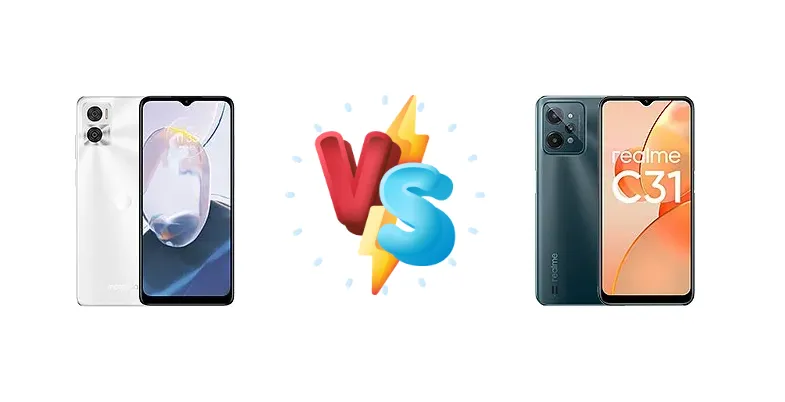
The sub-$150 smartphone market is fiercely competitive, and the Motorola Moto E22i and Realme C31 are two contenders vying for your attention. Both aim to deliver essential smartphone functionality at an accessible price, but they take different approaches to achieving this. This comparison dissects their core components to reveal which device offers the best value for everyday users.
🏆 Quick Verdict
For most users, the Realme C31 emerges as the slightly better choice. Its Unisoc Tiger T612 chipset, featuring Cortex-A75 cores, provides a noticeable performance edge over the Moto E22i’s Helio G37, particularly in multitasking and app loading. While both offer similar battery and charging capabilities, the C31’s CPU architecture translates to a smoother user experience.
| Network |
|---|
| 2G bands | GSM 850 / 900 / 1800 / 1900 | GSM 850 / 900 / 1800 / 1900 |
| 3G bands | HSDPA 850 / 900 / 2100 | HSDPA 850 / 900 / 2100 |
| 4G bands | 1, 3, 5, 7, 8, 20, 38, 40, 41 | 1, 3, 5, 8, 38, 40, 41 |
| Speed | HSPA 42.2/5.76 Mbps, LTE Cat4 150/50 Mbps | HSPA, LTE |
| Technology | GSM / HSPA / LTE | GSM / HSPA / LTE |
| Launch |
|---|
| Announced | 2022, September 16 | 2022, March 25 |
| Status | Available. Released 2022, October 11 | Available. Released 2022, March 31 |
| Body |
|---|
| Build | Glass front, plastic frame, plastic back | Glass front, plastic frame, plastic back |
| Dimensions | 163.6 x 74.7 x 8 mm (6.44 x 2.94 x 0.31 in) | 164.7 x 76.1 x 8.4 mm (6.48 x 3.00 x 0.33 in) |
| SIM | Nano-SIM + Nano-SIM | Nano-SIM + Nano-SIM |
| Weight | 169 g (5.96 oz) | 197 g (6.95 oz) |
| | Water-repellent coating | - |
| Display |
|---|
| Protection | - | Panda Glass |
| Resolution | 720 x 1600 pixels, 20:9 ratio (~270 ppi density) | 720 x 1600 pixels, 20:9 ratio (~270 ppi density) |
| Size | 6.5 inches, 102.0 cm2 (~83.5% screen-to-body ratio) | 6.5 inches, 102.0 cm2 (~81.4% screen-to-body ratio) |
| Type | IPS LCD, 90Hz | IPS LCD, 400 nits |
| Platform |
|---|
| CPU | Octa-core (4x2.3 GHz Cortex-A53 & 4x1.8 GHz Cortex-A53) | Octa-core (2x1.8 GHz Cortex-A75 & 6x1.8 GHz Cortex-A55) |
| Chipset | Mediatek MT6765V/CB Helio G37 (12 nm) | Unisoc Tiger T612 (12 nm) |
| GPU | PowerVR GE8320 | Mali-G57 |
| OS | Android 12 (Go edition) | Android 11, Realme UI 2.0 |
| Memory |
|---|
| Card slot | microSDXC (dedicated slot) | microSDXC (dedicated slot) |
| Internal | 32GB 2GB RAM, 64GB 2GB RAM | 32GB 3GB RAM, 64GB 4GB RAM |
| | eMMC 5.1 | UFS 2.2 |
| Main Camera |
|---|
| Dual | 16 MP, f/2.2, (wide), 1.0µm, PDAF
Auxiliary lens | - |
| Features | LED flash, HDR, panorama | LED flash, HDR, panorama |
| Single | - | 5 MP, f/2.2, 27mm (wide), 1/5.0", 1.12µm |
| Triple | - | 13 MP, f/2.2, 25mm (wide), 1/3.06", 1.12µm, AF
2 MP (macro)
Auxiliary lens |
| Video | 1080p@30fps | 1080p@30fps |
| Selfie camera |
|---|
| Features | HDR | HDR |
| Single | 5 MP, f/2.4, 1/5.0", 1.12µm | 5 MP, f/2.2, 27mm (wide), 1/5.0", 1.12µm |
| Video | 1080p@30fps | 720p@30fps |
| Sound |
|---|
| 3.5mm jack | Yes | Yes |
| 35mm jack | Yes | Yes |
| Loudspeaker | Yes, with stereo speakers | Yes |
| Comms |
|---|
| Bluetooth | 5.0, A2DP, LE | 5.0, A2DP, LE |
| NFC | No | No |
| Positioning | GPS, GLONASS, GALILEO | GPS, GLONASS, GALILEO, BDS |
| Radio | FM radio | No |
| USB | USB Type-C 2.0 | microUSB 2.0 |
| WLAN | Wi-Fi 802.11 a/b/g/n/ac, dual-band | Wi-Fi 802.11 b/g/n |
| Features |
|---|
| Sensors | Fingerprint (side-mounted), accelerometer, proximity | Fingerprint (side-mounted), accelerometer, gyro, proximity |
| Battery |
|---|
| Charging | 10W wired | 10W wired |
| Type | Li-Po 4020 mAh | 5000 mAh |
| Misc |
|---|
| Colors | Graphite Gray, Winter White | Light Silver, Dark Green |
| Models | - | RMX3501 |
| Price | About 90 EUR | About 150 EUR |
Motorola Moto E22i
- Clean Android experience (likely)
- Motorola’s reputation for software stability
- Potentially more durable build quality
- Less powerful chipset (Helio G37)
- Slower app loading times
- Potentially less responsive UI
Realme C31
- More powerful chipset (Unisoc Tiger T612)
- Smoother multitasking and app performance
- Better CPU architecture for sustained tasks
- Realme UI can include bloatware
- Potentially less frequent software updates
- May prioritize vibrant colors over accuracy in camera
Display Comparison
Neither device boasts a standout display. Both likely utilize LCD panels, a common cost-saving measure in this segment. Detailed display specs (resolution, brightness) are missing, but we can infer that they are similar. The focus here isn't on visual fidelity, but on basic usability. Bezels are likely to be substantial on both, maximizing screen real estate within a compact form factor. Color accuracy will likely be standard for the price point, prioritizing power efficiency over color calibration.
Camera Comparison
Camera performance is likely to be similar, with both devices relying on basic sensors. Detailed sensor information is unavailable, but it’s safe to assume both feature a primary sensor and potentially depth or macro lenses of limited utility. Image processing will be the key differentiator, and Realme’s software often prioritizes vibrant, saturated colors, while Motorola aims for a more natural look. The absence of Optical Image Stabilization (OIS) on either device means low-light performance will be challenging.
Performance
The core difference lies in the chipset. The Realme C31’s Unisoc Tiger T612 utilizes two Cortex-A75 cores clocked at 1.8 GHz alongside six Cortex-A55 cores, also at 1.8 GHz. This configuration provides a significant advantage over the Motorola Moto E22i’s MediaTek Helio G37, which employs four Cortex-A53 cores at 2.3 GHz and four Cortex-A53 cores at 1.8 GHz. While the G37 has a higher clock speed on its prime cores, the A75 architecture in the T612 is significantly more efficient and powerful. This translates to faster app launch times and smoother multitasking on the C31. Both are 12nm chips, so thermal efficiency will be comparable, but the C31 will likely handle sustained loads better.
Battery Life
Both the Motorola Moto E22i and Realme C31 are equipped with 10W wired charging, indicating a similar charging experience. Expect a full charge to take around 2.5 to 3 hours. While battery capacity isn’t specified, both likely house batteries in the 5000mAh range, common for this price point. Real-world battery life will depend heavily on usage, but both should comfortably last a full day with moderate use. The more efficient CPU in the Realme C31 *may* translate to slightly longer battery life under heavy load.
Buying Guide
Buy the Motorola Moto E22i if you prioritize a familiar, clean Android experience and a brand with a strong track record for software updates, even if they are infrequent. Buy the Realme C31 if you prioritize raw performance for the price, and are comfortable with Realme UI, which offers more features but can include pre-installed bloatware. The C31 is better suited for users who frequently switch between apps or engage in light gaming.
Frequently Asked Questions
❓ Will the Realme C31 struggle with popular apps like Facebook and WhatsApp?
No, the Unisoc Tiger T612 chipset is more than capable of handling everyday apps like Facebook, WhatsApp, and web browsing. The Cortex-A75 cores provide a performance boost that ensures smooth operation even with multiple apps open.
❓ Is the 10W charging on either phone fast enough for daily use?
10W charging is relatively slow by modern standards, but it's typical for phones in this price range. Both the Moto E22i and Realme C31 will take around 2.5-3 hours to fully charge. It's best to charge overnight to ensure you have a full battery in the morning.
❓ Does the Realme C31’s Realme UI have a lot of pre-installed bloatware?
Realme UI is known to include some pre-installed apps, often referred to as bloatware. While many can be uninstalled, it's a common complaint among users. The Moto E22i generally offers a cleaner Android experience, but may receive fewer feature updates.
❓ Can either of these phones handle basic mobile games like PUBG Mobile or Call of Duty Mobile?
Both phones can *run* these games, but don't expect a high-framerate experience. You'll likely need to play on the lowest graphics settings to achieve playable frame rates. The Realme C31’s chipset will provide a slightly smoother experience due to its more powerful CPU.