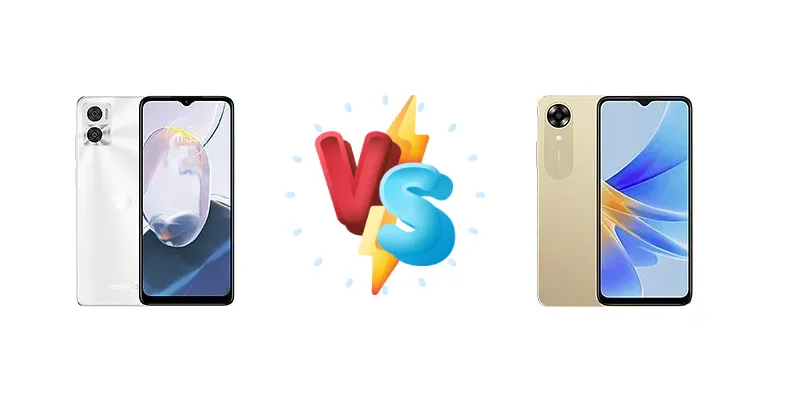
The Motorola Moto E22i and Oppo A17k represent the fiercely competitive sub-$150 smartphone market. Both devices target first-time smartphone buyers and those seeking a reliable secondary device. However, subtle differences in their core components, specifically the chipset, dictate their performance characteristics. This comparison dissects these differences to determine which phone delivers the best experience for the price.
🏆 Quick Verdict
For most users, the Motorola Moto E22i emerges as the slightly better choice. While both phones share a similar price point and target audience, the Helio G37 chipset within the E22i provides a marginal performance advantage, offering a smoother experience for everyday tasks and light gaming. The 10W charging is a drawback, but the performance edge is more impactful.
| Network |
|---|
| 2G bands | GSM 850 / 900 / 1800 / 1900 | GSM 850 / 900 / 1800 / 1900 |
| 3G bands | HSDPA 850 / 900 / 2100 | HSDPA 850 / 900 / 2100 |
| 4G bands | 1, 3, 5, 7, 8, 20, 38, 40, 41 | 1, 3, 5, 8, 38, 40, 41 |
| Speed | HSPA 42.2/5.76 Mbps, LTE Cat4 150/50 Mbps | HSPA, LTE |
| Technology | GSM / HSPA / LTE | GSM / HSPA / LTE |
| Launch |
|---|
| Announced | 2022, September 16 | 2022, October 13 |
| Status | Available. Released 2022, October 11 | Available. Released 2022, October 18 |
| Body |
|---|
| Build | Glass front, plastic frame, plastic back | - |
| Dimensions | 163.6 x 74.7 x 8 mm (6.44 x 2.94 x 0.31 in) | 164.2 x 75.6 x 8.3 mm (6.46 x 2.98 x 0.33 in) |
| SIM | Nano-SIM + Nano-SIM | Nano-SIM + Nano-SIM |
| Weight | 169 g (5.96 oz) | 189 g (6.67 oz) |
| | Water-repellent coating | IPX4 water resistance |
| Display |
|---|
| Protection | - | Panda Glass |
| Resolution | 720 x 1600 pixels, 20:9 ratio (~270 ppi density) | 720 x 1612 pixels, 20:9 ratio (~269 ppi density) |
| Size | 6.5 inches, 102.0 cm2 (~83.5% screen-to-body ratio) | 6.56 inches, 103.4 cm2 (~83.3% screen-to-body ratio) |
| Type | IPS LCD, 90Hz | IPS LCD, 480 nits (typ), 600 nits (HBM) |
| Platform |
|---|
| CPU | Octa-core (4x2.3 GHz Cortex-A53 & 4x1.8 GHz Cortex-A53) | Octa-core (4x2.3 GHz Cortex-A53 & 4x1.8 GHz Cortex-A53) |
| Chipset | Mediatek MT6765V/CB Helio G37 (12 nm) | Mediatek MT6765 Helio G35 (12 nm) |
| GPU | PowerVR GE8320 | PowerVR GE8320 |
| OS | Android 12 (Go edition) | Android 12, ColorOS 12.1 |
| Memory |
|---|
| Card slot | microSDXC (dedicated slot) | microSDXC |
| Internal | 32GB 2GB RAM, 64GB 2GB RAM | 64GB 3GB RAM |
| | eMMC 5.1 | eMMC 5.1 |
| Main Camera |
|---|
| Dual | 16 MP, f/2.2, (wide), 1.0µm, PDAF
Auxiliary lens | - |
| Features | LED flash, HDR, panorama | LED flash, panorama |
| Single | - | 8 MP, f/2.0, (wide), AF |
| Video | 1080p@30fps | 1080p@30fps |
| Selfie camera |
|---|
| Features | HDR | - |
| Single | 5 MP, f/2.4, 1/5.0", 1.12µm | 5 MP, f/2.2, (wide) |
| Video | 1080p@30fps | 1080p@30fps |
| Sound |
|---|
| 3.5mm jack | Yes | Yes |
| 35mm jack | Yes | Yes |
| Loudspeaker | Yes, with stereo speakers | Yes |
| Comms |
|---|
| Bluetooth | 5.0, A2DP, LE | 5.3, A2DP, LE, aptX HD |
| NFC | No | No |
| Positioning | GPS, GLONASS, GALILEO | GPS, GLONASS, BDS, GALILEO |
| Radio | FM radio | Unspecified |
| USB | USB Type-C 2.0 | microUSB 2.0, OTG |
| WLAN | Wi-Fi 802.11 a/b/g/n/ac, dual-band | Wi-Fi 802.11 a/b/g/n/ac, dual-band |
| Features |
|---|
| Sensors | Fingerprint (side-mounted), accelerometer, proximity | Fingerprint (side-mounted), accelerometer, proximity, compass |
| Battery |
|---|
| Charging | 10W wired | - |
| Type | Li-Po 4020 mAh | Li-Po 5000 mAh |
| Misc |
|---|
| Colors | Graphite Gray, Winter White | Navy Blue, Gold |
| Models | - | CPH2471 |
| Price | About 90 EUR | About 130 EUR |
Motorola Moto E22i
- Slightly better performance with Helio G37
- Potentially smoother multitasking
- More responsive app loading
- Slow 10W charging
- Likely basic camera performance
- Limited RAM (likely 2-4GB)
Oppo A17k
- Potentially streamlined software experience (ColorOS)
- Reliable for basic communication
- Competitive price point
- Lower performance with Helio G35
- May struggle with multitasking
- Likely basic camera performance
Display Comparison
Neither Motorola nor Oppo provide detailed display specifications beyond the basic panel size. Given the price bracket, both likely utilize LCD panels with 720p+ resolution. The absence of high refresh rates or advanced features like LTPO is expected. Bezels are likely to be substantial on both devices, contributing to a less immersive viewing experience. Color accuracy will likely be standard for this segment, prioritizing power efficiency over color fidelity.
Camera Comparison
Detailed camera specifications are unavailable. Given the market segment, both phones likely feature a primary camera (potentially 13MP) and a depth sensor. The inclusion of a 2MP macro camera on either device is largely symbolic, offering limited practical benefit due to the low resolution and lack of autofocus. Image processing will likely prioritize scene optimization over detail preservation. Expect acceptable results in well-lit conditions, but significant noise and softness in low-light environments. The aperture size of the main sensor will be a key determinant of low-light performance, but this information is currently unavailable.
Performance
The core difference lies in the chipset: the Motorola Moto E22i features the Mediatek MT6765V/CB Helio G37, while the Oppo A17k uses the Mediatek MT6765 Helio G35. Both are octa-core CPUs with the same core configuration (4x2.3 GHz Cortex-A53 & 4x1.8 GHz Cortex-A53). However, the G37 boasts a slightly higher clock speed and a marginally improved GPU. This translates to a small performance advantage for the E22i in tasks like app loading and scrolling. Both phones will likely struggle with demanding games, but the G37 will offer a slightly more playable experience. RAM configurations are not specified, but both will likely ship with 2-4GB, further limiting multitasking capabilities. The 12nm process node is consistent across both chipsets, suggesting similar thermal characteristics.
Battery Life
Battery capacity is not specified for either device. However, given the target market, both likely house a 4000-5000mAh battery. The Oppo A17k’s charging is not specified, but the Motorola Moto E22i is limited to 10W wired charging. This slower charging speed means a full charge will take considerably longer, potentially exceeding 3 hours. While the battery capacity might be similar, the slightly more power-hungry Helio G37 in the E22i could result in marginally shorter battery life under heavy use.
Buying Guide
Buy the Motorola Moto E22i if you prioritize a slightly more responsive user experience and anticipate running multiple apps or engaging in occasional light gaming. Its Helio G37 chipset offers a small but noticeable performance boost. Buy the Oppo A17k if you value a potentially more streamlined software experience (depending on ColorOS version) and are primarily focused on basic communication – calls, texts, and light social media use. The A17k is a solid option for those who need a dependable, no-frills device.
Frequently Asked Questions
❓ Will the Motorola Moto E22i handle popular social media apps like TikTok and Instagram smoothly?
The Moto E22i, with its Helio G37 chipset, should handle basic TikTok and Instagram usage without significant issues. However, intensive tasks like video editing or running multiple apps simultaneously may cause slowdowns. Expect a functional, but not necessarily fluid, experience.
❓ Is the Oppo A17k a good choice for someone who primarily uses their phone for calls and texts?
Yes, the Oppo A17k is an excellent choice for users who prioritize basic communication. The Helio G35 chipset is sufficient for calls, texts, and light messaging apps. Its focus is on reliability and battery life for essential functions, making it a dependable option for those needs.
❓ Can either of these phones run PUBG Mobile, and if so, at what settings?
Both phones will struggle to run PUBG Mobile at playable frame rates. If you can launch the game, you'll likely need to set the graphics to the absolute lowest settings and accept significant frame drops. These phones are not designed for demanding gaming.
❓ What version of Android do these phones ship with, and will they receive updates?
Both devices likely ship with Android Go Edition, a lightweight version of Android designed for low-end hardware. Update support is typically limited on phones in this price range. Expect at most one major Android version update, and security patches may be infrequent.