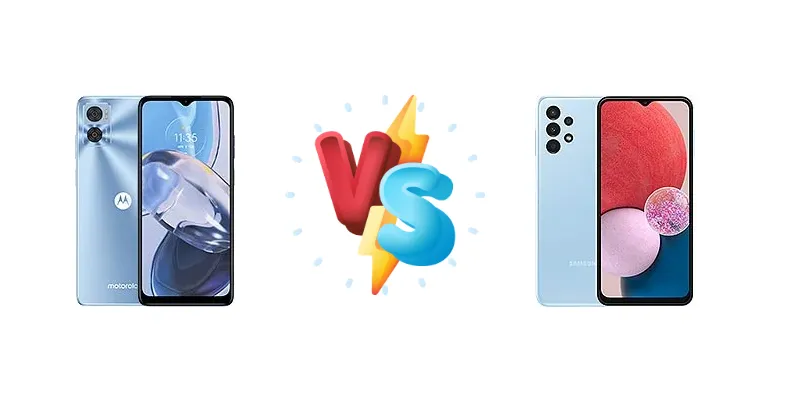
The Motorola Moto E22 and Samsung Galaxy A13 (SM-A137) represent the fiercely competitive sub-$150 smartphone market. Both aim to deliver essential smartphone functionality at an accessible price, but they take different approaches to achieving this. This comparison dissects their core specifications to determine which device offers the best value for everyday users.
🏆 Quick Verdict
For most users, the Samsung Galaxy A13 emerges as the better choice. Its Helio G80 chipset, featuring Cortex-A75 performance cores, provides a noticeable performance advantage over the Moto E22’s Helio G37, making it more capable for multitasking and gaming. While the Moto E22 is more affordable, the A13’s slightly faster charging and superior processing power justify the price difference.
| Network |
|---|
| 2G bands | GSM 850 / 900 / 1800 / 1900 | GSM 850 / 900 / 1800 / 1900 |
| 3G bands | HSDPA 850 / 900 / 2100 | HSDPA 850 / 900 / 2100 |
| 4G bands | 1, 3, 5, 7, 8, 20, 38, 40, 41 | 1, 3, 5, 7, 8, 20, 28, 38, 40, 41 |
| Speed | HSPA 42.2/5.76 Mbps, LTE Cat4 150/50 Mbps | HSPA, LTE |
| Technology | GSM / HSPA / LTE | GSM / HSPA / LTE |
| Launch |
|---|
| Announced | 2022, September 16 | 2022, June |
| Status | Available. Released 2022, October 11 | Available. Released 2022, July |
| Body |
|---|
| Build | Glass front, plastic frame, plastic back | Glass front (Gorilla Glass 5), plastic frame, plastic back |
| Dimensions | 163.6 x 74.7 x 8 mm (6.44 x 2.94 x 0.31 in) | 165.1 x 76.4 x 8.8 mm (6.5 x 3.01 x 0.35 in) |
| SIM | Nano-SIM + Nano-SIM | · Nano-SIM· Nano-SIM + Nano-SIM |
| Weight | 169 g (5.96 oz) | 195 g (6.88 oz) |
| | Water-repellent coating | - |
| Display |
|---|
| Protection | - | Corning Gorilla Glass 5 |
| Resolution | 720 x 1600 pixels, 20:9 ratio (~270 ppi density) | 1080 x 2408 pixels, 20:9 ratio (~400 ppi density) |
| Size | 6.5 inches, 102.0 cm2 (~83.5% screen-to-body ratio) | 6.6 inches, 104.9 cm2 (~83.2% screen-to-body ratio) |
| Type | IPS LCD, 90Hz | PLS LCD |
| Platform |
|---|
| CPU | Octa-core (4x2.3 GHz Cortex-A53 & 4x1.8 GHz Cortex-A53) | Octa-core (2x2.0 GHz Cortex-A75 & 6x1.8 GHz Cortex-A55) |
| Chipset | Mediatek MT6765V/CB Helio G37 (12 nm) | Mediatek MT6769V/CU Helio G80 (12 nm) |
| GPU | PowerVR GE8320 | Mali-G52 MC2 |
| OS | Android 12 | Android 12, upgradable to Android 14, One UI 6.1 |
| Memory |
|---|
| Card slot | microSDXC (dedicated slot) | microSDXC (dedicated slot) |
| Internal | 32GB 2GB RAM, 32GB 3GB RAM, 64GB 4GB RAM, 128GB 4GB RAM | 32GB 3GB RAM, 32GB 4GB RAM, 64GB 4GB RAM, 128GB 4GB RAM |
| | eMMC 5.1 | eMMC 5.1 |
| Main Camera |
|---|
| Dual | 16 MP, f/2.2, (wide), 1.0µm, PDAF
Auxiliary lens | - |
| Features | LED flash, HDR, panorama | LED flash, panorama, HDR |
| Quad | - | 50 MP, f/1.8, (wide), PDAF
5 MP, f/2.2, 123˚ (ultrawide), 1/5.0", 1.12µm
2 MP (macro)
Auxiliary lens |
| Single | - | 8 MP, f/2.2, (wide) |
| Video | 1080p@30fps | 1080p@30fps |
| Selfie camera |
|---|
| Features | HDR | - |
| Single | 5 MP, f/2.4, 1/5.0", 1.12µm | 8 MP, f/2.2, (wide) |
| Video | 1080p@30fps | 1080p@30fps |
| Sound |
|---|
| 3.5mm jack | Yes | Yes |
| 35mm jack | Yes | Yes |
| Loudspeaker | Yes, with stereo speakers | Yes |
| Comms |
|---|
| Bluetooth | 5.0, A2DP, LE | 5.2, A2DP, LE |
| NFC | Yes (32GB 3GB RAM model only) | Yes |
| Positioning | GPS, GLONASS, GALILEO | GPS, GLONASS, GALILEO, BDS |
| Radio | FM radio | No |
| USB | USB Type-C 2.0 | USB Type-C 2.0, OTG |
| WLAN | Wi-Fi 802.11 a/b/g/n/ac, dual-band | Wi-Fi 802.11 a/b/g/n/ac, dual-band, Wi-Fi Direct |
| Features |
|---|
| Sensors | Fingerprint (side-mounted), accelerometer, proximity | Fingerprint (side-mounted), accelerometer, compass |
| | - | Virtual proximity sensing |
| Battery |
|---|
| Charging | 10W wired | 15W wired |
| Type | Li-Po 4020 mAh | Li-Po 5000 mAh |
| Misc |
|---|
| Colors | Astro Black, Crystal Blue | Black, White, Blue |
| Models | - | SM-A137F, SM-A137F/DSN, SM-A137F/DS |
| Price | About 100 EUR | About 180 EUR |
| SAR EU | - | 0.35 W/kg (head) 1.22 W/kg (body) |
Motorola Moto E22
- Lower price point makes it highly accessible.
- Compact and lightweight design for easy handling.
- Clean Android experience with minimal bloatware (typical of Motorola).
- Significantly weaker performance due to the Helio G37 chipset.
- Slower 10W charging.
- Likely inferior camera performance.
Samsung Galaxy A13 (SM-A137)
- More powerful Helio G80 chipset for smoother performance.
- Faster 15W charging.
- Potentially better camera quality with a larger sensor and night mode.
- Slightly higher price compared to the Moto E22.
- Samsung’s One UI can include pre-installed apps (bloatware).
- Larger size may be less comfortable for some users.
Display Comparison
Neither device boasts a standout display. Both likely utilize LCD panels, common in this price bracket. The focus here isn't on visual fidelity, but functionality. While specific display specs (resolution, brightness) are missing, the A13’s larger screen size (typically 6.6 inches vs the E22’s 6.5 inches) offers a slightly more immersive viewing experience. Bezels are expected to be substantial on both, minimizing premium feel. Color accuracy will likely be standard for the segment, prioritizing power efficiency over color calibration.
Camera Comparison
Camera performance will be limited on both devices. While megapixel counts aren’t the sole determinant of image quality, the A13 likely features a larger primary sensor, offering better low-light performance. The presence of a dedicated night mode on the A13 (a common Samsung feature) further enhances its capabilities in challenging lighting conditions. The Moto E22’s camera system is likely more basic, relying heavily on software processing. The inclusion of 2MP macro/depth sensors on both devices is largely marketing fluff; their image quality will be minimal. Focus should be on the main sensor’s performance.
Performance
The core difference lies in the chipsets. The Samsung Galaxy A13’s Mediatek Helio G80 (12nm) is a clear upgrade over the Motorola Moto E22’s Helio G37 (12nm). The G80’s CPU configuration – 2x2.0 GHz Cortex-A75 & 6x1.8 GHz Cortex-A55 – includes more powerful Cortex-A75 cores, resulting in significantly better single-core and multi-core performance. The E22’s 4x2.3 GHz Cortex-A53 & 4x1.8 GHz Cortex-A53 configuration relies solely on less efficient A53 cores. This translates to snappier app launches, smoother multitasking, and a more enjoyable gaming experience on the A13. Both devices will likely be paired with 3-4GB of RAM, but the G80’s architecture will manage memory more effectively.
Battery Life
Both phones aim for all-day battery life. The Moto E22’s 10W charging is noticeably slower than the Galaxy A13’s 15W charging. While neither offers rapid charging, the A13 will reach a full charge approximately 30-45 minutes faster. The actual battery capacity is not specified, but both will likely be in the 4000-5000 mAh range. The G80’s slightly better power efficiency may contribute to marginally longer battery life on the A13, but the difference will be minimal in real-world usage. The faster charging speed of the A13 is a more tangible benefit.
Buying Guide
Buy the Motorola Moto E22 if you prioritize absolute affordability and need a basic smartphone for calls, texts, and light social media use. It’s ideal for first-time smartphone owners or those on a very tight budget. Buy the Samsung Galaxy A13 (SM-A137) if you value smoother performance for everyday tasks, enjoy occasional mobile gaming, and appreciate the slightly faster 15W charging, even if it means spending a bit more upfront.
Frequently Asked Questions
❓ Does the Mediatek Helio G80 in the Galaxy A13 struggle with demanding games like PUBG Mobile?
While the Helio G80 isn't a gaming powerhouse, it's capable of running PUBG Mobile at medium settings with reasonable frame rates. Expect some occasional stuttering during intense firefights, but it's a playable experience. The Moto E22’s Helio G37 will struggle significantly more with the same game.
❓ Is the 10W charging on the Moto E22 painfully slow in real-world use?
Yes, 10W charging is quite slow by today’s standards. Expect a full charge to take over 3 hours from a near-empty battery. This is a significant drawback if you frequently find yourself needing to top up your phone throughout the day. The A13’s 15W charging is a noticeable improvement.
❓ How much bloatware is pre-installed on the Samsung Galaxy A13?
Samsung’s One UI typically includes a moderate amount of pre-installed apps, often referred to as bloatware. While some can be uninstalled, others are disabled but remain on the system. This is a common trade-off for Samsung’s feature-rich software experience.
❓ Will either phone receive significant software updates in the future?
Neither the Moto E22 nor the Galaxy A13 are likely to receive extensive software updates. Both fall into the entry-level segment, and manufacturers typically prioritize updates for their higher-end devices. Expect at least one major Android version update, but long-term support is limited.