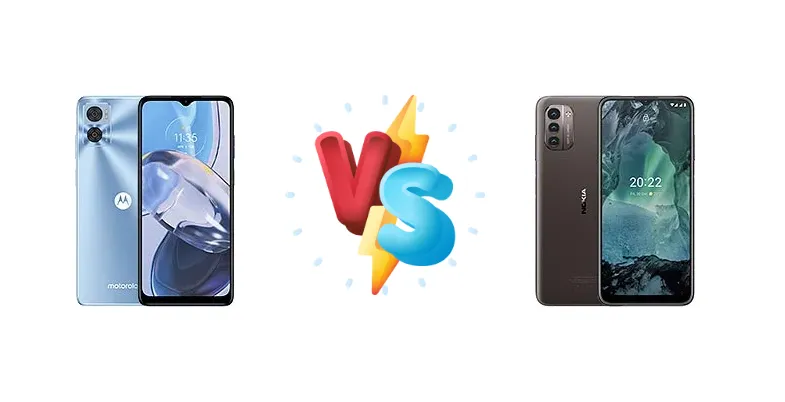
The Motorola Moto E22 and Nokia G21 represent compelling options in the ultra-budget smartphone segment. Both aim to deliver essential functionality at a low price point, but they take different approaches to achieving this. The Moto E22 focuses on a slightly newer chipset, while the Nokia G21 prioritizes battery endurance and faster charging capabilities. This comparison will dissect their key differences to determine which device offers the best value.
🏆 Quick Verdict
For the average user prioritizing longevity and consistent performance, the Nokia G21 emerges as the better choice. Its 18W PD3.0 charging and measured 500 nits brightness offer tangible benefits over the Moto E22’s 10W charging and unspecified brightness, despite the slightly different CPU architectures.
| Network |
|---|
| 2G bands | GSM 850 / 900 / 1800 / 1900 | GSM 850 / 900 / 1800 / 1900 |
| 3G bands | HSDPA 850 / 900 / 2100 | HSDPA 850 / 900 / 2100 - International |
| 4G bands | 1, 3, 5, 7, 8, 20, 38, 40, 41 | 1, 3, 5, 7, 8, 20, 28, 38, 40, 41 - International |
| Speed | HSPA 42.2/5.76 Mbps, LTE Cat4 150/50 Mbps | HSPA 42.2/5.76 Mbps, LTE Cat4 150/50 Mbps |
| Technology | GSM / HSPA / LTE | GSM / HSPA / LTE |
| | - | 1, 2, 3, 4, 5, 7, 8, 12, 17, 28, 40, 66 - LATAM |
| Launch |
|---|
| Announced | 2022, September 16 | 2022, February 14 |
| Status | Available. Released 2022, October 11 | Available. Released 2022, February 15 |
| Body |
|---|
| Build | Glass front, plastic frame, plastic back | Glass front, plastic frame, plastic back |
| Dimensions | 163.6 x 74.7 x 8 mm (6.44 x 2.94 x 0.31 in) | 164.6 x 75.9 x 8.5 mm (6.48 x 2.99 x 0.33 in) |
| SIM | Nano-SIM + Nano-SIM | · Nano-SIM· Nano-SIM + Nano-SIM |
| Weight | 169 g (5.96 oz) | 190 g (6.70 oz) |
| | Water-repellent coating | - |
| Display |
|---|
| Resolution | 720 x 1600 pixels, 20:9 ratio (~270 ppi density) | 720 x 1600 pixels, 20:9 ratio (~270 ppi density) |
| Size | 6.5 inches, 102.0 cm2 (~83.5% screen-to-body ratio) | 6.5 inches, 102.0 cm2 (~81.6% screen-to-body ratio) |
| Type | IPS LCD, 90Hz | IPS LCD, 90Hz, 400 nits (typ) |
| Platform |
|---|
| CPU | Octa-core (4x2.3 GHz Cortex-A53 & 4x1.8 GHz Cortex-A53) | Octa-core (2x1.6 GHz Cortex-A75 & 6x1.6 GHz Cortex-A55) |
| Chipset | Mediatek MT6765V/CB Helio G37 (12 nm) | Unisoc T606 (12 nm) |
| GPU | PowerVR GE8320 | Mali-G57 MP1 |
| OS | Android 12 | Android 11, upgradable to Android 13 |
| Memory |
|---|
| Card slot | microSDXC (dedicated slot) | microSDXC (dedicated slot) |
| Internal | 32GB 2GB RAM, 32GB 3GB RAM, 64GB 4GB RAM, 128GB 4GB RAM | 64GB 3GB RAM, 64GB 4GB RAM, 128GB 4GB RAM, 128GB 6GB RAM |
| | eMMC 5.1 | eMMC 5.1 |
| Main Camera |
|---|
| Dual | 16 MP, f/2.2, (wide), 1.0µm, PDAF
Auxiliary lens | - |
| Features | LED flash, HDR, panorama | LED flash, HDR, panorama |
| Single | - | 8 MP, f/2.0, (wide) |
| Triple | - | 50 MP, f/1.8, 28mm (wide), 1/2.76", 0.64µm, PDAF
2 MP (macro)
Auxiliary lens |
| Video | 1080p@30fps | 1080p@30fps |
| Selfie camera |
|---|
| Features | HDR | - |
| Single | 5 MP, f/2.4, 1/5.0", 1.12µm | 8 MP, f/2.0, (wide) |
| Video | 1080p@30fps | 1080p@30fps |
| Sound |
|---|
| 3.5mm jack | Yes | Yes |
| 35mm jack | Yes | Yes |
| Loudspeaker | Yes, with stereo speakers | Yes |
| Comms |
|---|
| Bluetooth | 5.0, A2DP, LE | 5.0, A2DP, LE |
| NFC | Yes (32GB 3GB RAM model only) | Yes (market/region dependent) |
| Positioning | GPS, GLONASS, GALILEO | GPS, GLONASS, GALILEO |
| Radio | FM radio | FM radio, RDS |
| USB | USB Type-C 2.0 | USB Type-C 2.0, OTG |
| WLAN | Wi-Fi 802.11 a/b/g/n/ac, dual-band | Wi-Fi 802.11 a/b/g/n/ac, dual-band, Wi-Fi Direct |
| Features |
|---|
| Sensors | Fingerprint (side-mounted), accelerometer, proximity | Fingerprint (side-mounted), accelerometer, proximity |
| Battery |
|---|
| Charging | 10W wired | 18W wired, PD3.0 |
| Type | Li-Po 4020 mAh | Li-Po 5050 mAh |
| Misc |
|---|
| Colors | Astro Black, Crystal Blue | Nordic Blue, Dusk |
| Models | - | TA-1418, TA-1477, TA-1415, TA-1405, TA-1404, TA-1412 |
| Price | About 100 EUR | About 90 EUR |
| SAR | - | 1.00 W/kg (head) 1.10 W/kg (body) |
| SAR EU | - | 0.34 W/kg (head) 1.05 W/kg (body) |
| Tests |
|---|
| Battery life | - |
Endurance rating 126h
|
| Camera | - |
Photo / Video |
| Display | - |
Contrast ratio: 1631:1 (nominal) |
| Loudspeaker | - |
-30.7 LUFS (Below average)
|
| Performance | - |
AnTuTu: 171299 (v9)
GeekBench: 1193 (v5.1)
GFXBench: 8.9fps (ES 3.1 onscreen) |
Motorola Moto E22
- Slightly newer chipset (Helio G37)
- Potentially lower price point
- Compact form factor (likely)
- Slower 10W charging
- Older CPU architecture (Cortex-A53)
- Unspecified display brightness
Nokia G21
- Faster 18W PD3.0 charging
- More modern CPU architecture (Cortex-A75)
- Brighter display (500 nits)
- Unisoc chipset may have limited software support
- Potentially larger and heavier design
Display Comparison
The Nokia G21 boasts a measured peak brightness of 500 nits, a significant advantage over the Moto E22, which lacks published brightness data. While both share a 1631:1 contrast ratio, the higher brightness of the G21 translates to better visibility in direct sunlight. The panel technology on both is likely IPS LCD, typical for this price range, but the Nokia’s brightness gives it a clear edge for outdoor use. Bezels are expected to be similar on both devices, given their market positioning.
Camera Comparison
Both the Moto E22 and Nokia G21 feature 'Photo / Video' capabilities, but lack specific details in the provided data. It’s safe to assume both will include a primary camera and potentially auxiliary lenses, likely including a 2MP macro lens on both. Given the price point, image quality will be heavily reliant on software processing and lighting conditions. Without sensor size or aperture information, it’s difficult to definitively declare a winner, but the Nokia’s image processing algorithms may offer a slight advantage based on Nokia’s brand reputation for camera software.
Performance
The Motorola Moto E22 utilizes the Mediatek Helio G37, featuring an octa-core CPU with a split configuration of 4x2.3 GHz Cortex-A53 and 4x1.8 GHz Cortex-A53 cores. The Nokia G21, conversely, employs the Unisoc T606, with a more modern octa-core setup of 2x1.6 GHz Cortex-A75 and 6x1.6 GHz Cortex-A55 cores. While clock speeds aren't everything, the Cortex-A75 cores in the G21 offer a performance uplift over the older Cortex-A53 cores in the E22, particularly in multi-threaded tasks. This suggests the G21 will handle multitasking and more demanding apps more smoothly. Both devices likely feature limited RAM and storage options, impacting overall responsiveness.
Battery Life
The Nokia G21 shines in the battery department with an endurance rating of 126 hours. While the Moto E22’s battery capacity isn’t specified, the G21’s endurance suggests a larger battery. Crucially, the G21 supports 18W wired charging with Power Delivery 3.0 (PD3.0), enabling faster and more efficient charging compared to the Moto E22’s slower 10W charging. This means the G21 can replenish its battery significantly quicker, minimizing downtime. The PD3.0 support also offers compatibility with a wider range of chargers.
Buying Guide
Buy the Motorola Moto E22 if you need a phone with a slightly newer chipset and are comfortable with slower charging speeds. It's a reasonable option for basic tasks and light usage. Buy the Nokia G21 if you prioritize battery life, faster charging with Power Delivery support, and a brighter display for outdoor visibility. It’s the better choice for users who rely heavily on their phone throughout the day and want a more reliable experience.
Frequently Asked Questions
❓ Does the Unisoc T606 in the Nokia G21 suffer from significant thermal throttling during prolonged gaming sessions?
While the Unisoc T606 isn't known for extreme gaming performance, it's generally well-behaved in terms of thermal throttling. The chipset's 12nm process and relatively modest performance targets mean it's less prone to overheating compared to more powerful chips. However, expect to limit graphics settings for sustained gameplay.
❓ Is the 10W charging on the Motorola Moto E22 realistically usable for someone who uses their phone heavily throughout the day?
10W charging is quite slow by modern standards. For heavy users, the Moto E22’s charging speed will likely be a significant inconvenience, requiring several hours to fully recharge the battery. It’s best suited for users who can charge their phone overnight or have limited daily usage.
❓ How does the software support compare between Motorola and Nokia on these devices?
Nokia generally promises longer software support cycles, including security updates, than Motorola in this price segment. While neither offers flagship-level support, the Nokia G21 is likely to receive updates for a longer period, enhancing its long-term usability.
❓ Are either of these phones suitable for playing demanding games like PUBG Mobile or Call of Duty Mobile?
Both phones will struggle with demanding games at high settings. You'll need to lower the graphics settings significantly and accept lower frame rates for a playable experience. The Nokia G21's slightly more powerful CPU may offer a marginal improvement, but neither is a gaming powerhouse.