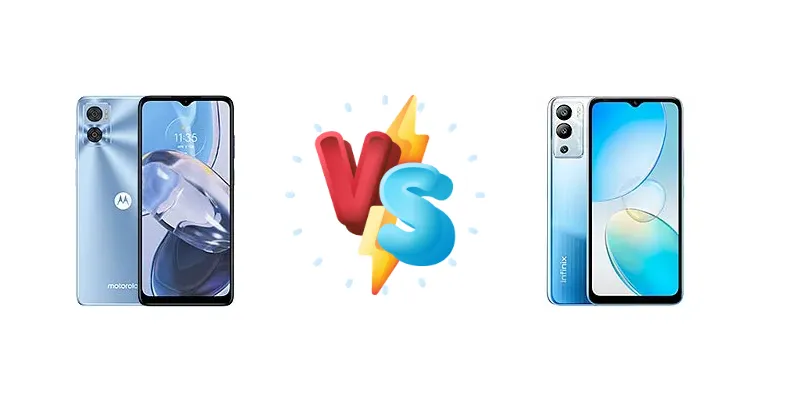
The Motorola Moto E22 and Infinix Hot 12i represent the ultra-budget end of the smartphone spectrum, targeting first-time buyers or those needing a reliable secondary device. Both aim to deliver essential functionality at a minimal cost, but significant differences in their core hardware – specifically the chipset – dictate their real-world performance and suitability for different users.
🏆 Quick Verdict
For the average user, the Motorola Moto E22 is the better choice. While both phones offer 10W charging and similar basic features, the Moto E22’s Mediatek Helio G37 chipset provides a substantial performance advantage over the Infinix Hot 12i’s Helio A22, making it more capable for everyday tasks and light multitasking.
| Network |
|---|
| 2G bands | GSM 850 / 900 / 1800 / 1900 | GSM 850 / 900 / 1800 / 1900 |
| 3G bands | HSDPA 850 / 900 / 2100 | HSDPA 850 / 900 / 2100 |
| 4G bands | 1, 3, 5, 7, 8, 20, 38, 40, 41 | 1, 3, 5, 8, 38, 40, 41 |
| Speed | HSPA 42.2/5.76 Mbps, LTE Cat4 150/50 Mbps | HSPA, LTE |
| Technology | GSM / HSPA / LTE | GSM / HSPA / LTE |
| | - | 1, 2, 3, 4, 5, 7, 8, 20, 28, 38, 40, 41 |
| Launch |
|---|
| Announced | 2022, September 16 | 2022, April 12 |
| Status | Available. Released 2022, October 11 | Available. Released 2022, April 12 |
| Body |
|---|
| Build | Glass front, plastic frame, plastic back | Glass front, plastic back, plastic frame |
| Dimensions | 163.6 x 74.7 x 8 mm (6.44 x 2.94 x 0.31 in) | 164.8 x 76.4 x 8.8 mm (6.49 x 3.01 x 0.35 in) |
| SIM | Nano-SIM + Nano-SIM | Nano-SIM + Nano-SIM |
| Weight | 169 g (5.96 oz) | 190 g (6.70 oz) |
| | Water-repellent coating | - |
| Display |
|---|
| Resolution | 720 x 1600 pixels, 20:9 ratio (~270 ppi density) | 720 x 1612 pixels, 20:9 ratio (~267 ppi density) |
| Size | 6.5 inches, 102.0 cm2 (~83.5% screen-to-body ratio) | 6.6 inches, 104.6 cm2 (~83.1% screen-to-body ratio) |
| Type | IPS LCD, 90Hz | IPS LCD, 480 nits |
| Platform |
|---|
| CPU | Octa-core (4x2.3 GHz Cortex-A53 & 4x1.8 GHz Cortex-A53) | Quad-core 2.0 GHz Cortex-A53 |
| Chipset | Mediatek MT6765V/CB Helio G37 (12 nm) | Mediatek MT6761 Helio A22 (12 nm) |
| GPU | PowerVR GE8320 | PowerVR GE8320 |
| OS | Android 12 | Android 11, XOS 7.6 |
| Memory |
|---|
| Card slot | microSDXC (dedicated slot) | microSDXC (dedicated slot) |
| Internal | 32GB 2GB RAM, 32GB 3GB RAM, 64GB 4GB RAM, 128GB 4GB RAM | 64GB 2GB RAM, 64GB 3GB RAM, 64GB 4GB RAM |
| | eMMC 5.1 | eMMC 5.1 |
| Main Camera |
|---|
| Dual | 16 MP, f/2.2, (wide), 1.0µm, PDAF
Auxiliary lens | - |
| Features | LED flash, HDR, panorama | Dual-LED flash |
| Single | - | 8 MP |
| Triple | - | 13 MP, f/1.8, (wide), AF
Auxiliary lenses |
| Video | 1080p@30fps | 1080p@30fps |
| Selfie camera |
|---|
| Features | HDR | LED flash |
| Single | 5 MP, f/2.4, 1/5.0", 1.12µm | 8 MP |
| Video | 1080p@30fps | 1080p@30fps |
| Sound |
|---|
| 3.5mm jack | Yes | Yes |
| 35mm jack | Yes | Yes |
| Loudspeaker | Yes, with stereo speakers | Yes |
| Comms |
|---|
| Bluetooth | 5.0, A2DP, LE | Yes |
| NFC | Yes (32GB 3GB RAM model only) | No |
| Positioning | GPS, GLONASS, GALILEO | GPS |
| Radio | FM radio | FM radio |
| USB | USB Type-C 2.0 | microUSB 2.0 |
| WLAN | Wi-Fi 802.11 a/b/g/n/ac, dual-band | Wi-Fi 802.11 a/b/g/n/ac, dual-band |
| Features |
|---|
| Sensors | Fingerprint (side-mounted), accelerometer, proximity | Fingerprint (rear-mounted), accelerometer, proximity |
| Battery |
|---|
| Charging | 10W wired | 10W wired |
| Type | Li-Po 4020 mAh | Li-Ion 5000 mAh |
| Misc |
|---|
| Colors | Astro Black, Crystal Blue | Racing Black, Horizon Blue, Haze Green, Champagne Gold |
| Models | - | X665B, X665 |
| Price | About 100 EUR | About 140 EUR |
Motorola Moto E22
- Significantly faster processor (Helio G37)
- More responsive user experience
- Better multitasking capabilities
- 10W charging is slow
- Camera performance likely limited
Infinix Hot 12i
- Extremely affordable
- Potentially longer battery life due to efficient processor
- Simple and easy to use
- Very slow processor (Helio A22)
- Struggles with multitasking and demanding apps
- Poor overall performance
Display Comparison
Neither device boasts a standout display. Both likely utilize LCD panels, typical for this price bracket. The focus here isn't on visual fidelity, but on basic usability. Without specific resolution or brightness data, it's safe to assume both offer adequate, but not impressive, viewing experiences. Bezels are likely to be substantial on both, maximizing screen real estate within a compact form factor.
Camera Comparison
Camera performance on both devices will be limited. Without sensor size or aperture information, it’s reasonable to expect basic image quality suitable for casual snapshots in good lighting conditions. The inclusion of a 2MP macro camera on either device is largely a marketing tactic, as the image quality will be significantly lower than the main sensor. Image processing will likely be minimal, resulting in images that lack detail and dynamic range. The G37's slightly better ISP *may* offer a marginal improvement in image processing, but don't expect miracles.
Performance
The core difference lies in the chipsets. The Motorola Moto E22’s Mediatek Helio G37, with its octa-core configuration (4x2.3 GHz Cortex-A53 & 4x1.8 GHz Cortex-A53), significantly outperforms the Infinix Hot 12i’s quad-core 2.0 GHz Cortex-A53 Helio A22. The G37’s higher clock speeds and additional cores translate to faster app loading times, smoother multitasking, and a more responsive user interface. The A22, while efficient, is demonstrably slower and will struggle with even moderately demanding applications. This difference is particularly noticeable when switching between apps or browsing web pages with multiple tabs open.
Battery Life
Both phones feature 10W wired charging, indicating similar charging speeds – expect around 2-3 hours for a full charge. Battery capacity is not specified, but given the target market and hardware, both likely house batteries in the 4000-5000 mAh range. The Helio G37’s slightly higher power consumption will be offset by its ability to complete tasks faster, potentially leading to similar real-world battery life despite being more powerful. The A22 will sip power, but the user experience will be so sluggish that they'll likely spend more time waiting for things to load, negating any potential battery savings.
Buying Guide
Buy the Motorola Moto E22 if you prioritize responsiveness and the ability to run more demanding apps, even if only occasionally. It’s a better fit for users who want a phone that feels relatively smooth for basic social media, messaging, and web browsing. Buy the Infinix Hot 12i if your needs are extremely basic – primarily calls, texts, and very light app usage – and you’re looking for the absolute lowest possible price point. It will struggle with anything beyond the most fundamental tasks.
Frequently Asked Questions
❓ Will the Infinix Hot 12i struggle with popular apps like WhatsApp and Facebook?
While the Infinix Hot 12i *can* run WhatsApp and Facebook, expect noticeable lag and slow loading times, especially with multiple chats or media-heavy content. The Helio A22 chipset is simply not powerful enough for a smooth experience with these apps, particularly when multitasking.
❓ Is the Motorola Moto E22 a good choice for playing mobile games?
The Motorola Moto E22 is not a gaming phone. While it can handle very basic 2D games, more demanding titles like PUBG Mobile or Call of Duty will likely be unplayable or require extremely low graphics settings and frame rates. The Helio G37 is an entry-level gaming chip, not a dedicated gaming processor.
❓ How long will it take to fully charge either phone from 0%?
With both phones utilizing 10W charging, expect a full charge to take approximately 2.5 to 3.5 hours. This is a relatively slow charging speed compared to modern smartphones, but it's typical for devices in this price range.
❓ Does either phone support expandable storage via microSD card?
While not explicitly stated in the provided specs, both the Motorola Moto E22 and Infinix Hot 12i are highly likely to support microSD card expansion, given their target market and price point. This is a common feature for budget smartphones to compensate for limited internal storage.