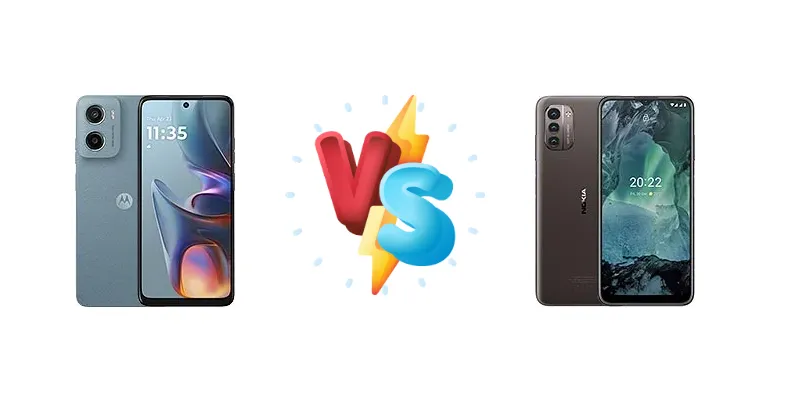
The Motorola Moto E15 and Nokia G21 represent compelling options in the ultra-budget smartphone space, but cater to different priorities. The Moto E15 emphasizes raw processing power with its Helio G81 Extreme chipset, while the Nokia G21 focuses on longevity, boasting a significantly higher endurance rating and PD3.0 charging. This comparison dissects their strengths and weaknesses to determine which device delivers the best value.
🏆 Quick Verdict
For users prioritizing sustained performance and occasional gaming, the Motorola Moto E15 is the better choice thanks to its more powerful Helio G81 Extreme chipset. However, if maximizing battery life and having a reliably bright display are paramount, the Nokia G21 emerges as the winner.
| Network |
|---|
| 2G bands | GSM 850 / 900 / 1800 / 1900 | GSM 850 / 900 / 1800 / 1900 |
| 3G bands | HSDPA 850 / 900 / 2100 | HSDPA 850 / 900 / 2100 - International |
| 4G bands | 1, 3, 5, 7, 8, 20, 28, 38, 40, 41 | 1, 3, 5, 7, 8, 20, 28, 38, 40, 41 - International |
| Speed | HSPA, LTE | HSPA 42.2/5.76 Mbps, LTE Cat4 150/50 Mbps |
| Technology | GSM / HSPA / LTE | GSM / HSPA / LTE |
| | - | 1, 2, 3, 4, 5, 7, 8, 12, 17, 28, 40, 66 - LATAM |
| Launch |
|---|
| Announced | 2024, December 17 | 2022, February 14 |
| Status | Available. Released 2025, January 22 | Available. Released 2022, February 15 |
| Body |
|---|
| Build | Glass front (Gorilla Glass 3), plastic frame, silicone polymer back (eco leather) | Glass front, plastic frame, plastic back |
| Dimensions | 165.7 x 76 x 8.2 mm (6.52 x 2.99 x 0.32 in) | 164.6 x 75.9 x 8.5 mm (6.48 x 2.99 x 0.33 in) |
| SIM | Nano-SIM + Nano-SIM | · Nano-SIM· Nano-SIM + Nano-SIM |
| Weight | 188.8 g (6.67 oz) | 190 g (6.70 oz) |
| Display |
|---|
| Protection | Corning Gorilla Glass 3, Mohs level 6 | - |
| Resolution | 720 x 1604 pixels, 20:9 ratio (~264 ppi density) | 720 x 1600 pixels, 20:9 ratio (~270 ppi density) |
| Size | 6.67 inches, 107.2 cm2 (~85.2% screen-to-body ratio) | 6.5 inches, 102.0 cm2 (~81.6% screen-to-body ratio) |
| Type | IPS LCD, 90Hz | IPS LCD, 90Hz, 400 nits (typ) |
| Platform |
|---|
| CPU | Octa-core (2x2.0 GHz Cortex-A75 & 6x1.7 GHz Cortex-A55) | Octa-core (2x1.6 GHz Cortex-A75 & 6x1.6 GHz Cortex-A55) |
| Chipset | Mediatek Helio G81 Extreme (12 nm) | Unisoc T606 (12 nm) |
| GPU | Mali-G52 MC2 | Mali-G57 MP1 |
| OS | Android 14 (Go edition) | Android 11, upgradable to Android 13 |
| Memory |
|---|
| Card slot | microSDXC | microSDXC (dedicated slot) |
| Internal | 64GB 2GB RAM | 64GB 3GB RAM, 64GB 4GB RAM, 128GB 4GB RAM, 128GB 6GB RAM |
| | - | eMMC 5.1 |
| Main Camera |
|---|
| Features | LED flash, HDR | LED flash, HDR, panorama |
| Single | 32 MP, f/2.2, (wide), 0.64µm, PDAF | 8 MP, f/2.0, (wide) |
| Triple | - | 50 MP, f/1.8, 28mm (wide), 1/2.76", 0.64µm, PDAF
2 MP (macro)
Auxiliary lens |
| Video | 1080p@30fps | 1080p@30fps |
| Selfie camera |
|---|
| Single | 8 MP, f/2.1, (wide), 1.12µm | 8 MP, f/2.0, (wide) |
| Video | 1080p@30fps | 1080p@30fps |
| Sound |
|---|
| 3.5mm jack | - | Yes |
| 35mm jack | Yes | Yes |
| Loudspeaker | Yes, with stereo speakers | Yes |
| Comms |
|---|
| Bluetooth | 5.0, A2DP, LE | 5.0, A2DP, LE |
| NFC | No | Yes (market/region dependent) |
| Positioning | GPS, GALILEO, GLONASS | GPS, GLONASS, GALILEO |
| Radio | FM radio (no radio in FR, IT) | FM radio, RDS |
| USB | USB Type-C 2.0 | USB Type-C 2.0, OTG |
| WLAN | Wi-Fi 802.11 a/b/g/n/ac, dual-band | Wi-Fi 802.11 a/b/g/n/ac, dual-band, Wi-Fi Direct |
| Features |
|---|
| Sensors | Fingerprint (side-mounted), accelerometer, proximity | Fingerprint (side-mounted), accelerometer, proximity |
| Battery |
|---|
| Charging | 18W wired | 18W wired, PD3.0 |
| Type | 5200 mAh | Li-Po 5050 mAh |
| Misc |
|---|
| Colors | Fresh Lavender, Misty Blue, Denim Blue | Nordic Blue, Dusk |
| Models | XT2523-6, XT2523-8 | TA-1418, TA-1477, TA-1415, TA-1405, TA-1404, TA-1412 |
| Price | $ 85.00 / C$ 100.00 / £ 60.99 / € 75.99 | About 90 EUR |
| SAR | - | 1.00 W/kg (head) 1.10 W/kg (body) |
| SAR EU | - | 0.34 W/kg (head) 1.05 W/kg (body) |
| Tests |
|---|
| Battery life | - |
Endurance rating 126h
|
| Camera | - |
Photo / Video |
| Display | - |
Contrast ratio: 1631:1 (nominal) |
| Loudspeaker | - |
-30.7 LUFS (Below average)
|
| Performance | - |
AnTuTu: 171299 (v9)
GeekBench: 1193 (v5.1)
GFXBench: 8.9fps (ES 3.1 onscreen) |
| EU LABEL |
|---|
| Battery | 68:26h endurance, 1000 cycles | - |
| Energy | Class A | - |
| Free fall | Class B (180 falls) | - |
| Repairability | Class B | - |
Motorola Moto E15
- More powerful processor for smoother performance
- Potentially longer battery lifespan (1000 cycles)
- Better suited for gaming and demanding apps
- Significantly shorter battery endurance
- Lack of PD3.0 charging support
Nokia G21
- Exceptional battery life (126h endurance)
- Brighter display for outdoor visibility
- PD3.0 charging support for faster charging
- Less powerful processor for demanding tasks
- Potentially slower app loading times
Display Comparison
The Nokia G21 features a display with a measured peak brightness of 500 nits and a 1631:1 contrast ratio, offering good visibility in most conditions. While the Moto E15’s display specifications are not provided, the Nokia’s brightness is a clear advantage for outdoor use. Both share the same nominal contrast ratio, suggesting similar panel technology in terms of color reproduction. The lack of refresh rate information for either device suggests both operate at the standard 60Hz.
Camera Comparison
Both the Moto E15 and Nokia G21 are listed as having 'Photo / Video' capabilities, but lack specific details regarding sensor size, aperture, or image stabilization. This suggests both phones employ entry-level camera systems. Without further information, it’s difficult to assess image quality, but the absence of details hints at a focus on affordability over photographic excellence. It's likely both phones will perform adequately in well-lit conditions but struggle in low light.
Performance
The Motorola Moto E15’s Mediatek Helio G81 Extreme (12nm) chipset, with its octa-core configuration (2x2.0 GHz Cortex-A75 & 6x1.7 GHz Cortex-A55), offers a performance advantage over the Nokia G21’s Unisoc T606 (12nm). The G81’s Cortex-A75 cores operate at a higher clock speed (2.0 GHz vs 1.6 GHz), translating to faster app loading and smoother multitasking. While both chipsets utilize a similar 12nm process, the G81’s architecture is geared towards more demanding tasks. The Nokia’s Unisoc T606 is sufficient for basic tasks but will struggle with graphically intensive games.
Battery Life
The Nokia G21’s endurance rating of 126 hours significantly surpasses the Motorola Moto E15’s 68:26h endurance. This difference is substantial, indicating the Nokia G21 can last nearly twice as long on a single charge. While both support 18W wired charging, the Nokia G21 adds PD3.0 support, potentially enabling faster charging speeds with compatible chargers. The Moto E15 boasts 1000 charge cycles, suggesting a longer lifespan for the battery itself, but this is offset by the significantly shorter overall endurance.
Buying Guide
Buy the Motorola Moto E15 if you need a phone capable of handling moderately demanding apps and light gaming without significant slowdowns. Its Helio G81 Extreme provides a noticeable performance edge. Buy the Nokia G21 if you prioritize all-day (and potentially multi-day) battery life and a display that remains visible outdoors, even if it means sacrificing some processing power. This phone is ideal for basic communication and media consumption.
Frequently Asked Questions
❓ Does the Unisoc T606 in the Nokia G21 struggle with multitasking?
The Unisoc T606 is a capable processor for basic tasks like calling, texting, and social media. However, it may exhibit slowdowns when running multiple apps simultaneously or handling resource-intensive applications. The Motorola Moto E15’s Helio G81 Extreme offers a more fluid multitasking experience.
❓ How does the 1000 charge cycle claim for the Moto E15 translate to real-world use?
The 1000 charge cycle claim suggests the Moto E15’s battery is designed to retain a significant portion of its capacity even after numerous charge-discharge cycles. This means the battery should degrade slower over time compared to phones with lower cycle counts. However, this benefit is somewhat diminished by the shorter initial battery endurance compared to the Nokia G21.
❓ Is PD3.0 charging on the Nokia G21 a significant advantage?
PD3.0 (Power Delivery 3.0) allows for potentially faster charging speeds when used with a compatible charger. While both phones support 18W charging, a PD3.0 charger can deliver more power efficiently, reducing the overall charging time. However, the actual charging speed will also depend on the charger and cable used.