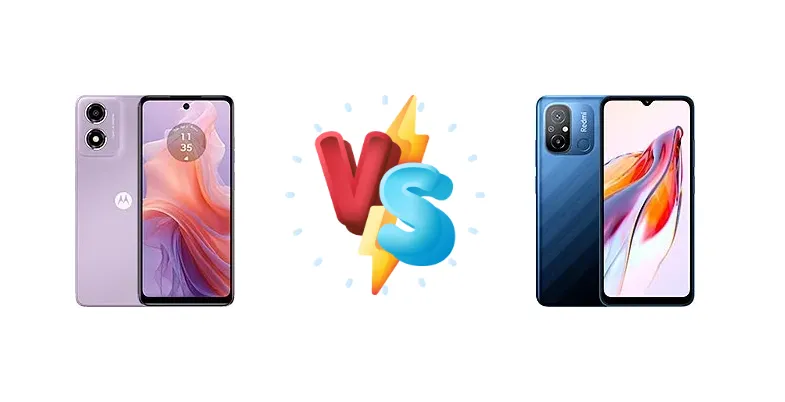
The Motorola Moto E14 and Xiaomi Redmi 12C represent the very bottom of the smartphone price spectrum, competing for the attention of first-time smartphone buyers and those seeking a reliable secondary device. Both aim to deliver essential functionality at an incredibly affordable price point, but they take different approaches to achieving this, primarily through their choice of chipset and charging implementation.
🏆 Quick Verdict
For most users, the Xiaomi Redmi 12C offers a slightly better overall experience. Its Helio G85 chipset, with higher clocked Cortex-A75 cores, provides a noticeable performance edge in everyday tasks and light gaming. While the Moto E14's Unisoc T606 is efficient, the Redmi 12C's extra processing power justifies the small price difference.
| Network |
|---|
| 2G bands | GSM 850 / 900 / 1800 / 1900 | GSM 850 / 900 / 1800 / 1900 |
| 3G bands | HSDPA 850 / 900 / 2100 | HSDPA 850 / 900 / 2100 |
| 4G bands | 1, 3, 5, 7, 8, 20, 28, 38, 40, 41 | 1, 3, 5, 7, 8, 20, 28, 38, 40, 41 - International |
| Speed | HSPA, LTE | HSPA, LTE |
| Technology | GSM / HSPA / LTE | GSM / CDMA / HSPA / EVDO / LTE |
| | - | CDMA2000 1xEV-DO |
| Launch |
|---|
| Announced | 2024, June | 2022, December 31 |
| Status | Available. Released 2024, June | Available. Released 2023, January 01 |
| Body |
|---|
| Build | Glass front (Gorilla Glass 3), plastic frame, plastic back | - |
| Dimensions | 163.5 x 74.5 x 8 mm (6.44 x 2.93 x 0.31 in) | 168.8 x 76.4 x 8.8 mm (6.65 x 3.01 x 0.35 in) |
| SIM | Nano-SIM + Nano-SIM | Nano-SIM + Nano-SIM |
| Weight | 178.8 g (6.31 oz) | 192 g (6.77 oz) |
| Display |
|---|
| Protection | Corning Gorilla Glass 3 | - |
| Resolution | 720 x 1612 pixels, 20:9 ratio (~269 ppi density) | 720 x 1650 pixels (~268 ppi density) |
| Size | 6.56 inches, 103.4 cm2 (~84.9% screen-to-body ratio) | 6.71 inches, 106.5 cm2 (~82.6% screen-to-body ratio) |
| Type | IPS LCD, 90Hz | IPS LCD, 500 nits (typ) |
| Platform |
|---|
| CPU | Octa-core (2x1.6 GHz Cortex-A75 & 6x1.6 GHz Cortex-A55) | Octa-core (2x2.0 GHz Cortex-A75 & 6x1.8 GHz Cortex-A55) |
| Chipset | Unisoc T606 (12 nm) | Mediatek MT6769Z Helio G85 (12 nm) |
| GPU | Mali-G57 MP1 | Mali-G52 MC2 |
| OS | Android 14 (Go edition) | Android 12, MIUI 13 |
| Memory |
|---|
| Card slot | microSDXC | microSDXC (dedicated slot) |
| Internal | 64GB 2GB RAM, 64GB 4GB RAM | 32GB 2GB RAM, 32GB 3GB RAM, 32GB 4GB RAM, 64GB 3GB RAM, 64GB 4GB RAM, 128GB 3GB RAM, 128GB 4GB RAM, 128GB 6GB RAM |
| | - | eMMC 5.1 |
| Main Camera |
|---|
| Dual | - | 50 MP, (wide), PDAF
0.08 MP (depth) |
| Features | LED flash, HDR | LED flash, HDR |
| Single | 13 MP, f/2.2, (wide), 1.12µm, PDAF | 50 MP, f/1.8, (wide), 1/2.76", PDAF
Auxiliary lens |
| Video | 1080p@30fps | 1080p@30fps |
| Selfie camera |
|---|
| Features | HDR | - |
| Single | 5 MP, f/2.2, (wide), 1/5.0", 1.12µm | 5 MP, f/2.2, (wide) |
| Video | 1080p@30fps | 1080p@30fps |
| Sound |
|---|
| 3.5mm jack | - | Yes |
| 35mm jack | Yes | Yes |
| Loudspeaker | Yes | Yes |
| Comms |
|---|
| Bluetooth | 5.0, A2DP, LE | 5.1, A2DP, LE |
| NFC | No | Yes (market/region dependent) |
| Positioning | GPS, GALILEO, GLONASS | GPS, GLONASS, BDS, GALILEO |
| Radio | Unspecified | FM radio |
| USB | USB Type-C 2.0 | microUSB 2.0 |
| WLAN | Wi-Fi 802.11 a/b/g/n/ac, dual-band | Wi-Fi 802.11 a/b/g/n/ac, dual-band, Wi-Fi Direct |
| Features |
|---|
| Sensors | Accelerometer, proximity | Fingerprint (rear-mounted), accelerometer |
| | - | Virtual proximity sensing |
| Battery |
|---|
| Charging | 15W wired | 10W wired |
| Type | 5000 mAh | Li-Po 5000 mAh |
| Misc |
|---|
| Colors | Pastel Green, Graphite Gray, Pastel Purple | Graphite Gray, Ocean Blue, Mint Green, Lavender Purple |
| Models | - | 22120RN86G, 22120RN86I, 22126RN91Y, 2212ARNC4L |
| Price | € 69.79 / £ 58.99 | £ 132.99 / € 107.41 |
| SAR | - | 1.08 W/kg (head) 0.64 W/kg (body) |
| SAR EU | - | 0.98 W/kg (head) 0.99 W/kg (body) |
Motorola Moto E14
- Faster 15W charging
- Potentially cleaner Android software
- Motorola's reputation for software updates (relative to Xiaomi in this segment)
- Less powerful Unisoc T606 chipset
- Likely slower app loading times
- Potentially less responsive user interface
Xiaomi Redmi 12C
- More powerful MediaTek Helio G85 chipset
- Higher clocked CPU cores for better performance
- More responsive user experience
- Slower 10W charging
- Xiaomi's MIUI software can be bloated
- Potentially less frequent software updates
Display Comparison
Neither device boasts a particularly impressive display. Both are likely utilizing LCD panels, a common cost-saving measure in this segment. Specifics like resolution and brightness are not provided, but we can assume they are similar – likely 720p+ and adequate for indoor use. The focus here isn't on visual fidelity, but on basic readability. Bezels are expected to be noticeable on both devices, contributing to a larger overall footprint for the screen size.
Camera Comparison
Camera performance is expected to be similar and unremarkable on both devices. Without sensor size or aperture information, it’s difficult to make definitive claims. However, given the price point, both will likely rely on a primary sensor paired with basic auxiliary lenses (often a 2MP macro or depth sensor). Image processing will be crucial, and Xiaomi’s software tends to favor more saturated colors, while Motorola aims for a more natural look. Users shouldn't expect exceptional low-light performance or detailed images from either phone.
Performance
The core difference lies in the chipsets. The Xiaomi Redmi 12C’s MediaTek Helio G85 (12nm) features two Cortex-A75 cores clocked at 2.0 GHz, paired with six Cortex-A55 cores at 1.8 GHz. This contrasts with the Motorola Moto E14’s Unisoc T606 (12nm), which has two Cortex-A75 cores at 1.6 GHz and six Cortex-A55 cores at 1.6 GHz. The higher clock speeds on the G85 translate to faster processing, particularly in single-core tasks. While both use the same 12nm process, the G85’s architecture provides a performance advantage. The Redmi 12C will likely exhibit smoother app launches and snappier responsiveness. RAM configurations are not specified, but the chipset difference will be the dominant factor.
Battery Life
Battery capacity is not specified for either device, but both likely house batteries in the 5000mAh range, typical for this price bracket. The key difference is charging speed: the Moto E14 supports 15W wired charging, while the Redmi 12C is limited to 10W. This means the Moto E14 will charge faster, potentially reducing the time spent tethered to an outlet. However, the slower charging speed of the Redmi 12C is less of a concern given the likely all-day battery life offered by the 5000mAh capacity.
Buying Guide
Buy the Motorola Moto E14 if you prioritize a clean Android experience and potentially longer software support from Motorola. It's a solid choice for users who primarily need a phone for calls, texts, and basic app usage. Buy the Xiaomi Redmi 12C if you value performance for the price, especially if you occasionally play mobile games or multitask between several apps. The Helio G85 provides a more responsive experience for demanding tasks.
Frequently Asked Questions
❓ Will the Redmi 12C struggle with popular apps like Facebook or WhatsApp?
The Helio G85 in the Redmi 12C is capable of running apps like Facebook and WhatsApp without significant issues. However, expect some loading times and occasional slowdowns when multitasking or using resource-intensive features within those apps. It's designed for basic social media usage, not heavy, continuous use.
❓ How long will it take to fully charge the Moto E14 with the 15W charger?
While a precise time isn't available, the Moto E14's 15W charging should take approximately 2.5 to 3.5 hours for a full charge from 0%, assuming a compatible charger is used. This is faster than the Redmi 12C's 10W charging, but still relatively slow compared to modern fast-charging standards.
❓ Can the Redmi 12C handle light gaming like Candy Crush or Subway Surfers?
Yes, the Redmi 12C's Helio G85 is capable of handling light games like Candy Crush or Subway Surfers. You won't be able to max out the graphics settings, but the experience should be playable and enjoyable. More demanding games will likely require reduced settings and may still exhibit frame rate drops.
❓ Does the Moto E14 receive regular Android security updates?
Motorola generally provides more consistent software updates than Xiaomi in the ultra-budget segment. While not guaranteed for multiple years, the Moto E14 is more likely to receive at least some security patches, improving the phone's security over time. However, don't expect major Android version upgrades.