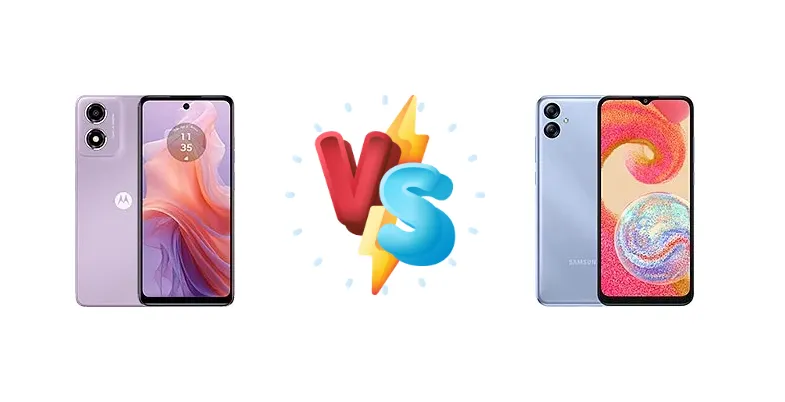
The Motorola Moto E14 and Samsung Galaxy A04e represent the absolute entry point into smartphone ownership. Both devices aim to deliver essential functionality at the lowest possible price, but they take different approaches to achieving this. This comparison dissects their core components to determine which offers the best value for users prioritizing performance, battery life, and overall usability.
🏆 Quick Verdict
For the average user, the Motorola Moto E14 emerges as the slightly better choice. Its Unisoc T606 chipset, featuring Cortex-A75 cores, provides a noticeable performance advantage over the Galaxy A04e’s older Helio P35, translating to smoother multitasking and app loading. While both offer basic functionality, the E14’s CPU architecture gives it an edge.
| Network |
|---|
| 2G bands | GSM 850 / 900 / 1800 / 1900 | GSM 850 / 900 / 1800 / 1900 |
| 3G bands | HSDPA 850 / 900 / 2100 | HSDPA 850 / 900 / 2100 |
| 4G bands | 1, 3, 5, 7, 8, 20, 28, 38, 40, 41 | 1, 3, 5, 7, 8, 20, 28, 38, 40, 41 |
| Speed | HSPA, LTE | HSPA, LTE |
| Technology | GSM / HSPA / LTE | GSM / HSPA / LTE |
| Launch |
|---|
| Announced | 2024, June | 2022, October 21 |
| Status | Available. Released 2024, June | Available. Released 2022, November 07 |
| Body |
|---|
| Build | Glass front (Gorilla Glass 3), plastic frame, plastic back | Glass front, plastic back, plastic frame |
| Dimensions | 163.5 x 74.5 x 8 mm (6.44 x 2.93 x 0.31 in) | 164.2 x 75.9 x 9.1 mm (6.46 x 2.99 x 0.36 in) |
| SIM | Nano-SIM + Nano-SIM | · Nano-SIM· Nano-SIM + Nano-SIM |
| Weight | 178.8 g (6.31 oz) | 188 g (6.63 oz) |
| Display |
|---|
| Protection | Corning Gorilla Glass 3 | - |
| Resolution | 720 x 1612 pixels, 20:9 ratio (~269 ppi density) | 720 x 1600 pixels, 20:9 ratio (~270 ppi density) |
| Size | 6.56 inches, 103.4 cm2 (~84.9% screen-to-body ratio) | 6.5 inches, 102.0 cm2 (~81.8% screen-to-body ratio) |
| Type | IPS LCD, 90Hz | PLS LCD |
| Platform |
|---|
| CPU | Octa-core (2x1.6 GHz Cortex-A75 & 6x1.6 GHz Cortex-A55) | Octa-core (4x2.3 GHz Cortex-A53 & 4x1.8 GHz Cortex-A53) |
| Chipset | Unisoc T606 (12 nm) | Mediatek MT6765 Helio P35 (12 nm) |
| GPU | Mali-G57 MP1 | PowerVR GE8320 |
| OS | Android 14 (Go edition) | Android 12, One UI Core 4.1 |
| Memory |
|---|
| Card slot | microSDXC | microSDXC (dedicated slot) |
| Internal | 64GB 2GB RAM, 64GB 4GB RAM | 32GB 2GB RAM, 32GB 3GB RAM, 32GB 4GB RAM, 64GB 2GB RAM, 64GB 3GB RAM, 64GB 4GB RAM, 128GB 4GB RAM |
| Main Camera |
|---|
| Dual | - | 13 MP, f/2.2, (wide), AF
Auxiliary lens |
| Features | LED flash, HDR | LED flash |
| Single | 13 MP, f/2.2, (wide), 1.12µm, PDAF | 5 MP, f/2.2 |
| Video | 1080p@30fps | 1080p@30fps |
| Selfie camera |
|---|
| Features | HDR | - |
| Single | 5 MP, f/2.2, (wide), 1/5.0", 1.12µm | 5 MP, f/2.2 |
| Video | 1080p@30fps | Yes |
| Sound |
|---|
| 3.5mm jack | - | Yes |
| 35mm jack | Yes | Yes |
| Loudspeaker | Yes | Yes |
| Comms |
|---|
| Bluetooth | 5.0, A2DP, LE | 5.0, A2DP, LE |
| NFC | No | No |
| Positioning | GPS, GALILEO, GLONASS | GPS, GLONASS, GALILEO, BDS |
| Radio | Unspecified | Unspecified |
| USB | USB Type-C 2.0 | USB Type-C 2.0, OTG |
| WLAN | Wi-Fi 802.11 a/b/g/n/ac, dual-band | Wi-Fi 802.11 b/g/n, Wi-Fi Direct |
| Features |
|---|
| Sensors | Accelerometer, proximity | Accelerometer, proximity |
| Battery |
|---|
| Charging | 15W wired | - |
| Type | 5000 mAh | Li-Po 5000 mAh |
| Misc |
|---|
| Colors | Pastel Green, Graphite Gray, Pastel Purple | Black, Copper, Light Blue |
| Models | - | SM-A042F, SM-A042F/DS, SM-A042M, SM-A042M/DS |
| Price | € 69.79 / £ 58.99 | ₹ 7,999 |
| SAR EU | - | 0.29 W/kg (head) 1.11 W/kg (body) |
Motorola Moto E14
- More powerful CPU architecture (Cortex-A75 cores)
- Potentially smoother multitasking experience
- 15W fast charging
- Brand recognition isn't as strong as Samsung
- Camera performance likely similar to A04e
Samsung Galaxy A04e
- Established brand reputation (Samsung)
- Potentially wider accessory availability
- Familiar One UI software (potentially)
- Older and less efficient CPU architecture (Cortex-A53 cores)
- Slower overall performance
- Charging speed likely similar or slower than E14
Display Comparison
Neither device boasts a standout display. Both are likely utilizing LCD panels, typical for this price bracket. Specifics like resolution and brightness are not provided, but we can assume they are similar – around 720p+ and modest brightness levels. The focus here isn’t on visual fidelity, but on basic readability. Bezels are likely to be substantial on both, maximizing screen real estate within a compact form factor. Color accuracy will be standard for budget displays, prioritizing power efficiency over color science.
Camera Comparison
Camera performance on both devices will be basic. Without specific sensor details, it’s safe to assume both feature a primary sensor paired with auxiliary lenses of limited utility. The A04e may have a slightly more aggressive image processing style, typical of Samsung’s software, but the underlying hardware limitations will be the primary constraint. Expect acceptable results in good lighting conditions, but significant noise and lack of detail in low light. The absence of Optical Image Stabilization (OIS) on either device further limits low-light capabilities.
Performance
The core difference lies in the chipsets. The Motorola Moto E14’s Unisoc T606 (12nm) utilizes a hybrid architecture with 2x 1.6 GHz Cortex-A75 cores and 6x 1.6 GHz Cortex-A55 cores. This is a significant advantage over the Samsung Galaxy A04e’s MediaTek Helio P35 (12nm), which features 4x 2.3 GHz Cortex-A53 cores and 4x 1.8 GHz Cortex-A53 cores. The Cortex-A75 cores in the E14 are substantially more powerful than the A53 cores in the A04e, resulting in faster app launches and smoother multitasking. While both are 12nm chips, the architectural improvements in the Unisoc T606 translate to a more responsive user experience. The A04e’s higher clock speed on the A53 cores doesn’t compensate for the architectural deficit.
Battery Life
Battery capacity isn’t specified, but both devices likely house batteries in the 4000-5000 mAh range. The Motorola Moto E14 supports 15W wired charging. The Galaxy A04e’s charging speed is unknown, but likely similar. Real-world battery life will depend heavily on usage patterns, but both should comfortably last a full day with moderate use. The 15W charging on the E14 will provide a reasonable, though not rapid, recharge time. The focus here is on longevity rather than quick top-ups.
Buying Guide
Buy the Motorola Moto E14 if you need a phone capable of handling everyday tasks with a bit more responsiveness, and if you occasionally play less demanding mobile games. The E14’s chipset offers a more modern architecture for improved performance. Buy the Samsung Galaxy A04e if you prioritize brand recognition and a potentially wider availability of accessories, and if your smartphone usage is limited to basic calling, texting, and light social media browsing. The A04e is a functional, if slower, option.
Frequently Asked Questions
❓ Will the Unisoc T606 in the Moto E14 struggle with demanding games like PUBG Mobile?
While the Unisoc T606 is a step up from the Helio P35, it's still an entry-level chipset. PUBG Mobile will likely be playable at lower graphics settings and frame rates. Expect some stuttering and frame drops during intense action. It's not designed for high-end gaming.
❓ Does the Samsung Galaxy A04e receive regular software updates and security patches?
Samsung generally provides better software support than Motorola, particularly for security updates. However, the A04e, being an entry-level device, may not receive updates as frequently or for as long as Samsung’s higher-end models. Expect a limited update lifecycle.
❓ Is the difference in performance between the Moto E14 and Galaxy A04e noticeable in everyday tasks like browsing and social media?
Yes, the difference is noticeable. The Moto E14’s Cortex-A75 cores will result in snappier app launches, smoother scrolling, and a more responsive overall experience when browsing the web or using social media apps. The A04e will feel comparatively sluggish.