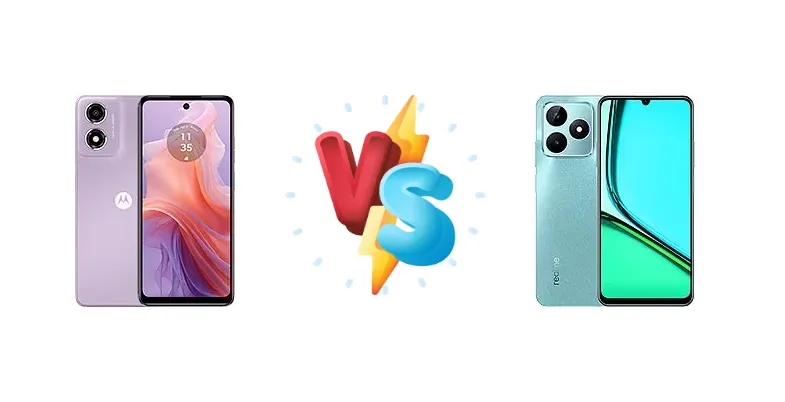
The Motorola Moto E14 and Realme C51s represent the current battleground for ultra-affordable smartphones. Both devices leverage Unisoc chipsets to deliver a functional Android experience, but diverge significantly in charging capabilities. This comparison dissects the nuances of each phone to determine which offers the best value for budget-conscious consumers.
🏆 Quick Verdict
For most users, the Realme C51s is the better choice. Its 33W charging, capable of reaching 50% in just 28 minutes, significantly improves usability compared to the Moto E14’s slower 15W charging. While the performance difference is incremental, the convenience of faster charging outweighs the minor CPU clock speed advantage of the Realme.
| Network |
|---|
| 2G bands | GSM 850 / 900 / 1800 / 1900 | GSM 850 / 900 / 1800 / 1900 |
| 3G bands | HSDPA 850 / 900 / 2100 | HSDPA 900 / 2100 |
| 4G bands | 1, 3, 5, 7, 8, 20, 28, 38, 40, 41 | 1, 3, 5, 8, 38, 40 |
| Speed | HSPA, LTE | HSPA, LTE |
| Technology | GSM / HSPA / LTE | GSM / HSPA / LTE |
| Launch |
|---|
| Announced | 2024, June | 2024, March 15 |
| Status | Available. Released 2024, June | Available. Released 2024, March 15 |
| Body |
|---|
| Build | Glass front (Gorilla Glass 3), plastic frame, plastic back | Glass front, plastic frame, plastic back |
| Dimensions | 163.5 x 74.5 x 8 mm (6.44 x 2.93 x 0.31 in) | 167.2 x 76.7 x 7.5 mm (6.58 x 3.02 x 0.30 in) |
| SIM | Nano-SIM + Nano-SIM | Nano-SIM + Nano-SIM |
| Weight | 178.8 g (6.31 oz) | 182 g (6.42 oz) |
| Display |
|---|
| Protection | Corning Gorilla Glass 3 | - |
| Resolution | 720 x 1612 pixels, 20:9 ratio (~269 ppi density) | 720 x 1600 pixels, 20:9 ratio (~260 ppi density) |
| Size | 6.56 inches, 103.4 cm2 (~84.9% screen-to-body ratio) | 6.74 inches, 109.7 cm2 (~85.5% screen-to-body ratio) |
| Type | IPS LCD, 90Hz | IPS LCD, 90Hz, 560 nits (peak) |
| Platform |
|---|
| CPU | Octa-core (2x1.6 GHz Cortex-A75 & 6x1.6 GHz Cortex-A55) | Octa-core (2x1.8 GHz Cortex-A75 & 6x1.8 GHz Cortex-A55) |
| Chipset | Unisoc T606 (12 nm) | Unisoc Tiger T612 (12 nm) |
| GPU | Mali-G57 MP1 | Mali-G57 |
| OS | Android 14 (Go edition) | Android 13, Realme UI |
| Memory |
|---|
| Card slot | microSDXC | microSDXC (dedicated slot) |
| Internal | 64GB 2GB RAM, 64GB 4GB RAM | 128GB 6GB RAM |
| Main Camera |
|---|
| Features | LED flash, HDR | LED flash, HDR, panorama |
| Single | 13 MP, f/2.2, (wide), 1.12µm, PDAF | 50 MP, f/1.8, 27mm (wide), 1/2.76", 0.64µm, PDAF
Auxiliary lens |
| Video | 1080p@30fps | 1080p@30fps |
| Selfie camera |
|---|
| Features | HDR | HDR |
| Single | 5 MP, f/2.2, (wide), 1/5.0", 1.12µm | 5 MP, f/2.2, 28mm (wide), 1/5.0", 1.12µm |
| Video | 1080p@30fps | 720p@30fps |
| Sound |
|---|
| 35mm jack | Yes | Yes |
| Loudspeaker | Yes | Yes |
| Comms |
|---|
| Bluetooth | 5.0, A2DP, LE | 5.0, A2DP, LE |
| NFC | No | Yes, 360˚ (market/region dependent) |
| Positioning | GPS, GALILEO, GLONASS | GPS, GLONASS, GALILEO |
| Radio | Unspecified | Unspecified |
| USB | USB Type-C 2.0 | USB Type-C |
| WLAN | Wi-Fi 802.11 a/b/g/n/ac, dual-band | Wi-Fi 802.11 a/b/g/n/ac, dual-band |
| Features |
|---|
| Sensors | Accelerometer, proximity | Fingerprint (side-mounted), accelerometer, gyro, proximity, compass |
| Battery |
|---|
| Charging | 15W wired | 33W wired, 0-50% in 28 min |
| Type | 5000 mAh | 5000 mAh |
| Misc |
|---|
| Colors | Pastel Green, Graphite Gray, Pastel Purple | Shiny Green, Mighty Black |
| Models | - | RMX3765 |
| Price | € 69.79 / £ 58.99 | About 100 EUR |
Motorola Moto E14
- Potentially cleaner software experience with Motorola’s near-stock Android.
- Stable performance due to conservative clock speeds.
- Reliable brand reputation for software updates (though limited).
- Significantly slower 15W charging.
- Less powerful CPU compared to the Realme C51s.
- Limited information on display quality.
Realme C51s
- 33W fast charging (0-50% in 28 minutes).
- Slightly more powerful Unisoc Tiger T612 chipset.
- Modern aesthetic design.
- Realme’s UI can be more resource-intensive than Motorola’s.
- Potential for more thermal throttling under heavy load.
- Camera performance likely similar to Moto E14.
Display Comparison
Neither Motorola nor Realme provide display specifications beyond resolution in their marketing materials. Given the price point, both likely utilize LCD panels. The absence of details like peak brightness or color gamut coverage suggests a focus on cost reduction. Bezels are expected to be noticeable on both devices, impacting the overall immersive experience. Color accuracy will likely be standard for this segment, prioritizing power efficiency over fidelity.
Camera Comparison
Camera details are sparse for both devices. Expect a primary camera on each, likely around 13MP, but image quality will heavily rely on software processing. The inclusion of a 2MP macro camera on both is largely a marketing tactic, offering limited practical benefit due to the low resolution and fixed focus. Without OIS (Optical Image Stabilization), low-light performance will be challenging on both phones. The Realme C51s may have a slight edge due to potentially more advanced image processing algorithms, but significant differences are unlikely.
Performance
The Realme C51s boasts the Unisoc Tiger T612, clocked at 1.8 GHz for both Cortex-A75 and A55 cores, while the Moto E14 uses the Unisoc T606 with a slightly lower 1.6 GHz clock speed on both core types. This 200 MHz difference, while measurable in benchmarks, translates to a subtle real-world performance gain for the C51s in tasks like app loading and multitasking. Both chipsets are built on a 12nm process, indicating similar thermal characteristics. However, the C51s’ slightly more powerful CPU may require more aggressive thermal throttling under sustained load. RAM configurations are not specified, but both will likely offer options around 4GB, sufficient for basic Android usage.
Battery Life
Battery capacity is not specified for either device, but both likely house batteries in the 5000mAh range, typical for this price bracket. The key differentiator is charging speed. The Realme C51s’ 33W wired charging, capable of reaching 50% charge in 28 minutes, is a significant advantage over the Moto E14’s 15W charging. This faster charging dramatically reduces downtime, making the C51s more convenient for users who need to quickly top up their battery throughout the day. While a larger battery capacity would be ideal, the faster charging of the C51s effectively mitigates the impact of a potentially smaller battery.
Buying Guide
Buy the Motorola Moto E14 if you prioritize a consistently stable, if slightly slower, experience and prefer Motorola’s near-stock Android interface. It’s ideal for users who rarely push their phones and value simplicity. Buy the Realme C51s if you frequently find yourself needing to top up your battery quickly and appreciate a more modern aesthetic. This phone is better suited for users who are on the go and need a fast-charging solution.
Frequently Asked Questions
❓ Will the Unisoc Tiger T612 in the Realme C51s handle demanding games like PUBG Mobile?
The Unisoc Tiger T612 can run PUBG Mobile, but expect to play at lower graphics settings (Balanced or Low) to maintain a stable frame rate. The chipset isn't designed for high-end gaming, and sustained gameplay may lead to some thermal throttling. The Moto E14 will offer a similar gaming experience, potentially with slightly lower peak frame rates.
❓ How does Realme’s UI compare to Motorola’s near-stock Android on the Moto E14 in terms of bloatware?
Realme UI typically includes more pre-installed apps (bloatware) than Motorola’s near-stock Android experience. While most of these apps can be uninstalled, they do consume storage space and system resources. Motorola’s cleaner interface offers a more streamlined experience out of the box, appealing to users who prefer minimal customization.
❓ Is the 2MP macro camera on either phone worth using?
The 2MP macro cameras on both the Moto E14 and Realme C51s offer limited practical value. The low resolution and fixed focus result in images that lack detail and sharpness. They are primarily included for marketing purposes and are unlikely to produce satisfying results in most scenarios.
❓ What type of charging cable and adapter does each phone include in the box?
Both phones include a USB-C charging cable in the box. However, the included adapter wattage differs. The Moto E14 comes with a 5W adapter, reflecting its 15W charging capability. The Realme C51s includes a 33W adapter, essential for utilizing its fast charging feature. Using a slower charger with the C51s will significantly increase charging times.