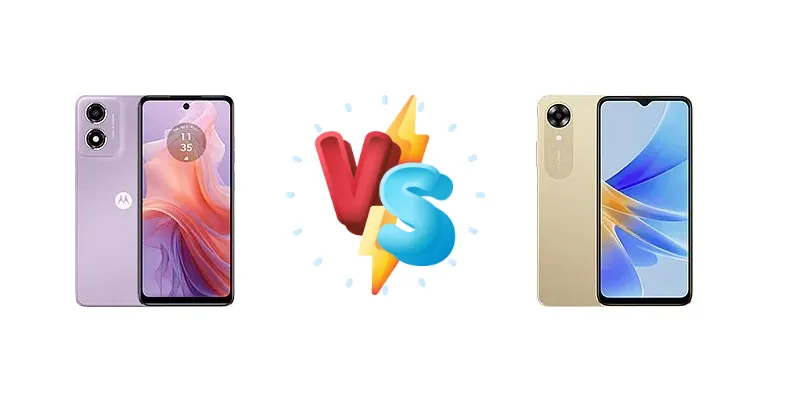
The Motorola Moto E14 and Oppo A17k represent the very bottom end of the smartphone market, targeting first-time buyers or those needing a reliable secondary device. Both aim to deliver essential functionality at an incredibly low price point, but they achieve this with different hardware choices. This comparison dissects those choices, focusing on how the Unisoc T606 in the Moto E14 stacks up against the MediaTek Helio G35 powering the Oppo A17k.
🏆 Quick Verdict
For the average user prioritizing consistent performance in everyday tasks, the Motorola Moto E14 emerges as the better choice. Its Unisoc T606 chipset, featuring Cortex-A75 cores, offers a noticeable advantage in responsiveness compared to the Oppo A17k’s older Cortex-A53 based Helio G35, despite the Oppo’s slightly higher clock speeds.
| Network |
|---|
| 2G bands | GSM 850 / 900 / 1800 / 1900 | GSM 850 / 900 / 1800 / 1900 |
| 3G bands | HSDPA 850 / 900 / 2100 | HSDPA 850 / 900 / 2100 |
| 4G bands | 1, 3, 5, 7, 8, 20, 28, 38, 40, 41 | 1, 3, 5, 8, 38, 40, 41 |
| Speed | HSPA, LTE | HSPA, LTE |
| Technology | GSM / HSPA / LTE | GSM / HSPA / LTE |
| Launch |
|---|
| Announced | 2024, June | 2022, October 13 |
| Status | Available. Released 2024, June | Available. Released 2022, October 18 |
| Body |
|---|
| Build | Glass front (Gorilla Glass 3), plastic frame, plastic back | - |
| Dimensions | 163.5 x 74.5 x 8 mm (6.44 x 2.93 x 0.31 in) | 164.2 x 75.6 x 8.3 mm (6.46 x 2.98 x 0.33 in) |
| SIM | Nano-SIM + Nano-SIM | Nano-SIM + Nano-SIM |
| Weight | 178.8 g (6.31 oz) | 189 g (6.67 oz) |
| | - | IPX4 water resistance |
| Display |
|---|
| Protection | Corning Gorilla Glass 3 | Panda Glass |
| Resolution | 720 x 1612 pixels, 20:9 ratio (~269 ppi density) | 720 x 1612 pixels, 20:9 ratio (~269 ppi density) |
| Size | 6.56 inches, 103.4 cm2 (~84.9% screen-to-body ratio) | 6.56 inches, 103.4 cm2 (~83.3% screen-to-body ratio) |
| Type | IPS LCD, 90Hz | IPS LCD, 480 nits (typ), 600 nits (HBM) |
| Platform |
|---|
| CPU | Octa-core (2x1.6 GHz Cortex-A75 & 6x1.6 GHz Cortex-A55) | Octa-core (4x2.3 GHz Cortex-A53 & 4x1.8 GHz Cortex-A53) |
| Chipset | Unisoc T606 (12 nm) | Mediatek MT6765 Helio G35 (12 nm) |
| GPU | Mali-G57 MP1 | PowerVR GE8320 |
| OS | Android 14 (Go edition) | Android 12, ColorOS 12.1 |
| Memory |
|---|
| Card slot | microSDXC | microSDXC |
| Internal | 64GB 2GB RAM, 64GB 4GB RAM | 64GB 3GB RAM |
| | - | eMMC 5.1 |
| Main Camera |
|---|
| Features | LED flash, HDR | LED flash, panorama |
| Single | 13 MP, f/2.2, (wide), 1.12µm, PDAF | 8 MP, f/2.0, (wide), AF |
| Video | 1080p@30fps | 1080p@30fps |
| Selfie camera |
|---|
| Features | HDR | - |
| Single | 5 MP, f/2.2, (wide), 1/5.0", 1.12µm | 5 MP, f/2.2, (wide) |
| Video | 1080p@30fps | 1080p@30fps |
| Sound |
|---|
| 3.5mm jack | - | Yes |
| 35mm jack | Yes | Yes |
| Loudspeaker | Yes | Yes |
| Comms |
|---|
| Bluetooth | 5.0, A2DP, LE | 5.3, A2DP, LE, aptX HD |
| NFC | No | No |
| Positioning | GPS, GALILEO, GLONASS | GPS, GLONASS, BDS, GALILEO |
| Radio | Unspecified | Unspecified |
| USB | USB Type-C 2.0 | microUSB 2.0, OTG |
| WLAN | Wi-Fi 802.11 a/b/g/n/ac, dual-band | Wi-Fi 802.11 a/b/g/n/ac, dual-band |
| Features |
|---|
| Sensors | Accelerometer, proximity | Fingerprint (side-mounted), accelerometer, proximity, compass |
| Battery |
|---|
| Charging | 15W wired | - |
| Type | 5000 mAh | Li-Po 5000 mAh |
| Misc |
|---|
| Colors | Pastel Green, Graphite Gray, Pastel Purple | Navy Blue, Gold |
| Models | - | CPH2471 |
| Price | € 69.79 / £ 58.99 | About 130 EUR |
Motorola Moto E14
- More responsive performance due to Cortex-A75 cores
- Potentially better software optimization from Motorola
- More modern chipset architecture
- 15W charging is slow
- Camera performance likely limited
Oppo A17k
- Potentially slightly longer battery life
- Lower price point (potentially)
- Simple and straightforward user experience
- Sluggish performance with Cortex-A53 cores
- Older chipset architecture
- Limited multitasking capabilities
Display Comparison
Neither device boasts a standout display. Both are likely utilizing LCD panels, typical for this price bracket. The focus here isn't on visual fidelity, but on basic usability. Without specific display specs, it's reasonable to assume both offer similar resolutions (likely 720p+) and brightness levels. The real difference will be in color calibration and viewing angles, areas where Motorola often provides a slightly more refined experience, though neither will approach the quality of IPS panels found in higher-end devices.
Camera Comparison
Both phones are expected to feature basic camera setups. Without detailed sensor information, it’s safe to assume both rely on a primary sensor paired with a depth or macro lens of minimal utility. The image processing capabilities will be limited on both devices. The Moto E14 might benefit from Motorola’s software optimizations, potentially delivering slightly more pleasing images in good lighting conditions. However, low-light performance will be poor on both, and the 2MP auxiliary cameras are unlikely to produce usable results.
Performance
The core difference lies in the chipsets. The Motorola Moto E14’s Unisoc T606 utilizes a hybrid core configuration: two Cortex-A75 cores clocked at 1.6 GHz, and six Cortex-A55 cores, also at 1.6 GHz. This is a significant advantage over the Oppo A17k’s MediaTek Helio G35, which employs eight Cortex-A53 cores clocked at 2.3 GHz and 1.8 GHz. While the Helio G35 has a higher peak clock speed, the Cortex-A75 cores in the T606 offer substantially better single-core performance, translating to faster app launch times and smoother scrolling. The T606’s architecture is more modern, leading to better efficiency and responsiveness. The Oppo A17k will likely struggle with even moderate multitasking.
Battery Life
The Oppo A17k’s Helio G35 chipset, being less power-hungry, *could* translate to slightly longer battery life in real-world usage. However, the difference will likely be marginal. Both phones feature 15W wired charging, meaning a full charge will take a considerable amount of time – likely over two hours. Battery life will heavily depend on usage patterns, but both should comfortably last a full day with light use, such as calls, texts, and occasional browsing.
Buying Guide
Buy the Motorola Moto E14 if you need a phone that feels reasonably snappy for basic tasks like browsing, messaging, and social media. The inclusion of Cortex-A75 cores provides a smoother experience. Buy the Oppo A17k if you prioritize a potentially slightly longer battery life due to the less powerful chipset, and are willing to accept a more sluggish user experience, particularly when multitasking or opening apps. It's a better fit for extremely light users.
Frequently Asked Questions
❓ Will the Moto E14 struggle with popular apps like WhatsApp and Facebook?
While the Moto E14 won't offer a flagship-level experience, the Unisoc T606 chipset is capable of running apps like WhatsApp and Facebook smoothly. The Cortex-A75 cores provide a performance boost that the Oppo A17k’s Helio G35 lacks, resulting in faster loading times and less lag.
❓ Is the Oppo A17k a good choice for someone who primarily makes calls and sends texts?
Yes, the Oppo A17k is a suitable option for basic communication. Its Helio G35 chipset is sufficient for handling calls and texts without significant issues. However, be prepared for a slower response when opening apps or switching between them.
❓ Can either of these phones handle light gaming?
Light gaming, such as simple puzzle games or older titles, is possible on both devices. However, demanding games will likely be unplayable or experience significant frame rate drops. The Moto E14 has a slight advantage due to its more powerful chipset, but don't expect a great gaming experience on either phone.
❓ What version of Android do these phones run?
Both devices likely ship with Android Go Edition, a lightweight version of Android designed for low-end hardware. This helps to optimize performance and reduce storage usage, but it also means some features found in the full Android experience may be missing.