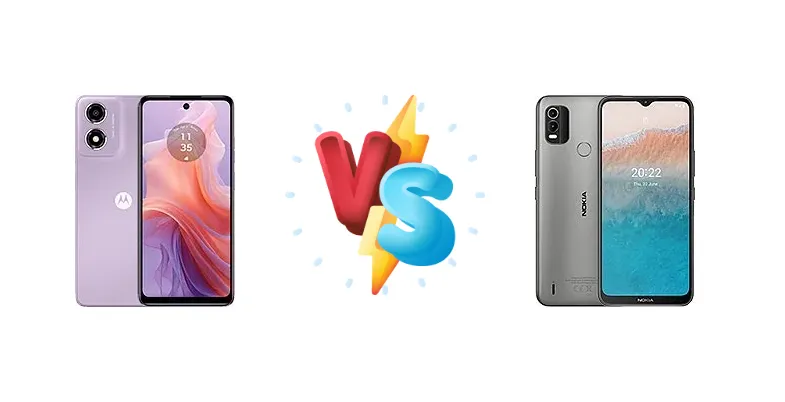
The Motorola Moto E14 and Nokia C21 Plus represent the very bottom rung of the smartphone market, targeting users prioritizing affordability above all else. However, even at this price point, significant differences exist. This comparison focuses on the core hardware – specifically the chipsets – to determine which device offers the better user experience for everyday tasks.
🏆 Quick Verdict
For most users, the Motorola Moto E14 is the superior choice. Its Unisoc T606 chipset, built on a more modern 12nm process, delivers noticeably better performance than the Nokia C21 Plus’s older 28nm Unisoc SC9863A. While both phones are entry-level, the E14 offers a smoother experience for basic apps and multitasking.
| Network |
|---|
| 2G bands | GSM 850 / 900 / 1800 / 1900 | GSM 850 / 900 / 1800 / 1900 |
| 3G bands | HSDPA 850 / 900 / 2100 | HSDPA 850 / 900 / 2100 |
| 4G bands | 1, 3, 5, 7, 8, 20, 28, 38, 40, 41 | LTE |
| Speed | HSPA, LTE | HSPA 42.2/5.76 Mbps, LTE Cat4 150/50 Mbps |
| Technology | GSM / HSPA / LTE | GSM / HSPA / LTE |
| | - | HSDPA 850 / 900 / 1700(AWS) / 1900 / 2100 |
| Launch |
|---|
| Announced | 2024, June | 2022, February 28 |
| Status | Available. Released 2024, June | Available. Released 2022, April 29 |
| Body |
|---|
| Build | Glass front (Gorilla Glass 3), plastic frame, plastic back | Glass front, aluminum frame, plastic back |
| Dimensions | 163.5 x 74.5 x 8 mm (6.44 x 2.93 x 0.31 in) | 164.8 x 75.9 x 8.6 mm (6.49 x 2.99 x 0.34 in) |
| SIM | Nano-SIM + Nano-SIM | · Nano-SIM· Nano-SIM + Nano-SIM |
| Weight | 178.8 g (6.31 oz) | 178 g or 191 g (6.28 oz) |
| | - | Splash protection |
| Display |
|---|
| Protection | Corning Gorilla Glass 3 | Scratch-resistant glass |
| Resolution | 720 x 1612 pixels, 20:9 ratio (~269 ppi density) | 720 x 1600 pixels, 20:9 ratio (~269 ppi density) |
| Size | 6.56 inches, 103.4 cm2 (~84.9% screen-to-body ratio) | 6.52 inches, 102.6 cm2 (~82.1% screen-to-body ratio) |
| Type | IPS LCD, 90Hz | IPS LCD |
| Platform |
|---|
| CPU | Octa-core (2x1.6 GHz Cortex-A75 & 6x1.6 GHz Cortex-A55) | Octa-core (4x1.6 GHz Cortex-A55 & 4x1.2 GHz Cortex-A55) |
| Chipset | Unisoc T606 (12 nm) | Unisoc SC9863A (28 nm) |
| GPU | Mali-G57 MP1 | IMG8322 |
| OS | Android 14 (Go edition) | Android 11 (Go edition) |
| Memory |
|---|
| Card slot | microSDXC | microSDXC (dedicated slot) |
| Internal | 64GB 2GB RAM, 64GB 4GB RAM | 32GB 2GB RAM, 32GB 3GB RAM, 64GB 2GB RAM, 64GB 3GB RAM, 64GB 4GB RAM |
| | - | eMMC 5.1 |
| Main Camera |
|---|
| Dual | - | 13 MP, (wide), AF
Auxiliary lens |
| Features | LED flash, HDR | LED flash, HDR, panorama |
| Single | 13 MP, f/2.2, (wide), 1.12µm, PDAF | 5 MP |
| Video | 1080p@30fps | 1080p@30fps |
| Selfie camera |
|---|
| Features | HDR | LED flash |
| Single | 5 MP, f/2.2, (wide), 1/5.0", 1.12µm | 5 MP |
| Video | 1080p@30fps | 720p |
| Sound |
|---|
| 3.5mm jack | - | Yes |
| 35mm jack | Yes | Yes |
| Loudspeaker | Yes | Yes |
| Comms |
|---|
| Bluetooth | 5.0, A2DP, LE | 4.2, A2DP |
| NFC | No | No |
| Positioning | GPS, GALILEO, GLONASS | GPS |
| Radio | Unspecified | FM radio |
| USB | USB Type-C 2.0 | microUSB 2.0 |
| WLAN | Wi-Fi 802.11 a/b/g/n/ac, dual-band | Wi-Fi 802.11 b/g/n |
| Features |
|---|
| Sensors | Accelerometer, proximity | Fingerprint (rear-mounted), accelerometer, proximity |
| Battery |
|---|
| Charging | 15W wired | 10W wired |
| Type | 5000 mAh | Li-Ion 4000/5050 mAh |
| Misc |
|---|
| Colors | Pastel Green, Graphite Gray, Pastel Purple | Dark Cyan, Warm Gray |
| Models | - | TA-1433, TA-1431, TA-1426, TA-1424 |
| Price | € 69.79 / £ 58.99 | About 120 EUR |
| SAR | - | 0.57 W/kg (head) 0.65 W/kg (body) |
| SAR EU | - | 0.40 W/kg (head) 0.99 W/kg (body) |
Motorola Moto E14
- Faster processor (Unisoc T606)
- More efficient 12nm process
- Faster 15W charging
- Potentially smoother user experience
- Likely similar camera performance to the C21 Plus
- Still an entry-level device with limitations
Nokia C21 Plus
- Lower price point (likely)
- Acceptable for very basic tasks
- Potentially longer battery life *if* usage is extremely light
- Simple and straightforward user experience
- Significantly slower processor (Unisoc SC9863A)
- Less efficient 28nm process
- Slower 10W charging
- Noticeably laggy performance with multiple apps
Display Comparison
Neither Motorola nor Nokia provide display specifications beyond resolution. Given the price point, both likely utilize LCD panels. The absence of detailed specs makes a direct comparison impossible, but the overall user experience will be more impacted by processor speed than display quality at this price. Expect both to have adequate, but not exceptional, viewing angles and color reproduction.
Camera Comparison
Both phones are unlikely to excel in photography. Without detailed sensor information, it’s safe to assume both feature basic camera setups. Focusing on the chipset, the E14’s more powerful processor *could* offer slightly faster image processing, but the limitations will be primarily due to the sensor and lens quality, which are likely similar in both devices. Any claims of advanced features should be viewed skeptically.
Performance
The core difference lies in the chipsets. The Moto E14’s Unisoc T606 (12nm) features an octa-core configuration with 2x Cortex-A75 cores clocked at 1.6GHz and 6x Cortex-A55 cores at the same speed. This is a significantly more capable architecture than the Nokia C21 Plus’s Unisoc SC9863A (28nm), which uses 4x Cortex-A55 cores at 1.6GHz and 4x Cortex-A55 cores at 1.2GHz. The 12nm process node of the T606 is far more efficient, leading to better performance per watt and potentially less thermal throttling. The inclusion of Cortex-A75 cores in the E14 provides a substantial boost in single-core performance, crucial for app responsiveness. The older 28nm process of the SC9863A will result in higher power consumption for similar tasks.
Battery Life
Battery capacity isn't specified, but both phones likely house batteries in the 4000-5000mAh range. The Moto E14’s 15W wired charging is a clear advantage over the Nokia C21 Plus’s 10W charging. While neither is fast charging by modern standards, the 5W difference translates to a noticeably quicker top-up time, reducing downtime for users. The more efficient Unisoc T606 in the E14 will also contribute to better battery life during typical usage.
Buying Guide
Buy the Motorola Moto E14 if you need a phone that feels responsive for everyday tasks like browsing, social media, and messaging. The faster processor will make a tangible difference in app loading times and overall smoothness. Buy the Nokia C21 Plus if your primary concern is absolute minimal cost and you only need a phone for very basic communication – calls and texts – and are willing to tolerate slower performance.
Frequently Asked Questions
❓ Will the Moto E14 handle popular apps like WhatsApp and Facebook smoothly?
Yes, the Unisoc T606 chipset in the Moto E14 is sufficiently powerful to run apps like WhatsApp and Facebook without significant lag. While it won't offer a flagship-level experience, it will provide a usable and responsive experience for these common applications, unlike the C21 Plus which may struggle.
❓ Is the difference in charging speed between 10W and 15W really noticeable?
Yes, while neither is fast charging, the 15W charging on the Moto E14 will noticeably reduce charging times compared to the 10W charging on the Nokia C21 Plus. Expect a roughly 30-60 minute difference for a full charge, depending on battery capacity.
❓ Can the Nokia C21 Plus handle light gaming?
The Nokia C21 Plus’s Unisoc SC9863A is not well-suited for gaming. While it might handle very simple 2D games, even moderately demanding titles will likely experience significant lag and frame rate drops. The Moto E14 offers a slightly better gaming experience, but still isn't ideal.
❓ Which phone is better for someone who primarily uses their phone for calls and texts?
For basic communication, the Nokia C21 Plus is sufficient. Its slower processor won't be a hindrance for calls and texts. However, the Moto E14 offers a more future-proof experience, even for basic tasks, and will feel more responsive overall.