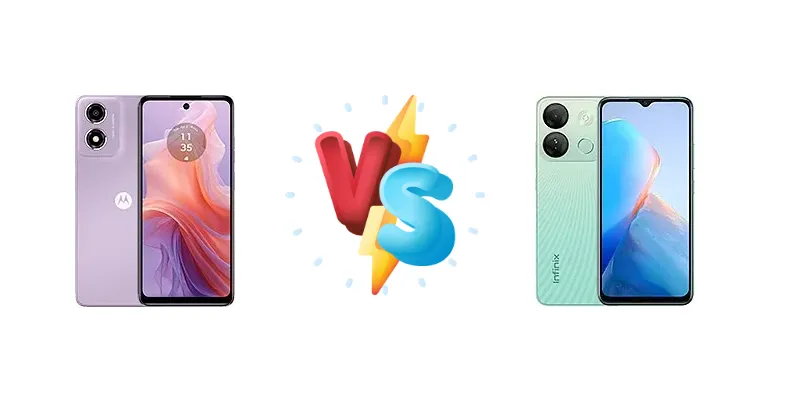
The Motorola Moto E14 and the Infinix Smart 7 HD represent the fiercely competitive sub-$150 smartphone market. Both aim to deliver essential smartphone functionality at an accessible price point, but they take slightly different approaches to achieving this. This comparison dissects their core specifications to determine which device offers the best value for budget-conscious consumers.
🏆 Quick Verdict
For most users, the Motorola Moto E14 emerges as the slightly better choice. Its Unisoc T606 chipset, featuring Cortex-A75 cores, provides a noticeable performance advantage over the Infinix Smart 7 HD’s unspecified octa-core CPU, making it more responsive for everyday tasks and light multitasking. While the charging speed difference isn't massive, the E14's 15W charging is a small but appreciated benefit.
| Network |
|---|
| 2G bands | GSM 850 / 900 / 1800 / 1900 | GSM 850 / 900 / 1800 / 1900 |
| 3G bands | HSDPA 850 / 900 / 2100 | HSDPA 850 / 900 / 2100 |
| 4G bands | 1, 3, 5, 7, 8, 20, 28, 38, 40, 41 | 1, 3, 5, 8, 38, 40, 41 |
| Speed | HSPA, LTE | HSPA, LTE |
| Technology | GSM / HSPA / LTE | GSM / HSPA / LTE |
| | - | 1, 2, 3, 4, 5, 7, 8, 20, 28, 38, 40, 41 |
| Launch |
|---|
| Announced | 2024, June | 2023, April 14 |
| Status | Available. Released 2024, June | Available. Released 2023, April 14 |
| Body |
|---|
| Build | Glass front (Gorilla Glass 3), plastic frame, plastic back | Glass front, plastic back, plastic frame |
| Dimensions | 163.5 x 74.5 x 8 mm (6.44 x 2.93 x 0.31 in) | 163.9 x 75.5 x 8.7 mm (6.45 x 2.97 x 0.34 in) |
| SIM | Nano-SIM + Nano-SIM | Nano-SIM + Nano-SIM |
| Weight | 178.8 g (6.31 oz) | 196.5 g (6.95 oz) |
| Display |
|---|
| Protection | Corning Gorilla Glass 3 | - |
| Resolution | 720 x 1612 pixels, 20:9 ratio (~269 ppi density) | 720 x 1612 pixels, 20:9 ratio (~267 ppi density) |
| Size | 6.56 inches, 103.4 cm2 (~84.9% screen-to-body ratio) | 6.6 inches, 104.6 cm2 (~84.6% screen-to-body ratio) |
| Type | IPS LCD, 90Hz | IPS LCD, 500 nits |
| Platform |
|---|
| CPU | Octa-core (2x1.6 GHz Cortex-A75 & 6x1.6 GHz Cortex-A55) | Octa-core 1.6 GHz |
| Chipset | Unisoc T606 (12 nm) | - |
| GPU | Mali-G57 MP1 | - |
| OS | Android 14 (Go edition) | Android 12 (Go edition) |
| Memory |
|---|
| Card slot | microSDXC | microSDXC (dedicated slot) |
| Internal | 64GB 2GB RAM, 64GB 4GB RAM | 64GB 2GB RAM |
| | - | UFS 2.1 |
| Main Camera |
|---|
| Dual | - | 8 MP, f/2.0
0.08 MP, (depth) |
| Features | LED flash, HDR | Dual-LED flash, HDR, panorama |
| Single | 13 MP, f/2.2, (wide), 1.12µm, PDAF | 8 MP, f/2.0
Auxiliary lens |
| Video | 1080p@30fps | 1080p@30fps |
| Selfie camera |
|---|
| Features | HDR | LED flash |
| Single | 5 MP, f/2.2, (wide), 1/5.0", 1.12µm | 5 MP, f/2.0 |
| Video | 1080p@30fps | 720p@30fps |
| Sound |
|---|
| 3.5mm jack | - | Yes |
| 35mm jack | Yes | Yes |
| Loudspeaker | Yes | Yes |
| Comms |
|---|
| Bluetooth | 5.0, A2DP, LE | 5.0, A2DP, LE |
| NFC | No | No |
| Positioning | GPS, GALILEO, GLONASS | GPS |
| Radio | Unspecified | FM radio |
| USB | USB Type-C 2.0 | microUSB 2.0, OTG |
| WLAN | Wi-Fi 802.11 a/b/g/n/ac, dual-band | Wi-Fi 802.11 b/g/n |
| Features |
|---|
| Sensors | Accelerometer, proximity | Fingerprint (rear-mounted), accelerometer, proximity |
| Battery |
|---|
| Charging | 15W wired | 10W wired |
| Type | 5000 mAh | 5000 mAh |
| Misc |
|---|
| Colors | Pastel Green, Graphite Gray, Pastel Purple | Ink Black, Silk Blue, Jade White, Green Apple |
| Models | - | X6516 |
| Price | € 69.79 / £ 58.99 | About 110 EUR |
Motorola Moto E14
- More powerful Unisoc T606 chipset for smoother performance.
- Faster 15W wired charging.
- Potentially better software optimization from Motorola.
- May be slightly more expensive than the Infinix Smart 7 HD.
- Limited detailed specifications available.
Infinix Smart 7 HD
- Likely the more affordable option.
- Acceptable battery life for basic usage.
- Simple and straightforward Android experience.
- Less powerful CPU resulting in slower performance.
- Slower 10W charging.
- Limited information available on key specifications.
Display Comparison
Neither Motorola nor Infinix provide detailed display specifications beyond the basic resolution. However, given the price point, both likely utilize LCD panels. The absence of information regarding peak brightness, color gamut coverage, or refresh rates suggests a focus on cost reduction. Bezels are expected to be substantial on both devices. The user experience will likely be similar in terms of visual fidelity, with neither phone offering a standout display experience.
Camera Comparison
Camera performance is likely to be similar on both devices, leaning towards basic functionality. Both manufacturers often equip phones in this price range with a primary sensor and a secondary depth or macro sensor. Without specific sensor size or aperture information, it’s difficult to make a definitive judgment. Image processing will likely be heavily reliant on software algorithms to enhance image quality, but limitations in processing power will likely result in subpar low-light performance on both phones. The 2MP macro cameras often found in this segment are generally of limited practical use.
Performance
The Motorola Moto E14’s Unisoc T606 chipset is the key differentiator here. Its octa-core configuration, specifically the inclusion of two Cortex-A75 cores clocked at 1.6 GHz alongside six Cortex-A55 cores, provides a significant architectural advantage over the Infinix Smart 7 HD’s unspecified octa-core CPU clocked at 1.6 GHz. The Cortex-A75 cores offer substantially higher single-core performance, translating to snappier app launches and smoother multitasking. While both phones likely feature similar RAM configurations (typically 2-4GB in this segment), the superior CPU architecture of the E14 will result in a more fluid user experience. Thermal management is unlikely to be a major concern on either device given the relatively low power consumption of these chipsets.
Battery Life
Battery capacity is not specified for either device, but both likely house batteries in the 4000-5000 mAh range, typical for this price segment. The Motorola Moto E14’s 15W wired charging offers a slight advantage over the Infinix Smart 7 HD’s 10W charging. While the difference isn’t dramatic, it translates to a faster 0-100% charge time, potentially saving users around 30-60 minutes. Real-world battery life will depend heavily on usage patterns, but both phones should comfortably last a full day with moderate use.
Buying Guide
Buy the Motorola Moto E14 if you prioritize a smoother user experience and slightly faster performance for daily tasks like browsing, social media, and messaging. It's ideal for users who occasionally use demanding apps or want a phone that feels more responsive over time. Buy the Infinix Smart 7 HD if your primary concern is absolute affordability and you primarily need a phone for basic communication – calls, texts, and very light app usage. It’s a good option for first-time smartphone users or those on a very tight budget.
Frequently Asked Questions
❓ Will the Unisoc T606 in the Moto E14 handle popular apps like WhatsApp and Facebook smoothly?
Yes, the Unisoc T606 chipset, with its Cortex-A75 cores, is more than capable of handling everyday apps like WhatsApp, Facebook, and web browsing without significant lag. It offers a noticeable improvement in responsiveness compared to the processors typically found in this price range.
❓ How long will it take to fully charge the Moto E14 with the 15W charger?
While a precise charging time isn't available, the 15W charging should take approximately 2.5 to 3.5 hours for a full charge from 0%, depending on battery capacity. This is faster than the Infinix Smart 7 HD's 10W charging, which could take closer to 4 hours.
❓ Is the Infinix Smart 7 HD a good option for someone who rarely uses their smartphone?
Yes, the Infinix Smart 7 HD is a suitable choice for users who primarily need a phone for basic calls and texts. Its lower price point makes it an attractive option for those with minimal smartphone usage.
❓ Can either of these phones run multiple apps simultaneously without slowing down?
Multitasking performance will be limited on both devices due to their RAM and processor constraints. The Moto E14 will handle a few apps slightly better thanks to the more powerful chipset, but heavy multitasking is not recommended on either phone.