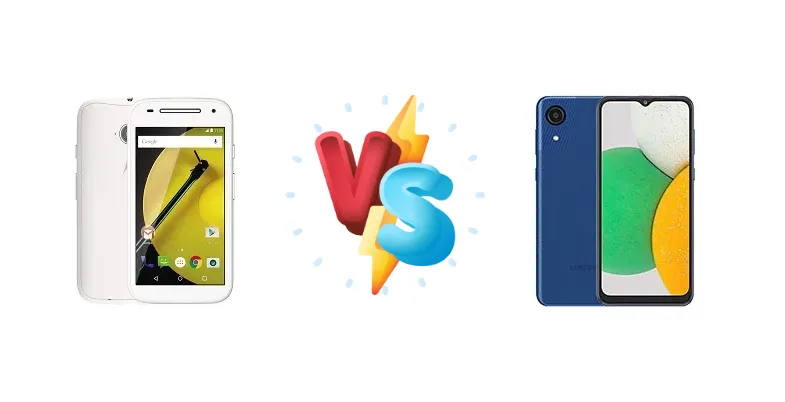
Looking for an affordable smartphone that doesn't completely break the bank? The Motorola Moto E (2nd Gen) and the Samsung Galaxy A03 Core are both contenders in the budget phone arena. But which one offers the best value for your money? Let's dive into a detailed comparison.
🏆 Quick Verdict
The Moto E (2nd Gen), particularly the LTE model, generally edges out the A03 Core thanks to its potentially faster processor (Snapdragon 410), wireless charging capabilities, and impressive battery life. However, the A03 Core might appeal to those prioritizing Samsung's brand and a slightly more modern design.
| Network |
|---|
| 2G bands | GSM 850 / 900 / 1800 / 1900 - all versions | GSM 850 / 900 / 1800 / 1900 |
| 3G bands | HSDPA 850 / 900 / 1900 / 2100 - XT1506, XT1521 | HSDPA 850 / 900 / 2100 |
| 4G bands | 1, 3, 7, 28, 40 - XT1521 | 1, 3, 5, 7, 8, 20, 28, 38, 40, 41 |
| Speed | HSPA, LTE | HSPA 21.1/5.76 Mbps, LTE |
| Technology | GSM / HSPA / LTE | GSM / HSPA / LTE |
| Launch |
|---|
| Announced | 2015, March. Released 2015, March | 2021, November 15 |
| Status | Discontinued | Available. Released 2021, December 06 |
| Body |
|---|
| Build | Glass front (Gorilla Glass 6), glass back (Gorilla Glass 6), aluminum frame | Plastic back, plastic frame |
| Dimensions | 129.9 x 66.8 x 12.3 mm (5.11 x 2.63 x 0.48 in) | 164.2 x 75.9 x 9.1 mm (6.46 x 2.99 x 0.36 in) |
| SIM | Dual SIM (Micro-SIM, dual stand-by) | · Nano-SIM· Nano-SIM + Nano-SIM |
| Weight | 145 g (5.11 oz) | 211 g (7.44 oz) |
| Display |
|---|
| Protection | Corning Gorilla Glass 3, oleophobic coating | - |
| Resolution | 540 x 960 pixels, 16:9 ratio (~245 ppi density) | 720 x 1600 pixels, 20:9 ratio (~270 ppi density) |
| Size | 4.5 inches, 55.8 cm2 (~64.3% screen-to-body ratio) | 6.5 inches, 102.0 cm2 (~81.8% screen-to-body ratio) |
| Type | IPS LCD | PLS LCD |
| Platform |
|---|
| CPU | Quad-core 1.2 GHz Cortex-A7 - 3G modelQuad-core 1.2 GHz Cortex-A53 - LTE model | Octa-core (4x1.6 GHz Cortex-A55 & 4x1.2 GHz Cortex-A55) |
| Chipset | Qualcomm Snapdragon 200 (28 nm) - 3G modelQualcomm Snapdragon 410 (28 nm) - LTE model | Unisoc SC9863A (28 nm) |
| GPU | Adreno 302 - 3G modelAdreno 306 - LTE model | IMG8322 |
| OS | Android 5.0 (Lollipop) | Android 11 (Go edition) |
| Memory |
|---|
| Card slot | microSDHC (dedicated slot) | microSDXC (dedicated slot) |
| Internal | 8GB 1GB RAM | 32GB 2GB RAM |
| | eMMC 4.5 | eMMC 5.1 |
| Main Camera |
|---|
| Features | Panorama, HDR | LED flash |
| Single | 5 MP, f/2.2, AF | 8 MP, f/2.0, AF |
| Triple | 40 MP, f/1.6, 27mm (wide), 1/1.7", PDAF, OIS
8 MP, f/2.4, 80mm (telephoto), 1/4.0", PDAF, OIS, 3x optical zoom
40 MP, f/1.8, 18mm (ultrawide), 1/1.54", PDAF
TOF 3D, (depth) | - |
| Video | 480p@30fps (3G), 720p@30fps (4G) | 1080p@30fps |
| Selfie camera |
|---|
| Features | HDR, panorama | - |
| Single | VGA | 5 MP, f/2.2 |
| Sound |
|---|
| 3.5mm jack | Yes | Yes |
| 35mm jack | Yes | Yes |
| Loudspeaker | Yes | Yes |
| Comms |
|---|
| Bluetooth | 4.0, LE, aptX | 4.2, A2DP |
| Infrared port | Yes | - |
| NFC | No | No |
| Positioning | GPS, GLONASS | GPS, GLONASS |
| Radio | FM radio, RDS | Unspecified |
| USB | microUSB 2.0, OTG | microUSB 2.0, OTG |
| WLAN | Wi-Fi 802.11 b/g/n, hotspot | Wi-Fi 802.11 b/g/n, Wi-Fi Direct |
| Features |
|---|
| Sensors | Accelerometer, proximity | Accelerometer, proximity |
| Battery |
|---|
| Charging | 40W wired
27W wireless
Reverse wireless | - |
| Type | Li-Ion 2390 mAh, non-removable | Li-Ion 5000 mAh |
| Misc |
|---|
| Colors | Black, White | Black, Blue |
| Models | XT1521, XT1506 | SM-A032F, SM-A032F/DS, SM-A032M |
| Price | About 100 EUR | £ 74.99 |
| SAR | - | 0.30 W/kg (head) |
| SAR EU | - | 0.24 W/kg (head) 1.39 W/kg (body) |
| Tests |
|---|
| Battery life | Endurance rating 103h | - |
| Camera |
Photo / Video | - |
| Display |
Contrast ratio: Infinite (nominal) | - |
| Loudspeaker |
-29.3 LUFS (Average) | - |
| Performance |
AnTuTu: 378950 (v7), 484529 (v8)
GeekBench: 11936 (v4.4), 3038 (v5.1)
GFXBench: 34fps (ES 3.1 onscreen) | - |
Motorola Moto E Dual SIM (2nd gen)
- Excellent battery life
- Wireless charging (LTE model)
- Potentially faster processor (LTE model)
- Dual SIM support
- Basic display
- Camera quality likely average
- Design may feel dated
Samsung Galaxy A03 Core
- Samsung brand recognition
- Simple user interface
- Compact design (likely)
- Affordable price
- Less powerful processor
- No wireless charging
- Camera likely average
- Potentially shorter battery life
Display Comparison
Both phones feature basic LCD displays, likely around 6.5 inches. The Moto E (2nd Gen) boasts a 'contrast ratio: Infinite (nominal)' which is likely a marketing term and doesn't translate to a significantly better display in practical use. Expect similar viewing experiences with adequate brightness and color accuracy for everyday use.
Camera Comparison
Camera specs are not fully detailed for either phone. Both likely feature basic camera setups suitable for casual snapshots. Image quality will depend heavily on software processing and lighting conditions. The Moto E might have a slight edge due to Motorola's generally decent camera software.
Performance
The Moto E (2nd Gen) has a slight advantage here. The LTE model with the Snapdragon 410 offers a more capable CPU than the Unisoc SC9863A in the A03 Core. While both are entry-level chips, the Snapdragon generally performs better in real-world scenarios. Expect smoother multitasking and app loading on the Moto E.
Battery Life
The Moto E (2nd Gen) shines in battery life, boasting an endurance rating of 103h. This suggests exceptional longevity. The A03 Core's battery capacity is likely around 5000mAh, but the less efficient processor could result in shorter battery life compared to the Moto E.
Buying Guide
The Motorola Moto E (2nd Gen) is ideal for users prioritizing battery life, wireless charging, and a slightly more powerful processor for basic tasks. The Samsung Galaxy A03 Core is a good choice for those who prefer the Samsung ecosystem, a simple user experience, and a more compact design, even if it means sacrificing some performance.
Frequently Asked Questions
❓ Which phone is better for gaming?
The Motorola Moto E (2nd Gen) LTE model is slightly better suited for basic gaming due to its more powerful processor, but neither phone is designed for demanding games.
❓ Does the Samsung Galaxy A03 Core have 5G?
No, the Samsung Galaxy A03 Core is a 4G LTE device.