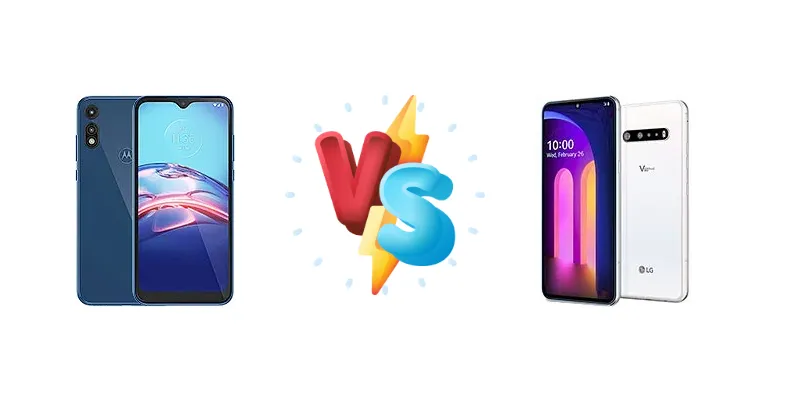
Choosing a new smartphone can be overwhelming, especially with so many options available. Today, we're pitting a budget champion, the Motorola Moto E (2020), against a former flagship powerhouse, the LG V60 ThinQ 5G UW. This comparison will help you decide which phone best suits your needs and budget.
🏆 Quick Verdict
The LG V60 ThinQ 5G UW is the clear winner in terms of performance, camera quality, and features. However, the Moto E (2020) offers incredible value for its price, making it a solid choice for budget-conscious users who prioritize affordability over premium features.
| Network |
|---|
| 2G bands | GSM 850 / 900 / 1800 / 1900 | GSM 850 / 900 / 1800 / 1900 |
| 3G bands | HSDPA 850 / 900 / 1700(AWS) / 1900 / 2100 | HSDPA 850 / 900 / 1700(AWS) / 1900 / 2100 |
| 4G bands | 1, 2, 3, 4, 5, 7, 8, 12, 13, 14, 17, 25, 26, 30, 66, 71 | 2, 3, 4, 5, 7, 12, 13, 20, 28, 46, 48, 66 |
| 5G bands | - | 260, 261 mmWave |
| Speed | HSPA, LTE | HSPA 42.2/5.76 Mbps, LTE (7CA) Cat22, 5G |
| Technology | GSM / CDMA / HSPA / EVDO / LTE | GSM / CDMA / HSPA / EVDO / LTE / 5G |
| | CDMA2000 1xEV-DO | CDMA2000 1xEV-DO |
| Launch |
|---|
| Announced | 2020, June 05. Released 2020, June 10 | 2020, February 26. Released 2020, April 02 |
| Status | Discontinued | Discontinued |
| Body |
|---|
| Build | Glass front, plastic back, plastic frame | Glass front (Gorilla Glass 5), glass back (Gorilla Glass 6), aluminum frame |
| Dimensions | 159.8 x 76.6 x 8.7 mm (6.29 x 3.02 x 0.34 in) | 169.3 x 77.6 x 8.9 mm (6.67 x 3.06 x 0.35 in) |
| SIM | Nano-SIM | Nano-SIM (pre-installed) |
| Weight | 185 g (6.53 oz) | 218 g (7.69 oz) |
| | Water-repellent coating | IP68 dust/water resistant (up to 1.5m for 30 min)
MIL-STD-810G compliant*
Method 516.6, Procedure IV "Transit Drop"
*does not guarantee ruggedness or use in extreme conditions |
| Display |
|---|
| Protection | - | Corning Gorilla Glass 5 |
| Resolution | 720 x 1520 pixels, 19:9 ratio (~271 ppi density) | 1080 x 2460 pixels (~395 ppi density) |
| Size | 6.2 inches, 95.9 cm2 (~78.4% screen-to-body ratio) | 6.8 inches, 109.8 cm2 (~83.6% screen-to-body ratio) |
| Type | IPS LCD | P-OLED, HDR10+ |
| | - | Always-on display |
| Platform |
|---|
| CPU | Octa-core (4x1.8 GHz Kryo 250 Gold & 4x1.8 GHz Kryo 250 Silver) | Octa-core (1x2.84 GHz Cortex-A77 & 3x2.42 GHz Cortex-A77 & 4x1.80 GHz Cortex-A55) |
| Chipset | Qualcomm SDM632 Snapdragon 632 (14 nm) | Qualcomm SM8250 Snapdragon 865 5G (7 nm+) |
| GPU | Adreno 506 | Adreno 650 |
| OS | Android 10 | Android 10, upgradable to Android 13 |
| Memory |
|---|
| Card slot | microSDXC (dedicated slot) | microSDXC (uses shared SIM slot) - dual-SIM model |
| Internal | 32GB 2GB RAM, 32GB 3GB RAM | 128GB 8GB RAM |
| | eMMC 5.1 | UFS 2.1 |
| Main Camera |
|---|
| Dual | 13 MP, f/2.0, 1/3.1", 1.12µm, PDAF
Auxiliary lens | 64 MP, f/1.8, 27mm (standard), 1/1.72", 0.8µm, dual pixel PDAF, OIS
13 MP, f/1.9, 12mm (ultrawide), 1/3.4", 1.0µm
0.3 MP, TOF 3D, f/1.4, (depth) |
| Features | LED flash, HDR, panorama | Dual-LED dual-tone flash, HDR, panorama |
| Video | 1080p@30/60fps | 8K@30fps, 4K@30/60fps, 1080p, HDR10+, 24-bit/192kHz stereo sound rec., gyro-EIS |
| Selfie camera |
|---|
| Features | HDR | HDR |
| Single | 5 MP, f/2.0, 1.12µm | 10 MP, f/1.9, 30mm (standard), 1/3.1", 1.22µm |
| Video | 1080p@30fps | 4K@30fps, gyro-EIS |
| Sound |
|---|
| 3.5mm jack | Yes | Yes |
| 35mm jack | Yes | Yes |
| Loudspeaker | Yes | Yes, with stereo speakers |
| | - | 32-bit/192kHz audio
24-bit/192kHz audio recording |
| Comms |
|---|
| Bluetooth | 4.2, A2DP, LE | 5.1, A2DP, LE, aptX HD |
| NFC | No | Yes |
| Positioning | GPS, GLONASS, GALILEO | GPS, GLONASS, GALILEO, BDS |
| Radio | FM radio | FM radio (USA model only) |
| USB | microUSB 2.0 | USB Type-C 3.1, OTG |
| WLAN | Wi-Fi 802.11 a/b/g/n, dual-band | Wi-Fi 802.11 a/b/g/n/ac/6, dual-band, Wi-Fi Direct, DLNA |
| Features |
|---|
| Sensors | Fingerprint (rear-mounted), accelerometer, proximity, compass | Fingerprint (under display, optical), accelerometer, gyro, proximity, compass, barometer |
| Battery |
|---|
| Charging | - | Wired, PD2.0, QC4
Wireless |
| Type | Li-Po 3550 mAh | Li-Po 5000 mAh |
| Misc |
|---|
| Colors | Midnight Blue | Classy Blue, Classy White |
| Models | XT2052DL | LM-V600VML, LMV600VML |
| Price | About 90 EUR | About 870 EUR |
| SAR | - | 0.85 W/kg (head) 1.12 W/kg (body) |
Motorola Moto E (2020)
- Extremely affordable
- Decent battery life
- Clean Android experience
- Lightweight and compact
- Underpowered processor
- Basic camera
- Low-resolution display
- No 5G
LG V60 ThinQ 5G UW
- Powerful Snapdragon 865 processor
- Excellent camera system
- Stunning OLED display with 120Hz
- 5G connectivity
- Expandable storage
- Expensive (even used)
- Older model
- LG's exit from the smartphone market raises concerns about future updates
- Large and bulky
Display Comparison
The LG V60 boasts a stunning 6.8-inch OLED display with a 120Hz refresh rate, offering vibrant colors and smooth scrolling. The Moto E (2020) has a smaller 6.5-inch IPS LCD display with a standard 60Hz refresh rate. The V60's display is significantly superior in terms of quality and responsiveness.
Camera Comparison
The LG V60's triple-lens camera system (64MP main, 13MP ultrawide, 2MP depth) delivers exceptional image quality, especially in low light. It also features advanced features like OIS and 8K video recording. The Moto E (2020)'s 13MP main camera is decent for basic photography but lacks the V60's versatility and image processing capabilities.
Performance
The Snapdragon 865 in the LG V60 is a beast, easily handling demanding games and multitasking. The Moto E's Snapdragon 632 is adequate for everyday tasks but will struggle with more intensive applications. The V60's performance is in a different league.
Battery Life
Both phones offer decent battery life. The LG V60 has a larger 4,500mAh battery and supports faster charging (PD2.0, QC4). The Moto E (2020) has a 4,000mAh battery. While the Moto E might last slightly longer on a single charge due to its less demanding processor, the V60's faster charging gives it an edge.
Buying Guide
The Motorola Moto E (2020) is ideal for first-time smartphone users, students, or anyone needing a reliable and affordable device for basic tasks like calling, texting, and browsing. The LG V60 ThinQ 5G UW is perfect for power users, photographers, and those who demand top-tier performance and a premium experience, even if it's an older model.
Frequently Asked Questions
❓ Is the LG V60 still worth buying?
Yes, if you can find it at a good price, the LG V60 still offers excellent performance and a great camera. However, consider LG's exit from the smartphone market and potential lack of future updates.
❓ What is the Moto E (2020) best used for?
The Moto E (2020) is best suited for basic tasks like calling, texting, browsing, and light social media use. It's a great entry-level smartphone for those on a tight budget.