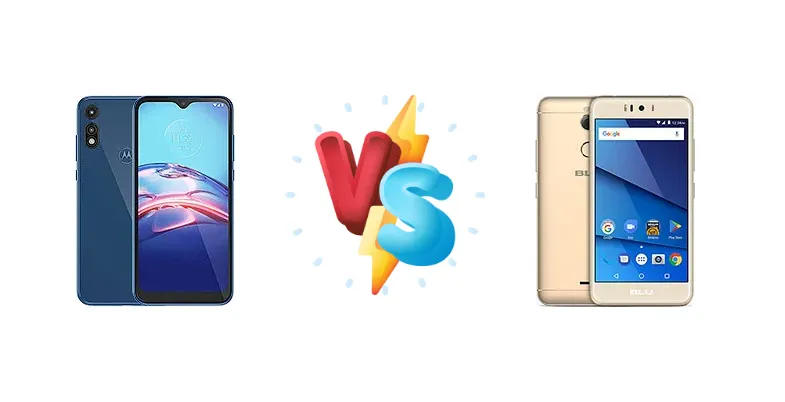
Looking for an affordable smartphone that won't break the bank? The Motorola Moto E (2020) and the BLU R2 LTE are both contenders in the budget phone arena. But which one offers the best bang for your buck? Let's dive into a detailed comparison.
🏆 Quick Verdict
The Motorola Moto E (2020) is the clear winner. Its significantly more powerful processor, better camera, and generally more modern features make it a superior choice despite potentially similar pricing. The BLU R2 LTE is a very basic option for those needing the absolute bare minimum.
| Network |
|---|
| 2G bands | GSM 850 / 900 / 1800 / 1900 | GSM 850 / 900 / 1800 / 1900 - SIM 1 & SIM 2 |
| 3G bands | HSDPA 850 / 900 / 1700(AWS) / 1900 / 2100 | HSDPA 850 / 900 / 1700(AWS) / 1900 / 2100 |
| 4G bands | 1, 2, 3, 4, 5, 7, 8, 12, 13, 14, 17, 25, 26, 30, 66, 71 | 1, 3, 7, 20 - R0150EE |
| EDGE | - | No |
| GPRS | - | No |
| Speed | HSPA, LTE | HSPA 42.2/11.5 Mbps, LTE Cat4 150/50 Mbps |
| Technology | GSM / CDMA / HSPA / EVDO / LTE | GSM / HSPA / LTE |
| | CDMA2000 1xEV-DO | 1, 2, 3, 4, 7, 12, 17, 28 - R0170WW |
| Launch |
|---|
| Announced | 2020, June 05. Released 2020, June 10 | 2017, July. Released 2017, July |
| Status | Discontinued | Discontinued |
| Body |
|---|
| Build | Glass front, plastic back, plastic frame | - |
| Dimensions | 159.8 x 76.6 x 8.7 mm (6.29 x 3.02 x 0.34 in) | 150.3 x 74.3 x 9.6 mm (5.92 x 2.93 x 0.38 in) |
| SIM | Nano-SIM | Dual SIM (Micro-SIM) |
| Weight | 185 g (6.53 oz) | 156 g (5.50 oz) |
| | Water-repellent coating | - |
| Display |
|---|
| Resolution | 720 x 1520 pixels, 19:9 ratio (~271 ppi density) | 720 x 1280 pixels, 16:9 ratio (~282 ppi density) |
| Size | 6.2 inches, 95.9 cm2 (~78.4% screen-to-body ratio) | 5.2 inches, 74.5 cm2 (~66.8% screen-to-body ratio) |
| Type | IPS LCD | IPS LCD |
| Platform |
|---|
| CPU | Octa-core (4x1.8 GHz Kryo 250 Gold & 4x1.8 GHz Kryo 250 Silver) | Quad-core 1.3 GHz Cortex-A53 |
| Chipset | Qualcomm SDM632 Snapdragon 632 (14 nm) | Mediatek MT6737 (28 nm) |
| GPU | Adreno 506 | Mali-T720 |
| OS | Android 10 | Android 7.0 (Nougat) |
| Memory |
|---|
| Card slot | microSDXC (dedicated slot) | microSDXC |
| Internal | 32GB 2GB RAM, 32GB 3GB RAM | 16GB 2GB RAM, 32GB 3GB RAM |
| | eMMC 5.1 | eMMC 5.0 |
| Main Camera |
|---|
| Dual | 13 MP, f/2.0, 1/3.1", 1.12µm, PDAF
Auxiliary lens | - |
| Features | LED flash, HDR, panorama | Dual-LED dual-tone flash |
| Single | - | 13 MP |
| Video | 1080p@30/60fps | 720p@30fps |
| Selfie camera |
|---|
| Features | HDR | dual-LED dual-tone flash |
| Single | 5 MP, f/2.0, 1.12µm | 13 MP |
| Video | 1080p@30fps | - |
| Sound |
|---|
| 3.5mm jack | Yes | Yes |
| 35mm jack | Yes | Yes |
| Loudspeaker | Yes | Yes |
| Comms |
|---|
| Bluetooth | 4.2, A2DP, LE | 4.0, A2DP |
| NFC | No | No |
| Positioning | GPS, GLONASS, GALILEO | GPS |
| Radio | FM radio | FM radio |
| USB | microUSB 2.0 | microUSB 2.0 |
| WLAN | Wi-Fi 802.11 a/b/g/n, dual-band | Wi-Fi 802.11 b/g/n |
| Features |
|---|
| Sensors | Fingerprint (rear-mounted), accelerometer, proximity, compass | Fingerprint (rear-mounted), accelerometer, proximity, compass |
| Battery |
|---|
| Stand-by | - | Up to 725 h (2G) / Up to 625 h (3G) |
| Talk time | - | Up to 26 h (2G) / Up to 16 h (3G) |
| Type | Li-Po 3550 mAh | Li-Po 3000 mAh, non-removable |
| Misc |
|---|
| Colors | Midnight Blue | Black, Gold, Rose Gold, Silver |
| Models | XT2052DL | - |
| Price | About 90 EUR | About 80 EUR |
Motorola Moto E (2020)
- More powerful processor
- Better camera
- Larger display
- More modern features
- Generally better build quality
- May be slightly more expensive than the BLU R2 LTE
- Still a budget phone, so don't expect flagship performance
BLU R2 LTE
- Very affordable
- Lightweight
- Basic functionality for calls and texts
- Slow performance
- Poor camera quality
- Small display
- Outdated chipset
- Limited storage
Display Comparison
The Moto E (2020) typically features a 6.5-inch HD+ display, offering a larger and generally more vibrant viewing experience compared to the BLU R2 LTE's likely smaller and lower-resolution screen. Color accuracy and brightness are also likely to be better on the Moto E.
Camera Comparison
The Moto E (2020) generally boasts a better camera setup, likely including a higher resolution main sensor and potentially additional lenses. Image quality, low-light performance, and video recording capabilities will be noticeably superior on the Moto E. The BLU R2 LTE's camera is likely basic and produces mediocre results.
Performance
Here's where the Moto E (2020) truly shines. The Snapdragon 632 chipset is significantly more powerful than the BLU R2 LTE's MT6737. Expect smoother multitasking, faster app loading times, and a more responsive user experience on the Moto E. The BLU R2 LTE will struggle with more demanding apps and games.
Battery Life
While both phones likely offer adequate battery life for a full day of moderate use, the Moto E (2020) may have a slightly larger battery capacity and more efficient processor, potentially leading to slightly longer battery life.
Buying Guide
The Motorola Moto E (2020) is ideal for users who want a reliable, everyday smartphone with decent performance and a good camera for the price. The BLU R2 LTE is best suited for users with extremely limited budgets who primarily need a phone for calls and basic texting, and minimal app usage.
Frequently Asked Questions
❓ Is the BLU R2 LTE good for gaming?
No, the BLU R2 LTE's weak processor makes it unsuitable for gaming. Even simple games will likely run poorly.
❓ Which phone has more storage?
The Motorola Moto E (2020) typically offers more storage options, often including expandable storage via microSD card.
❓ Which phone gets longer software updates?
Motorola generally provides better software support than BLU, so the Moto E (2020) is more likely to receive updates.