
Motorola G96 vs Xiaomi 11 Lite 5G NE: A Deep Dive into Mid-Range Performance
| Phones Images | |||||
|---|---|---|---|---|---|
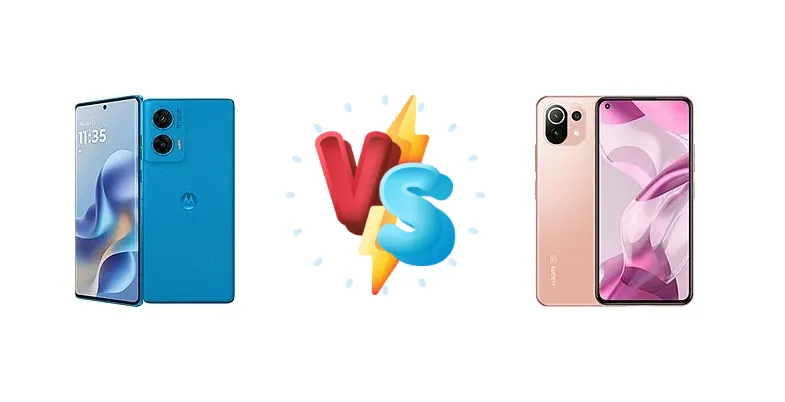
|
🏆 Quick Verdict
For most users, the Motorola G96 emerges as the slightly better choice. Its Snapdragon 7s Gen 2, built on a more efficient 4nm process, provides a performance edge and potentially better thermal management. While both phones offer similar battery endurance, the G96’s newer processor gives it a slight advantage in future-proofing and sustained performance.
| PHONES | ||
|---|---|---|
| Phone Names | Motorola G96 | Xiaomi 11 Lite 5G NE |
| Network | ||
|---|---|---|
| 2G bands | GSM 850 / 900 / 1800 / 1900 | GSM 850 / 900 / 1800 / 1900 |
| 3G bands | HSDPA 850 / 900 / 1900 / 2100 | HSDPA 850 / 900 / 1700(AWS) / 1900 / 2100 |
| 4G bands | 1, 2, 3, 5, 7, 8, 18, 19, 20, 26, 28, 32, 38, 40, 41, 42 | 1, 2, 3, 4, 5, 7, 8, 12, 13, 17, 18, 19, 20, 26, 28, 32, 38, 40, 41, 42, 66 |
| 5G bands | 1, 3, 5, 7, 8, 20, 26, 28, 38, 40, 41, 77, 78 SA/NSA | 1, 3, 5, 7, 8, 20, 26, 38, 41, 66, 77, 78 SA/NSA |
| Speed | HSPA, LTE, 5G | HSPA, LTE, 5G |
| Technology | GSM / HSPA / LTE / 5G | GSM / HSPA / LTE / 5G |
| Launch | ||
|---|---|---|
| Announced | 2025, July 09 | 2021, September 15 |
| Status | Available. Released 2025, July 16 | Available. Released 2021, October 02 |
| Body | ||
|---|---|---|
| Build | Glass front (Gorilla Glass 5), silicone polymer back (eco leather), plastic frame | - |
| Dimensions | 161.9 x 73.3 x 7.9 mm (6.37 x 2.89 x 0.31 in) | 160.5 x 75.7 x 6.8 mm (6.32 x 2.98 x 0.27 in) |
| SIM | Nano-SIM + Nano-SIM | Nano-SIM + Nano-SIM |
| Weight | 178 g (6.28 oz) | 158 g (5.57 oz) |
| - | IP53, dust and splash resistant | |
| Display | ||
|---|---|---|
| Protection | Corning Gorilla Glass 5 | Corning Gorilla Glass 5 |
| Resolution | 1080 x 2400 pixels, 20:9 ratio (~395 ppi density) | 1080 x 2400 pixels, 20:9 ratio (~402 ppi density) |
| Size | 6.67 inches, 107.4 cm2 (~90.5% screen-to-body ratio) | 6.55 inches, 103.6 cm2 (~85.3% screen-to-body ratio) |
| Type | P-OLED, 1B colors, 144Hz, 1600 nits (peak) | AMOLED, 1B colors, Dolby Vision, HDR10+, 90Hz, 500 nits (typ), 800 nits (HBM) |
| Platform | ||
|---|---|---|
| CPU | Octa-core (4x2.40 GHz Cortex-A78 & 4x1.95 GHz Cortex-A55) | Octa-core (1x2.4 GHz Cortex-A78 & 3x2.2 GHz Cortex-A78 & 4x1.9 GHz Cortex-A55) |
| Chipset | Qualcomm SM7435-AB Snapdragon 7s Gen 2 (4 nm) | Qualcomm SM7325 Snapdragon 778G 5G (6 nm) |
| GPU | Adreno 710 | Adreno 642L |
| OS | Android 15, up to 1 major Android upgrade | Android 11, upgradable to Android 14, HyperOS |
| Memory | ||
|---|---|---|
| Card slot | No | microSDXC (uses shared SIM slot) |
| Internal | 128GB 8GB RAM, 256GB 8GB RAM | 128GB 6GB RAM, 128GB 8GB RAM, 256GB 8GB RAM |
| - | UFS 2.2 | |
| Main Camera | ||
|---|---|---|
| Dual | 50 MP, f/1.9, (wide), 1/1.56", 1.0µm, multi-directional PDAF, OIS 8 MP, f/2.2, 119˚ (ultrawide), 1/4.0", 1.12µm, AF | - |
| Features | LED flash, HDR, panorama | Dual-LED dual-tone flash, HDR, panorama |
| Single | - | 20 MP, f/2.2, 27mm (wide), 1/3.4", 0.8µm |
| Triple | - | 64 MP, f/1.8, 26mm (wide), 1/1.97", 0.7µm, PDAF 8 MP, f/2.2, 119˚ (ultrawide), 1/4.0", 1.12µm 5 MP, f/2.4, 50mm (telephoto macro), 1/5.0", 1.12µm, AF |
| Video | 4K@30fps, 1080p@30/60/120fps, gyro-EIS, OIS | 4K@30fps, 1080p@30/60/120fps, 720p@960fps; gyro-EIS |
| Selfie camera | ||
|---|---|---|
| Features | HDR | HDR, panorama |
| Single | 32 MP, f/2.2, (wide), 1/3.14", 0.7µm | 20 MP, f/2.2, 27mm (wide), 1/3.4", 0.8µm |
| Video | 4K@30fps, 1080p@30fps, gyro-EIS | 1080p@30/60fps, 720p@120fps |
| Sound | ||
|---|---|---|
| 3.5mm jack | - | No |
| 35mm jack | No | No |
| Loudspeaker | Yes, with stereo speakers (with Dolby Atmos) | Yes, with dual speakers |
| Comms | ||
|---|---|---|
| Bluetooth | 5.2, A2DP, LE | 5.2 (Global), 5.1 (India) |
| Infrared port | - | Yes |
| NFC | No | Yes (market/region dependent) |
| Positioning | GPS, GALILEO, GLONASS, BDS, QZSS | GPS (L1+L5), GLONASS, BDS, GALILEO, NavIC |
| Radio | No | No |
| USB | USB Type-C 2.0, OTG | USB Type-C 2.0, OTG |
| WLAN | Wi-Fi 802.11 a/b/g/n/ac, dual-band | Wi-Fi 802.11 a/b/g/n/ac/6 (Global), Wi-Fi 802.11 a/b/g/n/ac (India) |
| Features | ||
|---|---|---|
| Sensors | Fingerprint (under display, optical), accelerometer, gyro, proximity, compass | Fingerprint (side-mounted), accelerometer, gyro, compass |
| - | Virtual proximity sensing | |
| Battery | ||
|---|---|---|
| Charging | 30W wired | 33W wired |
| Type | 5500 mAh | Li-Po 4250 mAh |
| Misc | ||
|---|---|---|
| Colors | Pantone (Greener Pastures, Cattleya Orchid, Dresden Blue, Ashleigh Blue) | Truffle Black (Vinyl Black), Bubblegum Blue (Jazz Blue), Peach Pink (Tuscany Coral), Snowflake White (Diamond Dazzle) |
| Models | - | 2109119DG, 2107119DC, 2109119DI |
| Price | ₹ 16,304 | About 200 EUR |
| SAR | - | 1.09 W/kg (head) 1.05 W/kg (body) |
| SAR EU | - | 0.59 W/kg (head) 0.95 W/kg (body) |
| Tests | ||
|---|---|---|
| Battery life | - | Endurance rating 122h |
| Camera | - | Photo / Video |
| Display | - | Contrast ratio: Infinite (nominal) |
| Loudspeaker | - | -23.6 LUFS (Very good) |
| Performance | - | AnTuTu: 527663 (v9) GeekBench: 2832 (v5.1) GFXBench: 28fps (ES 3.1 onscreen) |
Motorola G96
- Newer Snapdragon 7s Gen 2 chipset offers better performance and efficiency.
- 4nm process node reduces heat and improves battery life.
- Potentially better future software support due to newer hardware.
- Charging speed is slightly slower at 30W.
- Camera specifications are largely unknown.
Xiaomi 11 Lite 5G NE
- Faster 33W charging.
- Likely AMOLED display for vibrant colors and efficiency.
- Established software optimization and potentially refined camera processing.
- Older Snapdragon 778G chipset is less efficient.
- 6nm process node generates more heat under load.
Display Comparison
Both the Motorola G96 and Xiaomi 11 Lite 5G NE feature displays with an 'Infinite' (nominal) contrast ratio, suggesting excellent black levels. However, detailed specifications like peak brightness and panel type (AMOLED vs. LCD) are missing. Given the Xiaomi 11 Lite 5G NE’s positioning, it likely utilizes an AMOLED panel, known for vibrant colors and efficient power consumption. Without further data on the G96’s panel, it’s difficult to definitively declare a winner, but the Xiaomi’s likely AMOLED advantage is a strong point. Both phones lack information on refresh rate, a crucial factor for smooth scrolling and gaming.
Camera Comparison
Both devices are listed as having 'Photo / Video' capabilities, offering little concrete detail. The absence of sensor size information is a critical omission. The Xiaomi 11 Lite 5G NE, given its marketing, likely prioritizes a more polished camera experience with potentially better image processing algorithms. The G96’s newer ISP (Image Signal Processor) within the Snapdragon 7s Gen 2 *could* offer improvements in low-light performance and dynamic range, but this is speculative without sample images and detailed specifications. The prevalence of 2MP macro lenses on both devices suggests they are largely marketing features and unlikely to significantly impact image quality.
Performance
The core difference lies in the chipsets. The Motorola G96’s Snapdragon 7s Gen 2 (4nm) is a significant upgrade over the Xiaomi 11 Lite 5G NE’s Snapdragon 778G 5G (6nm). The 4nm process node inherently offers better power efficiency, translating to less heat generation and potentially reduced throttling during prolonged use. While the 778G boasts a slightly higher clock speed on its prime Cortex-A78 core (2.4 GHz vs 2.40 GHz), the G96’s architecture – 4x Cortex-A78 vs 1x Cortex-A78 + 3x Cortex-A78 – suggests a more balanced CPU performance. The G96’s CPU configuration, combined with the newer process, should deliver a noticeable performance boost in multi-threaded tasks. Both phones likely utilize LPDDR5 RAM, but specific speeds are unknown.
Battery Life
Interestingly, both phones share an identical battery endurance rating of 122 hours. This suggests similar real-world battery life despite the differing chipsets. However, the Motorola G96’s 30W charging is slightly slower than the Xiaomi 11 Lite 5G NE’s 33W charging. While the difference isn’t massive, the Xiaomi will likely achieve a 0-100% charge slightly faster. The Snapdragon 7s Gen 2’s improved efficiency *could* offset the slower charging speed over time, leading to less frequent charging cycles.
Buying Guide
Buy the Motorola G96 if you prioritize sustained performance during demanding tasks like gaming or video editing, and value a more modern chipset for potential software updates. Buy the Xiaomi 11 Lite 5G NE if you prefer a phone with a proven track record of software stability and a potentially more refined camera experience, and are less concerned with having the absolute latest processor.