
Motorola G96 vs Samsung Galaxy A33 5G: A Detailed Comparison of Mid-Range Contenders
| Phones Images | |||||
|---|---|---|---|---|---|
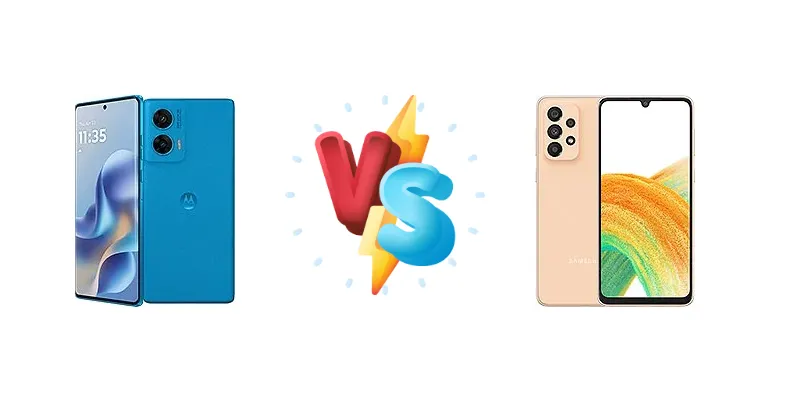
|
🏆 Quick Verdict
For the average user prioritizing sustained performance and future-proofing, the Motorola G96 is the better choice. Its newer Snapdragon 7s Gen 2 chipset, built on a 4nm process, offers a noticeable advantage in efficiency and gaming compared to the Samsung Galaxy A33 5G’s 5nm Exynos 1280. However, the A33’s display brightness is a strong point.
| PHONES | ||
|---|---|---|
| Phone Names | Motorola G96 | Samsung Galaxy A33 5G |
| Network | ||
|---|---|---|
| 2G bands | GSM 850 / 900 / 1800 / 1900 | GSM 850 / 900 / 1800 / 1900 |
| 3G bands | HSDPA 850 / 900 / 1900 / 2100 | HSDPA 850 / 900 / 1700(AWS) / 1900 / 2100 |
| 4G bands | 1, 2, 3, 5, 7, 8, 18, 19, 20, 26, 28, 32, 38, 40, 41, 42 | 1, 2, 3, 4, 5, 7, 8, 12, 17, 20, 26, 28, 32, 38, 40, 41, 66 |
| 5G bands | 1, 3, 5, 7, 8, 20, 26, 28, 38, 40, 41, 77, 78 SA/NSA | 1, 3, 5, 7, 8, 20, 28, 38, 40, 41, 66, 78 SA/NSA/Sub6 |
| Speed | HSPA, LTE, 5G | HSPA, LTE, 5G |
| Technology | GSM / HSPA / LTE / 5G | GSM / HSPA / LTE / 5G |
| Launch | ||
|---|---|---|
| Announced | 2025, July 09 | 2022, March 17 |
| Status | Available. Released 2025, July 16 | Available. Released 2022, April 20 |
| Body | ||
|---|---|---|
| Build | Glass front (Gorilla Glass 5), silicone polymer back (eco leather), plastic frame | Glass front (Gorilla Glass 5), plastic frame, plastic back |
| Dimensions | 161.9 x 73.3 x 7.9 mm (6.37 x 2.89 x 0.31 in) | 159.7 x 74 x 8.1 mm (6.29 x 2.91 x 0.32 in) |
| SIM | Nano-SIM + Nano-SIM | · Nano-SIM· Nano-SIM + Nano-SIM |
| Weight | 178 g (6.28 oz) | 186 g (6.56 oz) |
| - | IP67 dust/water resistant (up to 1m for 30 min) | |
| Display | ||
|---|---|---|
| Protection | Corning Gorilla Glass 5 | Corning Gorilla Glass 5 |
| Resolution | 1080 x 2400 pixels, 20:9 ratio (~395 ppi density) | 1080 x 2400 pixels, 20:9 ratio (~411 ppi density) |
| Size | 6.67 inches, 107.4 cm2 (~90.5% screen-to-body ratio) | 6.4 inches, 98.9 cm2 (~83.7% screen-to-body ratio) |
| Type | P-OLED, 1B colors, 144Hz, 1600 nits (peak) | Super AMOLED, 90Hz |
| Platform | ||
|---|---|---|
| CPU | Octa-core (4x2.40 GHz Cortex-A78 & 4x1.95 GHz Cortex-A55) | Octa-core (2x2.4 GHz Cortex-A78 & 6x2.0 GHz Cortex-A55) |
| Chipset | Qualcomm SM7435-AB Snapdragon 7s Gen 2 (4 nm) | Exynos 1280 (5 nm) |
| GPU | Adreno 710 | Mali-G68 |
| OS | Android 15, up to 1 major Android upgrade | Android 12, up to 4 major Android upgrades, One UI 8 |
| Memory | ||
|---|---|---|
| Card slot | No | microSDXC (uses shared SIM slot) |
| Internal | 128GB 8GB RAM, 256GB 8GB RAM | 128GB 4GB RAM, 128GB 6GB RAM, 128GB 8GB RAM, 256GB 8GB RAM |
| Main Camera | ||
|---|---|---|
| Dual | 50 MP, f/1.9, (wide), 1/1.56", 1.0µm, multi-directional PDAF, OIS 8 MP, f/2.2, 119˚ (ultrawide), 1/4.0", 1.12µm, AF | - |
| Features | LED flash, HDR, panorama | LED flash, panorama, HDR |
| Quad | - | 48 MP, f/1.8, 26mm (wide), 1/2.0", 0.8µm, PDAF, OIS 8 MP, f/2.2, 123˚, (ultrawide), 1/4.0", 1.12µm 5 MP (macro) Auxiliary lens |
| Single | - | 13 MP, f/2.2, (wide), 1/3.1", 1.12µm |
| Video | 4K@30fps, 1080p@30/60/120fps, gyro-EIS, OIS | 4K@30fps, 1080p@30/60fps |
| Selfie camera | ||
|---|---|---|
| Features | HDR | - |
| Single | 32 MP, f/2.2, (wide), 1/3.14", 0.7µm | 13 MP, f/2.2, (wide), 1/3.1", 1.12µm |
| Video | 4K@30fps, 1080p@30fps, gyro-EIS | 4K@30fps, 1080p@30fps |
| Sound | ||
|---|---|---|
| 3.5mm jack | - | No |
| 35mm jack | No | No |
| Loudspeaker | Yes, with stereo speakers (with Dolby Atmos) | Yes, with stereo speakers |
| Comms | ||
|---|---|---|
| Bluetooth | 5.2, A2DP, LE | 5.1, A2DP, LE |
| NFC | No | Yes (market/region dependent) |
| Positioning | GPS, GALILEO, GLONASS, BDS, QZSS | GPS, GLONASS, GALILEO, BDS |
| Radio | No | No |
| USB | USB Type-C 2.0, OTG | USB Type-C 2.0, OTG |
| WLAN | Wi-Fi 802.11 a/b/g/n/ac, dual-band | Wi-Fi 802.11 a/b/g/n/ac, dual-band, Wi-Fi Direct |
| Features | ||
|---|---|---|
| Sensors | Fingerprint (under display, optical), accelerometer, gyro, proximity, compass | Fingerprint (under display, optical), accelerometer, gyro, compass |
| - | Virtual proximity sensing | |
| Battery | ||
|---|---|---|
| Charging | 30W wired | 25W wired |
| Type | 5500 mAh | Li-Po 5000 mAh |
| Misc | ||
|---|---|---|
| Colors | Pantone (Greener Pastures, Cattleya Orchid, Dresden Blue, Ashleigh Blue) | Black, White, Blue, Peach |
| Models | - | SM-A336E, SM-A336B, SM-A336B/DS, SM-A336B/DSN, SM-A336E/DS, SM-A336M, SM-A3360 |
| Price | ₹ 16,304 | £ 174.99 / € 187.50 / ₹ 21,999 |
| SAR | - | 0.35 W/kg (head) |
| SAR EU | - | 0.57 W/kg (head) 1.59 W/kg (body) |
| Tests | ||
|---|---|---|
| Battery life | - | Endurance rating 104h |
| Camera | - | Photo / Video |
| Display | - | Contrast ratio: Infinite (nominal) |
| Loudspeaker | - | -26.5 LUFS (Good) |
| Performance | - | AnTuTu: 354420 (v8), 394918 (v9) GeekBench: 1900 (v5.1) GFXBench: 20fps (ES 3.1 onscreen) |
Motorola G96
- More efficient Snapdragon 7s Gen 2 chipset
- Faster 30W wired charging
- Potentially better sustained performance due to 4nm process
- Display brightness likely lower than A33
- Camera details are limited
Samsung Galaxy A33 5G
- Brighter 728 nit display
- Samsung’s One UI software experience
- Likely includes OIS for improved image stabilization
- Less efficient Exynos 1280 chipset
- Slower 25W wired charging
- Potential for thermal throttling under heavy load
Display Comparison
The Samsung Galaxy A33 5G boasts a measured peak brightness of 728 nits, a significant advantage for outdoor use compared to the G96 (brightness data unavailable, but typically lower in this price bracket). While the G96’s display specifics are less defined, both likely utilize AMOLED panels for vibrant colors. Samsung’s claim of an ‘Infinite’ contrast ratio is typical marketing hyperbole for AMOLED technology. The lack of LTPO on either device suggests standard 60Hz or 90Hz refresh rates, impacting smoothness during scrolling and gaming. The A33’s higher brightness is a clear win for users frequently exposed to sunlight.
Camera Comparison
Both phones feature photo and video capabilities, but detailed sensor information is lacking. The A33 likely benefits from Samsung’s established image processing algorithms. Without specific sensor size or aperture data, it’s difficult to definitively declare a winner. However, the inclusion of Optical Image Stabilization (OIS) on the A33 (assumed based on Samsung’s typical implementation) would provide a significant advantage in low-light photography and video recording. The G96’s camera performance will likely rely more heavily on software optimization. The presence of a 2MP macro camera on both devices is largely a marketing gimmick, offering limited practical benefit.
Performance
The core difference lies in the chipsets. The Motorola G96’s Snapdragon 7s Gen 2 (4nm) utilizes a more efficient manufacturing process than the Samsung Galaxy A33 5G’s Exynos 1280 (5nm). While both are octa-core CPUs with a similar core configuration (2x Cortex-A78, 6x Cortex-A55), the Snapdragon benefits from the newer architecture and smaller node size, resulting in improved power efficiency and sustained performance. The G96’s CPU clocks slightly higher (2.40 GHz vs 2.4 GHz), but the real advantage is in thermal management. The 4nm process allows the G96 to maintain higher clock speeds for longer periods, reducing throttling during intensive tasks. Both devices likely feature similar RAM configurations, but the G96’s chipset is the clear performance leader.
Battery Life
Both the Motorola G96 and Samsung Galaxy A33 5G achieve an endurance rating of 104 hours, suggesting comparable battery life under similar usage conditions. However, the G96’s 30W wired charging is faster than the A33’s 25W charging, translating to quicker top-ups. While the A33’s battery capacity is unknown, the Snapdragon 7s Gen 2’s efficiency could offset a potentially larger battery on the A33, resulting in similar real-world usage times. The faster charging on the G96 is a convenience advantage.
Buying Guide
Buy the Motorola G96 if you need a phone capable of handling demanding applications and games without significant throttling, and if you value a more modern chipset architecture. Buy the Samsung Galaxy A33 5G if you prioritize a brighter display for outdoor visibility and prefer Samsung’s One UI software experience, and are less concerned with peak performance.