
Motorola G96 vs Google Pixel 6a: A Deep Dive into Mid-Range Champions
| Phones Images | |||||
|---|---|---|---|---|---|
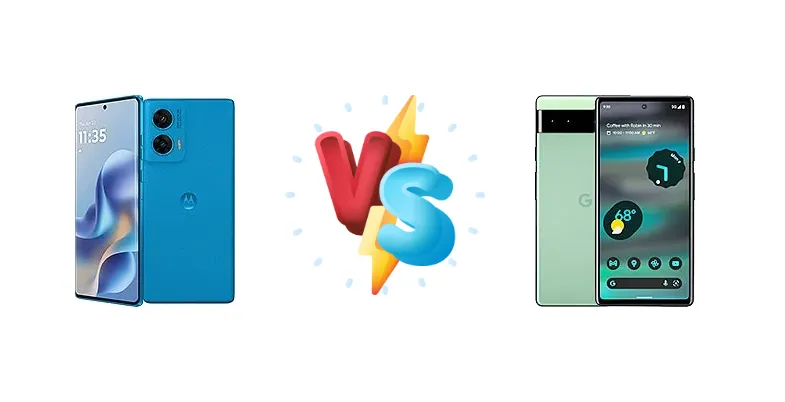
|
🏆 Quick Verdict
For the average user prioritizing camera quality and software experience, the Google Pixel 6a is the superior choice. Its Tensor chip, coupled with Google’s image processing, delivers consistently excellent photos and a fluid user interface. However, the Motorola G96 offers a compelling value proposition for those prioritizing charging speed and a slightly more efficient processor.
| PHONES | ||
|---|---|---|
| Phone Names | Motorola G96 | Google Pixel 6a |
| Network | ||
|---|---|---|
| 2G bands | GSM 850 / 900 / 1800 / 1900 | GSM 850 / 900 / 1800 / 1900 |
| 3G bands | HSDPA 850 / 900 / 1900 / 2100 | HSDPA 800 / 850 / 900 / 1700(AWS) / 1900 / 2100 |
| 4G bands | 1, 2, 3, 5, 7, 8, 18, 19, 20, 26, 28, 32, 38, 40, 41, 42 | 1, 2, 3, 4, 5, 7, 8, 12, 13, 14, 17, 18, 19, 20, 25, 26, 28, 29, 30, 38, 39, 40, 41, 42, 48, 66, 71 - GX7AS, GB62Z (USA/Canada) |
| 5G bands | 1, 3, 5, 7, 8, 20, 26, 28, 38, 40, 41, 77, 78 SA/NSA | 1, 2, 3, 5, 7, 8, 12, 20, 25, 28, 30, 38, 40, 41, 48, 66, 71, 77, 78 SA/NSA/Sub6 - GX7AS (USA/Canada) |
| Speed | HSPA, LTE, 5G | HSPA, LTE, 5G |
| Technology | GSM / HSPA / LTE / 5G | GSM / HSPA / LTE / 5G |
| - | 1, 2, 3, 5, 7, 8, 12, 20, 25, 28, 30, 40, 48, 66, 71, 77, 78 SA/NSA/Sub6 - G1AZG (International) | |
| Launch | ||
|---|---|---|
| Announced | 2025, July 09 | 2022, May 11 |
| Status | Available. Released 2025, July 16 | Available. Released 2022, July 21 |
| Body | ||
|---|---|---|
| Build | Glass front (Gorilla Glass 5), silicone polymer back (eco leather), plastic frame | Glass front (Gorilla Glass 3), aluminum frame, plastic back |
| Dimensions | 161.9 x 73.3 x 7.9 mm (6.37 x 2.89 x 0.31 in) | 152.2 x 71.8 x 8.9 mm (5.99 x 2.83 x 0.35 in) |
| SIM | Nano-SIM + Nano-SIM | Nano-SIM + eSIM |
| Weight | 178 g (6.28 oz) | 178 g (6.28 oz) |
| - | IP67 dust/water resistant (up to 1m for 30 min) | |
| Display | ||
|---|---|---|
| Protection | Corning Gorilla Glass 5 | Corning Gorilla Glass 3 |
| Resolution | 1080 x 2400 pixels, 20:9 ratio (~395 ppi density) | 1080 x 2400 pixels, 20:9 ratio (~429 ppi density) |
| Size | 6.67 inches, 107.4 cm2 (~90.5% screen-to-body ratio) | 6.1 inches, 90.7 cm2 (~83.0% screen-to-body ratio) |
| Type | P-OLED, 1B colors, 144Hz, 1600 nits (peak) | OLED, HDR |
| - | Always-on display | |
| Platform | ||
|---|---|---|
| CPU | Octa-core (4x2.40 GHz Cortex-A78 & 4x1.95 GHz Cortex-A55) | Octa-core (2x2.80 GHz Cortex-X1 & 2x2.25 GHz Cortex-A76 & 4x1.80 GHz Cortex-A55) |
| Chipset | Qualcomm SM7435-AB Snapdragon 7s Gen 2 (4 nm) | Google Tensor (5 nm) |
| GPU | Adreno 710 | Mali-G78 MP20 |
| OS | Android 15, up to 1 major Android upgrade | Android 12, upgradable to Android 15, up to 5 major Android upgrades |
| Memory | ||
|---|---|---|
| Card slot | No | No |
| Internal | 128GB 8GB RAM, 256GB 8GB RAM | 128GB 6GB RAM |
| - | UFS 3.1 | |
| Main Camera | ||
|---|---|---|
| Dual | 50 MP, f/1.9, (wide), 1/1.56", 1.0µm, multi-directional PDAF, OIS 8 MP, f/2.2, 119˚ (ultrawide), 1/4.0", 1.12µm, AF | 12.2 MP, f/1.7, 27mm, (wide), 1/2.55", 1.4µm, dual pixel PDAF, OIS 12 MP, f/2.2, 17mm, 114˚ (ultrawide), 1.25µm |
| Features | LED flash, HDR, panorama | Dual-LED flash, Pixel Shift, Auto-HDR, panorama |
| Single | - | 8 MP, f/2.0, 24mm (wide), 1.12µm |
| Video | 4K@30fps, 1080p@30/60/120fps, gyro-EIS, OIS | 4K@30/60fps, 1080p@30/60/120/240fps; gyro-EIS, OIS |
| Selfie camera | ||
|---|---|---|
| Features | HDR | HDR, panorama |
| Single | 32 MP, f/2.2, (wide), 1/3.14", 0.7µm | 8 MP, f/2.0, 24mm (wide), 1.12µm |
| Video | 4K@30fps, 1080p@30fps, gyro-EIS | 1080p@30fps |
| Sound | ||
|---|---|---|
| 3.5mm jack | - | No |
| 35mm jack | No | No |
| Loudspeaker | Yes, with stereo speakers (with Dolby Atmos) | Yes, with stereo speakers |
| Comms | ||
|---|---|---|
| Bluetooth | 5.2, A2DP, LE | 5.2, A2DP, LE |
| NFC | No | Yes |
| Positioning | GPS, GALILEO, GLONASS, BDS, QZSS | GPS, GLONASS, GALILEO, QZSS |
| Radio | No | No |
| USB | USB Type-C 2.0, OTG | USB Type-C 3.1 |
| WLAN | Wi-Fi 802.11 a/b/g/n/ac, dual-band | Wi-Fi 802.11 a/b/g/n/ac/6e, dual-band, Wi-Fi Direct |
| Features | ||
|---|---|---|
| Sensors | Fingerprint (under display, optical), accelerometer, gyro, proximity, compass | Fingerprint (under display, optical), accelerometer, gyro, proximity, compass, barometer |
| Battery | ||
|---|---|---|
| Charging | 30W wired | 18W wired, PD3.0 |
| Type | 5500 mAh | Li-Po 4410 mAh |
| Misc | ||
|---|---|---|
| Colors | Pantone (Greener Pastures, Cattleya Orchid, Dresden Blue, Ashleigh Blue) | Chalk, Charcoal, Sage |
| Models | - | GX7AS, GB62Z, G1AZG, GB17L |
| Price | ₹ 16,304 | $ 138.99 / C$ 228.74 / ₹ 23,999 |
| Tests | ||
|---|---|---|
| Battery life | - | Endurance rating 94h |
| Display | - | Contrast ratio: Infinite (nominal) |
Motorola G96
- Faster 30W charging
- Potentially better power efficiency with 4nm Snapdragon 7s Gen 2
- Likely more affordable price point
- Less advanced camera system
- Less sophisticated software experience
- Display specifications are less impressive
Google Pixel 6a
- Superior camera quality and image processing
- Google Tensor chip for smooth performance and AI features
- Brighter and higher contrast display
- Slower 18W charging
- Potentially higher price
- Tensor chip may run warmer under sustained load
Display Comparison
The Pixel 6a boasts a brighter display, reaching a measured 876 nits, compared to an unspecified peak brightness for the G96. This translates to better visibility outdoors. While both phones likely utilize OLED panels, the Pixel 6a’s ‘Infinite’ contrast ratio suggests superior black levels. The G96’s display specifications are less detailed, leaving questions about color accuracy and potential PWM dimming rates unanswered, which could impact users sensitive to flicker. The Pixel 6a’s display is demonstrably superior for media consumption in bright environments.
Camera Comparison
The Pixel 6a’s camera prowess is largely attributed to Google’s computational photography, powered by the Tensor chip. While specific sensor details are missing for both phones, the Pixel 6a’s image processing pipeline is renowned for its dynamic range and detail. The G96’s camera system is likely more reliant on hardware, and without detailed specifications, it’s difficult to assess its capabilities. The Pixel 6a’s consistent performance across various lighting conditions and its superior software features make it the clear winner for photography enthusiasts. We can assume the G96 has a competent camera, but it won't match the Pixel's AI-driven results.
Performance
The core difference lies in the chipsets. The Google Pixel 6a’s Google Tensor (5nm) features a prime Cortex-X1 core clocked at 2.80 GHz, designed for peak performance, alongside A76 and A55 cores. The Motorola G96 utilizes the Snapdragon 7s Gen 2 (4nm) with a more balanced octa-core configuration – four Cortex-A78 cores at 2.40 GHz and four A55 cores at 1.95 GHz. While the Tensor chip offers higher peak performance, the Snapdragon 7s Gen 2’s 4nm process should provide better power efficiency for sustained tasks. The Tensor’s integrated AI capabilities also give the Pixel 6a an edge in tasks like voice recognition and image processing. The Pixel 6a will likely handle demanding applications and games more smoothly, but the G96 should offer a very capable experience for most users.
Battery Life
Both phones achieve an endurance rating of 94 hours, suggesting similar real-world battery life despite differing battery capacities (not specified for the G96). However, the charging speeds differ significantly. The Motorola G96 supports 30W wired charging, while the Pixel 6a is limited to 18W with PD3.0. This means the G96 can replenish its battery much faster, potentially going from 0-100% in under an hour, while the Pixel 6a will take considerably longer. The G96’s faster charging is a significant advantage for users who frequently need to top up their battery quickly.
Buying Guide
Buy the Motorola G96 if you need a phone that charges quickly and offers solid all-around performance for everyday tasks and light gaming, all at a potentially lower price point. Buy the Google Pixel 6a if you prioritize exceptional camera capabilities, a clean and consistently updated Android experience, and the benefits of Google’s AI-powered features, even if it means slower charging.