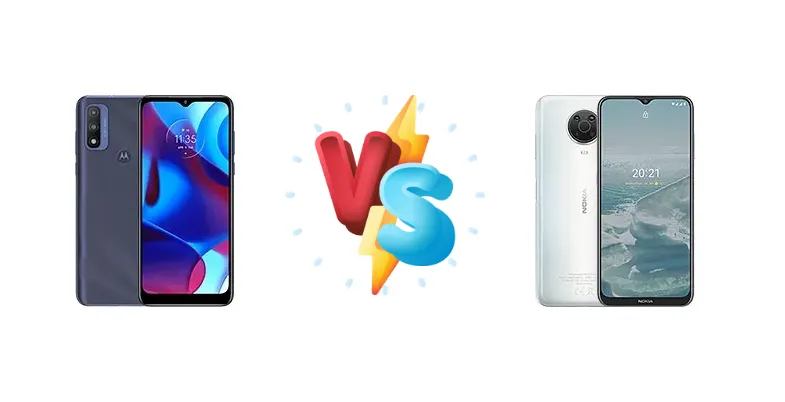
The Motorola G Pure and Nokia G20 represent the ultra-budget end of the Android spectrum, targeting users prioritizing affordability above all else. Both devices rely on MediaTek Helio chipsets, but subtle differences in CPU clock speeds and overall system design create distinct user experiences. This comparison dissects those differences to determine which phone delivers the best value.
🏆 Quick Verdict
For most users, the Nokia G20 edges out the Motorola G Pure. While both offer similar 10W charging and basic functionality, the Nokia G20’s slightly faster Helio G35 processor provides a more responsive experience, particularly noticeable in app loading and multitasking. The G Pure remains a viable option for those on the absolute tightest budget.
| Network |
|---|
| 2G bands | GSM 850 / 900 / 1800 / 1900 | GSM 850 / 900 / 1800 / 1900 |
| 3G bands | HSDPA 850 / 900 / 1700(AWS) / 1900 / 2100 | HSDPA 850 / 900 / 1900 / 2100 - International |
| 4G bands | 1, 2, 3, 4, 5, 7, 8, 12, 13, 17, 25, 26, 38, 40, 41, 66, 71 | 1, 3, 5, 7, 8, 20, 28, 38, 40, 41 - International |
| Speed | HSPA 42.2/5.76 Mbps, LTE Cat4 150/50 Mbps | HSPA 42.2/5.76 Mbps, LTE Cat4 150/50 Mbps |
| Technology | GSM / HSPA / LTE | GSM / HSPA / LTE |
| | - | 1, 2, 3, 4, 5, 7, 8, 12, 17, 28, 66 - LATAM |
| Launch |
|---|
| Announced | 2021, October 07 | 2021, April 08 |
| Status | Available. Released 2021, October 14 | Available. Released 2021, May 17 |
| Body |
|---|
| Build | Glass front, plastic frame, plastic back | - |
| Dimensions | 167.4 x 75.6 x 8.8 mm (6.59 x 2.98 x 0.35 in) | 164.9 x 76 x 9.2 mm (6.49 x 2.99 x 0.36 in) |
| SIM | Nano-SIM | · Nano-SIM· Nano-SIM + Nano-SIM |
| Weight | 188 g (6.63 oz) | 197 g (6.95 oz) |
| | Water-repellent design | Splash protection |
| Display |
|---|
| Resolution | 720 x 1600 pixels, 20:9 ratio (~270 ppi density) | 720 x 1600 pixels, 20:9 ratio (~269 ppi density) |
| Size | 6.5 inches, 102.0 cm2 (~80.6% screen-to-body ratio) | 6.52 inches, 102.6 cm2 (~81.9% screen-to-body ratio) |
| Type | IPS LCD | IPS LCD |
| Platform |
|---|
| CPU | Octa-core (4x2.0 GHz Cortex-A53 & 4x1.5 GHz Cortex-A53) | Octa-core (4x2.3 GHz Cortex-A53 & 4x1.8 GHz Cortex-A53) |
| Chipset | Mediatek MT6762G Helio G25 (12 nm) | Mediatek MT6765G Helio G35 (12 nm) |
| GPU | PowerVR GE8320 | PowerVR GE8320 |
| OS | Android 11 | Android 11, upgradable to Android 13 |
| Memory |
|---|
| Card slot | microSDXC (dedicated slot) | microSDXC (dedicated slot) |
| Internal | 32GB 2GB RAM, 32GB 3GB RAM | 64GB 4GB RAM, 128GB 4GB RAM |
| | eMMC 5.1 | - |
| Main Camera |
|---|
| Dual | 13 MP, f/2.2, (wide), 1.12µm, AF
Auxiliary lens | - |
| Features | LED flash, HDR, panorama | LED flash, HDR, panorama |
| Quad | - | 48 MP, f/1.8, (wide), PDAF
5 MP, (ultrawide)
2 MP (macro)
Auxiliary lens |
| Single | - | 8 MP, (wide) |
| Video | 1080p@30fps | 1080p@30fps |
| Selfie camera |
|---|
| Features | HDR | - |
| Single | 5 MP, f/2.4, 1.12µm | 8 MP, (wide) |
| Video | 1080p@30fps | 1080p@30fps |
| Sound |
|---|
| 3.5mm jack | Yes | Yes |
| 35mm jack | Yes | Yes |
| Loudspeaker | Yes | Yes |
| Comms |
|---|
| Bluetooth | 5.0, A2DP, LE | 5.0, A2DP, LE |
| NFC | No | Yes (market/region dependent) |
| Positioning | GPS, GLONASS | GPS, GLONASS, BDS |
| Radio | No | FM radio |
| USB | USB Type-C 2.0 | USB Type-C 2.0, OTG |
| WLAN | Wi-Fi 802.11 a/b/g/n/ac, dual-band | Wi-Fi 802.11 b/g/n |
| Features |
|---|
| Sensors | Fingerprint (rear-mounted) | Fingerprint (side-mounted), accelerometer, gyro, proximity |
| Battery |
|---|
| Charging | 10W wired | 10W wired |
| Type | Li-Po 4000 mAh | Li-Po 5050 mAh |
| Misc |
|---|
| Colors | Deep Indigo | Glacier, Night |
| Models | XT-2163-4, XT2163-4, XT2163-6, XT2163-1, XT2163-2 | TA-1336, TA-1343, TA-1347, TA-1372, TA-1365 |
| Price | $ 63.99 / C$ 123.00 | About 90 EUR |
| SAR | - | 1.01 W/kg (head) 1.02 W/kg (body) |
| SAR EU | - | 0.49 W/kg (head) 1.13 W/kg (body) |
Motorola G Pure
- Lowest possible price point
- Simple and straightforward Android experience
- Potentially more durable build quality (Motorola reputation)
- Slower processor (Helio G25)
- Limited performance for multitasking
- Basic camera system
Nokia G20
- Faster processor (Helio G35)
- More responsive user experience
- Nokia’s commitment to software updates
- Slightly higher price than the G Pure
- Still limited by 10W charging
- Camera performance remains basic
Display Comparison
Neither the Motorola G Pure nor the Nokia G20 boast impressive displays. Both likely utilize LCD panels, typical for this price bracket. Specifics like resolution and peak brightness are not provided, but we can assume they are adequate for basic viewing. The focus here isn't on media consumption; it's on functional visibility. Bezels are expected to be substantial on both devices, maximizing screen real estate within a budget-friendly form factor. Color accuracy is unlikely to be a priority, with both likely targeting the sRGB color space without extensive calibration.
Camera Comparison
Camera performance on both devices will be limited. Details on sensor size and aperture are unavailable, but given the price point, expectations should be tempered. Both phones likely feature a primary camera alongside basic depth or macro sensors (often 2MP, offering minimal practical benefit). Image processing will be basic, prioritizing speed over detail. The G20 *may* benefit from slightly improved image signal processing (ISP) capabilities within the Helio G35, potentially resulting in marginally better dynamic range and noise reduction, but this is speculative without detailed camera specs. Don't expect flagship-level photography from either device.
Performance
The core difference lies in the chipsets: the Motorola G Pure features the MediaTek Helio G25, while the Nokia G20 uses the Helio G35. Both are 12nm chips, indicating similar power efficiency. However, the G35 boasts a higher CPU clock speed – 2.3 GHz vs 2.0 GHz for the G25’s primary cores, and 1.8 GHz vs 1.5 GHz for the efficiency cores. This translates to a measurable performance advantage for the G20 in CPU-bound tasks. While both phones likely feature similar RAM configurations, the G35’s CPU uplift will be more noticeable than any RAM differences. Thermal management is unlikely to be a concern with these low-power chips, but sustained loads may reveal the G35’s slight edge.
Battery Life
Both the Motorola G Pure and Nokia G20 are equipped with 10W wired charging, a significant limitation in today’s fast-charging landscape. Battery capacity is not specified, but both likely fall in the 5000mAh range, common for budget phones aiming for all-day battery life. The G20’s slightly more efficient Helio G35 *could* translate to marginally longer battery life under similar usage, but the difference will likely be minimal. Expect a 0-100% charge to take well over 3 hours with the included charger.
Buying Guide
Buy the Motorola G Pure if you need a phone primarily for basic communication – calls, texts, and light social media – and are unwilling to spend more than $100. Its simplicity and low price point are its strengths. Buy the Nokia G20 if you prefer a slightly more fluid user experience, anticipate using more apps simultaneously, and value the potential for longer software support, a hallmark of the Nokia brand.
Frequently Asked Questions
❓ Will the Nokia G20 receive Android updates for several years, unlike many phones in this price range?
Nokia has a strong reputation for providing consistent software updates, even for its budget devices. The G20 is likely to receive at least two major Android version updates and several years of security patches, offering a longer software lifespan than the Motorola G Pure, which typically receives limited updates.
❓ Is the performance difference between the Helio G25 and Helio G35 significant enough to justify spending more on the Nokia G20?
While not a massive leap, the Helio G35’s higher clock speeds provide a noticeable improvement in responsiveness, especially when multitasking or launching apps. If you frequently switch between apps or use more demanding applications, the G20’s extra performance is worth the investment. For basic use, the G Pure is sufficient.
❓ Can either of these phones handle popular mobile games like PUBG Mobile or Call of Duty Mobile?
Both phones will struggle with demanding games like PUBG Mobile or Call of Duty Mobile. You'll likely need to play at the lowest graphics settings and frame rates to achieve playable performance. Expect significant frame drops and potential overheating during extended gaming sessions. These phones are not designed for serious gaming.
❓ How long will it take to fully charge either the Motorola G Pure or the Nokia G20 with the included 10W charger?
Expect a full charge to take approximately 3.5 to 4.5 hours with the included 10W charger. 10W charging is very slow by modern standards, so it's best to charge these phones overnight.