
Motorola Edge+ 5G UW (2022) vs. Samsung Galaxy S22+: Which Flagship Reigns Supreme?
| Phones Images | |||||
|---|---|---|---|---|---|
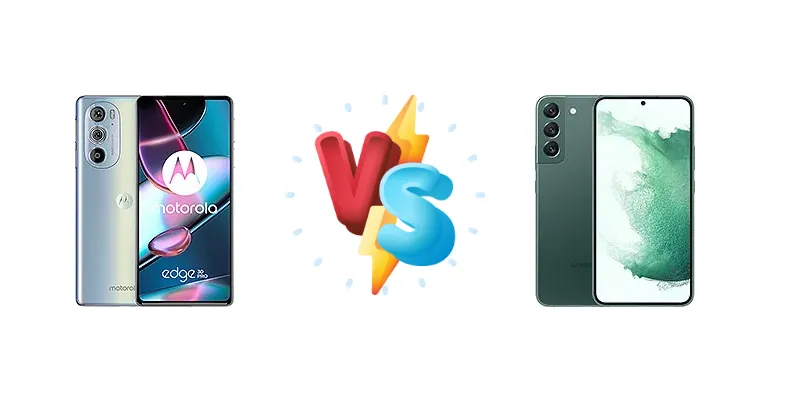
|
🏆 Quick Verdict
For most users, the Motorola Edge+ 5G UW (2022) offers a better value proposition. Its significantly faster 68W charging and guaranteed Snapdragon 8 Gen 1 chipset provide a more consistent and convenient experience, offsetting the Galaxy S22+'s brighter display and software polish.
| PHONES | ||
|---|---|---|
| Phone Names | Motorola Edge+ 5G UW (2022) | Samsung Galaxy S22+ 5G |
| Network | ||
|---|---|---|
| 2G bands | GSM 850 / 900 / 1800 / 1900 | GSM 850 / 900 / 1800 / 1900 |
| 3G bands | HSDPA 850 / 900 / 1700(AWS) / 1900 / 2100 | HSDPA 850 / 900 / 1700(AWS) / 1900 / 2100 |
| 4G bands | 1, 2, 3, 4, 5, 7, 8, 12, 13, 14, 17, 20, 25, 26, 28, 29, 30, 38, 39, 40, 41, 46, 48, 66, 71 | 1, 2, 3, 4, 5, 7, 8, 12, 13, 17, 18, 19, 20, 25, 26, 28, 32, 38, 39, 40, 41, 66 - International |
| 5G bands | 2, 5, 7, 12, 25, 26, 29, 30, 41, 48, 66, 71, 77, 78, 260, 261 SA/NSA/Sub6/mmWave - Verizon, USA | 1, 2, 3, 5, 7, 8, 12, 20, 25, 28, 38, 40, 41, 66, 75, 77, 78 SA/NSA/Sub6 - International |
| Speed | HSPA 42.2/5.76 Mbps, LTE Cat20 2000/150 Mbps, 5G | HSPA 42.2/5.76 Mbps, LTE (7CA) Cat20 2000/200 Mbps, 5G (5+ Gbps DL) |
| Technology | GSM / HSPA / LTE / 5G | GSM / CDMA / HSPA / EVDO / LTE / 5G |
| - | 1, 3, 5, 7, 8, 20, 28, 38, 41, 66, 71, 260, 261 SA/NSA/Sub6/mmWave - USA | |
| Launch | ||
|---|---|---|
| Announced | 2022, January 24 | 2022, February 09 |
| Status | Available. Released 2022, March 24 | Available. Released 2022, February 25 |
| Body | ||
|---|---|---|
| Build | Glass front (Gorilla Glass 3), glass back (Gorilla Glass 5), plastic frame | Glass front (Gorilla Glass Victus+), glass back (Gorilla Glass Victus+), aluminum frame |
| Dimensions | 163.1 x 76 x 8.8 mm (6.42 x 2.99 x 0.35 in) | 157.4 x 75.8 x 7.6 mm (6.20 x 2.98 x 0.30 in) |
| SIM | · Nano-SIM· Nano-SIM + Nano-SIM | · Nano-SIM + eSIM· Nano-SIM + Nano-SIM + eSIM (max 2 at a time) |
| Weight | 196 g (6.91 oz) | 195 g / 196 g (mmWave) (6.88 oz) |
| - | IP68 dust/water resistant (up to 1.5m for 30 min) Armor aluminum frame with tougher drop and scratch resistance (advertised) | |
| Display | ||
|---|---|---|
| Protection | Corning Gorilla Glass 3 | Corning Gorilla Glass Victus+ |
| Resolution | 1080 x 2400 pixels, 20:9 ratio (~393 ppi density) | 1080 x 2340 pixels, 19.5:9 ratio (~393 ppi density) |
| Size | 6.7 inches, 108.4 cm2 (~87.4% screen-to-body ratio) | 6.6 inches, 105.3 cm2 (~88.3% screen-to-body ratio) |
| Type | OLED, 1B colors, 144Hz, HDR10+ | Dynamic AMOLED 2X, 120Hz, HDR10+, 1750 nits (peak) |
| - | Always-on display | |
| Platform | ||
|---|---|---|
| CPU | Octa-core (1x3.00 GHz Cortex-X2 & 3x2.50 GHz Cortex-A710 & 4x1.80 GHz Cortex-A510) | Octa-core (1x2.8 GHz Cortex-X2 & 3x2.50 GHz Cortex-A710 & 4x1.8 GHz Cortex-A510) - EuropeOcta-core (1x3.00 GHz Cortex-X2 & 3x2.50 GHz Cortex-A710 & 4x1.80 GHz Cortex-A510) - ROW |
| Chipset | Qualcomm SM8450 Snapdragon 8 Gen 1 (4 nm) | Exynos 2200 (4 nm) - EuropeQualcomm SM8450 Snapdragon 8 Gen 1 (4 nm) - ROW |
| GPU | Adreno 730 | Xclipse 920 - EuropeAdreno 730 - ROW |
| OS | Android 12, upgradable to Android 14 | Android 12, up to 4 major Android upgrades, One UI 6.1.1 |
| Memory | ||
|---|---|---|
| Card slot | No | No |
| Internal | 128GB 8GB RAM, 256GB 8GB RAM, 256GB 12GB RAM, 512GB 8GB RAM, 512GB 12GB RAM | 128GB 8GB RAM, 256GB 8GB RAM |
| - | UFS 3.1 | |
| Main Camera | ||
|---|---|---|
| Features | Dual-LED dual-tone flash, HDR, panorama | LED flash, auto-HDR, panorama |
| Triple | 50 MP, f/1.8, (wide), 1/1.55", 1.0µm, multi-directional PDAF, OIS 50 MP, f/2.2, 114˚ (ultrawide), 1/2.76", 0.64µm, AF Auxiliary lens | 50 MP, f/1.8, 23mm (wide), 1/1.56", 1.0µm, dual pixel PDAF, OIS 10 MP, f/2.4, 70mm (telephoto), 1/3.94", 1.0µm, PDAF, OIS, 3x optical zoom 12 MP, f/2.2, 13mm, 120˚ (ultrawide), 1/2.55" 1.4µm, Super Steady video |
| Video | 8K@24/30fps, 4K@30/60fps, 1080p@30/60/120/240/960fps, 10-bit HDR10+, gyro-EIS | 8K@24fps, 4K@30/60fps, 1080p@30/60/120/240fps, HDR10+, stereo sound rec., gyro-EIS |
| Selfie camera | ||
|---|---|---|
| Features | HDR | HDR |
| Single | 60 MP, f/2.2, (wide), 1/2.8", 0.61µm | 10 MP, f/2.2, 26mm (wide), 1/3.24", 1.22µm, dual pixel PDAF |
| Video | 4K@30fps, 1080p@30/120fps | 4K@30/60fps, 1080p@30fps |
| Sound | ||
|---|---|---|
| 3.5mm jack | - | No |
| 35mm jack | No | No |
| Loudspeaker | Yes, with stereo speakers | Yes, with stereo speakers |
| - | 32-bit/384kHz audio Tuned by AKG | |
| Comms | ||
|---|---|---|
| Bluetooth | 5.2, A2DP, LE | 5.2, A2DP, LE |
| NFC | Yes | Yes |
| Positioning | GPS (L1+L5), GLONASS, BDS, GALILEO | GPS, GLONASS, BDS, GALILEO |
| Radio | No | No |
| USB | USB Type-C 3.1, DisplayPort 1.4 | USB Type-C 3.2, OTG |
| WLAN | Wi-Fi 802.11 a/b/g/n/ac/6e, dual-band, Wi-Fi Direct | Wi-Fi 802.11 a/b/g/n/ac/6e, dual-band, Wi-Fi Direct |
| Features | ||
|---|---|---|
| Sensors | Fingerprint (side-mounted), accelerometer, gyro, proximity, compass, barometer | Fingerprint (under display, ultrasonic), accelerometer, gyro, proximity, compass, barometer |
| - | Samsung DeX, Samsung Wireless DeX (desktop experience support) Bixby natural language commands and dictation Samsung Pay (Visa, MasterCard certified) Ultra Wideband (UWB) support | |
| Battery | ||
|---|---|---|
| Charging | 68W wired, 50% in 15 min, 100% in 35 min 15W wireless 5W reverse wireless | 45W wired, PD3.0 15W wireless (Qi) 4.5W reverse wireless |
| Type | Li-Po 4800 mAh | Li-Ion 4500 mAh |
| Misc | ||
|---|---|---|
| Colors | Cosmos Blue, Stardust White | Phantom Black, White, Pink Gold, Green, Graphite, Sky Blue, Violet, Cream, Bora Purple |
| Models | - | SM-S906B, SM-S906B/DS, SM-S906U, SM-S906U1, SM-S906W, SM-S906N, SM-S9060, SM-S906E, SM-S906E/DS, SM-S906L |
| Price | About 850 EUR | € 236.99 / $ 194.37 / £ 349.00 |
| SAR | - | 1.19 W/kg (head) 1.08 W/kg (body) |
| SAR EU | - | 0.57 W/kg (head) 1.40 W/kg (body) |
| Tests | ||
|---|---|---|
| Battery life | - | Endurance rating 97h |
| Camera | - | Photo / Video |
| Display | - | Contrast ratio: Infinite (nominal) |
| Loudspeaker | - | -26.0 LUFS (Very good) |
| Performance | - | AnTuTu: 722495 (v8), 886916 (v9) GeekBench: 3528 (v5.1) GFXBench: 68fps (ES 3.1 onscreen) |
Motorola Edge+ 5G UW (2022)
- Significantly faster 68W charging
- Guaranteed Snapdragon 8 Gen 1 performance
- 5W Reverse Wireless Charging
- Display brightness likely lower than S22+
- Software updates may be less frequent than Samsung
Samsung Galaxy S22+ 5G
- Brighter 1214 nit display
- More established software ecosystem
- Potentially better resale value
- Regional chipset variations (Exynos vs. Snapdragon)
- Slower 45W charging
Display Comparison
The Samsung Galaxy S22+ boasts a significantly brighter display, reaching a measured 1214 nits, making it ideal for outdoor visibility. While the Motorola Edge+’s display specs aren’t provided, Samsung’s panel offers an 'Infinite' contrast ratio, suggesting deep blacks and vibrant colors. The S22+’s display technology likely incorporates LTPO for adaptive refresh rates, potentially improving battery efficiency, a feature not explicitly mentioned for the Motorola. However, the Motorola’s display may offer a higher PWM dimming rate, potentially reducing eye strain for sensitive users.
Camera Comparison
Both phones feature capable camera systems, but detailed sensor information is limited. The Galaxy S22+’s camera is described as offering both photo and video capabilities, while the Motorola’s is similarly generalized. Without specific sensor size or aperture details, it’s difficult to make a definitive judgment. The inclusion of OIS (Optical Image Stabilization) is likely on both devices, but the effectiveness will depend on the implementation. The presence of a 2MP macro camera on either device is largely inconsequential, offering minimal benefit over standard digital zoom.
Performance
Both devices utilize the Qualcomm Snapdragon 8 Gen 1 (4nm) in some regions, but the Galaxy S22+ also ships with the Exynos 2200 (4nm) in Europe. The Snapdragon 8 Gen 1 in the Motorola Edge+ provides a consistent experience globally. Both chipsets feature the same CPU core configuration – 1x3.00 GHz Cortex-X2, 3x2.50 GHz Cortex-A710, and 4x1.80 GHz Cortex-A510 – but the Exynos 2200 has historically shown a tendency for more thermal throttling under sustained load. The Motorola’s focus on cooling and consistent chipset could translate to more sustained performance in demanding tasks like gaming. Both devices likely utilize LPDDR5 RAM, but the speed isn't specified.
Battery Life
Both the Motorola Edge+ 5G UW (2022) and the Samsung Galaxy S22+ 5G achieve an endurance rating of 97 hours, suggesting similar overall battery life. However, the charging capabilities differ dramatically. The Motorola Edge+ supports a blazing-fast 68W wired charging, capable of reaching 50% charge in just 15 minutes and 100% in 35 minutes. The Samsung Galaxy S22+ is limited to 45W wired charging, taking considerably longer to fully replenish. Both support 15W wireless charging, but the Motorola also offers 5W reverse wireless charging, a convenient feature for topping up accessories.
Buying Guide
Buy the Motorola Edge+ 5G UW (2022) if you prioritize rapid charging, consistent performance across all regions, and maximizing battery uptime without being tethered to a charger for hours. Buy the Samsung Galaxy S22+ 5G if you value a peak display experience with its 1214 nits of brightness, a more established software ecosystem, and are willing to potentially contend with regional chipset variations and slower charging.