
Motorola Edge+ 5G UW (2022) vs. Samsung Galaxy S22 Ultra 5G: A Deep Dive
| Phones Images | |||||
|---|---|---|---|---|---|
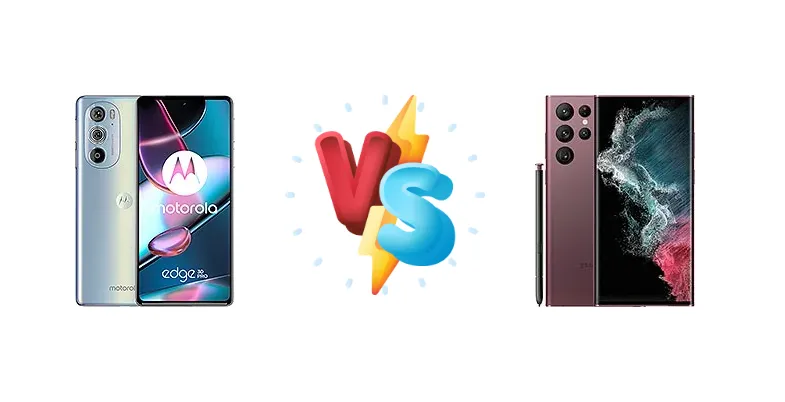
|
🏆 Quick Verdict
For the average user prioritizing raw performance and faster charging, the Motorola Edge+ 5G UW (2022) offers compelling value. However, the Samsung Galaxy S22 Ultra 5G’s superior display, more versatile camera system, and broader feature set make it the better choice for those willing to invest in a premium experience.
| PHONES | ||
|---|---|---|
| Phone Names | Motorola Edge+ 5G UW (2022) | Samsung Galaxy S22 Ultra 5G |
| Network | ||
|---|---|---|
| 2G bands | GSM 850 / 900 / 1800 / 1900 | GSM 850 / 900 / 1800 / 1900 |
| 3G bands | HSDPA 850 / 900 / 1700(AWS) / 1900 / 2100 | HSDPA 850 / 900 / 1700(AWS) / 1900 / 2100 |
| 4G bands | 1, 2, 3, 4, 5, 7, 8, 12, 13, 14, 17, 20, 25, 26, 28, 29, 30, 38, 39, 40, 41, 46, 48, 66, 71 | 1, 2, 3, 4, 5, 7, 8, 12, 13, 17, 18, 19, 20, 25, 26, 28, 32, 38, 39, 40, 41, 66 - International |
| 5G bands | 2, 5, 7, 12, 25, 26, 29, 30, 41, 48, 66, 71, 77, 78, 260, 261 SA/NSA/Sub6/mmWave - Verizon, USA | 1, 2, 3, 5, 7, 8, 12, 20, 25, 28, 38, 40, 41, 66, 75, 77, 78 SA/NSA/Sub6 - International |
| Speed | HSPA 42.2/5.76 Mbps, LTE Cat20 2000/150 Mbps, 5G | HSPA 42.2/5.76 Mbps, LTE (7CA) Cat20 2000/200 Mbps, 5G (5+ Gbps DL) |
| Technology | GSM / HSPA / LTE / 5G | GSM / CDMA / HSPA / EVDO / LTE / 5G |
| - | 1, 3, 5, 7, 8, 20, 28, 38, 41, 66, 71, 260, 261 SA/NSA/Sub6/mmWave - USA | |
| Launch | ||
|---|---|---|
| Announced | 2022, January 24 | 2022, February 09 |
| Status | Available. Released 2022, March 24 | Available. Released 2022, February 25 |
| Body | ||
|---|---|---|
| Build | Glass front (Gorilla Glass 3), glass back (Gorilla Glass 5), plastic frame | Glass front (Gorilla Glass Victus+), glass back (Gorilla Glass Victus+), aluminum frame |
| Dimensions | 163.1 x 76 x 8.8 mm (6.42 x 2.99 x 0.35 in) | 163.3 x 77.9 x 8.9 mm (6.43 x 3.07 x 0.35 in) |
| SIM | · Nano-SIM· Nano-SIM + Nano-SIM | · Nano-SIM + eSIM· Nano-SIM + Nano-SIM + eSIM (max 2 at a time) |
| Weight | 196 g (6.91 oz) | 228 g / 229 g (mmWave) (8.04 oz) |
| - | IP68 dust/water resistant (up to 1.5m for 30 min) Armor aluminum frame with tougher drop and scratch resistance (advertised) Stylus, 2.8ms latency (Bluetooth integration, accelerometer, gyro) | |
| Display | ||
|---|---|---|
| Protection | Corning Gorilla Glass 3 | Corning Gorilla Glass Victus+ |
| Resolution | 1080 x 2400 pixels, 20:9 ratio (~393 ppi density) | 1440 x 3088 pixels, 19.3:9 ratio (~500 ppi density) |
| Size | 6.7 inches, 108.4 cm2 (~87.4% screen-to-body ratio) | 6.8 inches, 114.7 cm2 (~90.2% screen-to-body ratio) |
| Type | OLED, 1B colors, 144Hz, HDR10+ | Dynamic AMOLED 2X, 120Hz, HDR10+, 1750 nits (peak) |
| - | Always-on display | |
| Platform | ||
|---|---|---|
| CPU | Octa-core (1x3.00 GHz Cortex-X2 & 3x2.50 GHz Cortex-A710 & 4x1.80 GHz Cortex-A510) | Octa-core (1x2.8 GHz Cortex-X2 & 3x2.50 GHz Cortex-A710 & 4x1.8 GHz Cortex-A510) - EuropeOcta-core (1x3.00 GHz Cortex-X2 & 3x2.50 GHz Cortex-A710 & 4x1.80 GHz Cortex-A510) - ROW |
| Chipset | Qualcomm SM8450 Snapdragon 8 Gen 1 (4 nm) | Exynos 2200 (4 nm) - EuropeQualcomm SM8450 Snapdragon 8 Gen 1 (4 nm) - ROW |
| GPU | Adreno 730 | Xclipse 920 - EuropeAdreno 730 - ROW |
| OS | Android 12, upgradable to Android 14 | Android 12, up to 4 major Android upgrades, One UI 8 |
| Memory | ||
|---|---|---|
| Card slot | No | No |
| Internal | 128GB 8GB RAM, 256GB 8GB RAM, 256GB 12GB RAM, 512GB 8GB RAM, 512GB 12GB RAM | 128GB 8GB RAM, 256GB 12GB RAM, 512GB 12GB RAM, 1TB 12GB RAM |
| - | UFS 3.1 | |
| Main Camera | ||
|---|---|---|
| Features | Dual-LED dual-tone flash, HDR, panorama | Laser AF, LED flash, auto-HDR, panorama |
| Quad | - | 108 MP, f/1.8, 23mm (wide), 1/1.33", 0.8µm, PDAF, OIS 10 MP, f/2.4, 70mm (telephoto), 1/3.52", 1.12µm, PDAF, OIS, 3x optical zoom 10 MP, f/4.9, 230mm (periscope telephoto), 1/3.52", 1.12µm, PDAF, OIS, 10x optical zoom 12 MP, f/2.2, 13mm, 120˚ (ultrawide), 1/2.55", 1.4µm, dual pixel PDAF, Super Steady video |
| Triple | 50 MP, f/1.8, (wide), 1/1.55", 1.0µm, multi-directional PDAF, OIS 50 MP, f/2.2, 114˚ (ultrawide), 1/2.76", 0.64µm, AF Auxiliary lens | - |
| Video | 8K@24/30fps, 4K@30/60fps, 1080p@30/60/120/240/960fps, 10-bit HDR10+, gyro-EIS | 8K@24fps, 4K@30/60fps, 1080p@30/60/120/240fps, HDR10+, stereo sound rec., gyro-EIS |
| Selfie camera | ||
|---|---|---|
| Features | HDR | HDR |
| Single | 60 MP, f/2.2, (wide), 1/2.8", 0.61µm | 40 MP, f/2.2, 26mm (wide), 1/2.82", 0.7µm, PDAF |
| Video | 4K@30fps, 1080p@30/120fps | 4K@30/60fps, 1080p@30fps |
| Sound | ||
|---|---|---|
| 3.5mm jack | - | No |
| 35mm jack | No | No |
| Loudspeaker | Yes, with stereo speakers | Yes, with stereo speakers |
| - | 32-bit/384kHz audio Tuned by AKG | |
| Comms | ||
|---|---|---|
| Bluetooth | 5.2, A2DP, LE | 5.2, A2DP, LE |
| NFC | Yes | Yes |
| Positioning | GPS (L1+L5), GLONASS, BDS, GALILEO | GPS, GLONASS, BDS, GALILEO |
| Radio | No | No |
| USB | USB Type-C 3.1, DisplayPort 1.4 | USB Type-C 3.2, OTG |
| WLAN | Wi-Fi 802.11 a/b/g/n/ac/6e, dual-band, Wi-Fi Direct | Wi-Fi 802.11 a/b/g/n/ac/6e, dual-band, Wi-Fi Direct |
| Features | ||
|---|---|---|
| Sensors | Fingerprint (side-mounted), accelerometer, gyro, proximity, compass, barometer | Fingerprint (under display, ultrasonic), accelerometer, gyro, proximity, compass, barometer |
| - | Samsung DeX, Samsung Wireless DeX (desktop experience support) Bixby natural language commands and dictation Samsung Pay (Visa, MasterCard certified) Ultra Wideband (UWB) support | |
| Battery | ||
|---|---|---|
| Charging | 68W wired, 50% in 15 min, 100% in 35 min 15W wireless 5W reverse wireless | 45W wired, PD3.0 15W wireless (Qi) 4.5W reverse wireless |
| Type | Li-Po 4800 mAh | Li-Ion 5000 mAh |
| Misc | ||
|---|---|---|
| Colors | Cosmos Blue, Stardust White | Phantom Black, White, Burgundy, Green, Graphite, Red, Sky Blue, Bora Purple |
| Models | - | SM-S908B, SM-S908B/DS, SM-S908U, SM-S908U1, SM-S908W, SM-S908N, SM-S9080, SM-S908E, SM-S908E/DS |
| Price | About 850 EUR | € 397.07 / $ 269.98 / £ 304.99 / ₹ 63,899 |
| SAR | - | 1.18 W/kg (head) 0.98 W/kg (body) |
| SAR EU | - | 1.05 W/kg (head) 1.58 W/kg (body) |
| Tests | ||
|---|---|---|
| Battery life | - | Endurance rating 108h |
| Camera | - | Photo / Video |
| Display | - | Contrast ratio: Infinite (nominal) |
| Loudspeaker | - | -27.3 LUFS (Good) |
| Performance | - | AnTuTu: 968359 (v9) GeekBench: 3657 (v5.1) GFXBench: 37fps (ES 3.1 onscreen) |
Motorola Edge+ 5G UW (2022)
- Significantly faster 68W wired charging
- Potentially better sustained performance with Snapdragon 8 Gen 1
- More affordable price point
- Less versatile camera system
- Display not as bright or color-accurate as the S22 Ultra
Samsung Galaxy S22 Ultra 5G
- Superior display quality (brightness, color accuracy)
- More versatile and capable camera system
- Integrated S Pen functionality
- Slower 45W wired charging
- Exynos variant may experience thermal throttling
Display Comparison
The Samsung Galaxy S22 Ultra boasts a significantly brighter display, reaching a measured 1266 nits, compared to an unstated peak brightness for the Motorola Edge+. This difference is immediately noticeable in direct sunlight. While both likely utilize AMOLED technology, Samsung’s display benefits from an infinite contrast ratio and potentially a more sophisticated color calibration. The S22 Ultra’s adaptive refresh rate (LTPO) is also likely more granular, contributing to better power efficiency. The Motorola Edge+’s display, while good, doesn’t reach the same level of visual fidelity.
Camera Comparison
The Galaxy S22 Ultra’s camera system is far more comprehensive. While both phones offer capable photography, Samsung’s offering includes multiple lenses with varying focal lengths and significantly more advanced image processing. The S22 Ultra’s larger main sensor (spec not provided, but typically larger than Motorola’s) captures more light, resulting in better low-light performance. The S22 Ultra’s optical image stabilization (OIS) is also likely more sophisticated. The Motorola Edge+’s camera is competent, but lacks the versatility and refinement of Samsung’s flagship. The inclusion of a 2MP macro camera on the Motorola is largely a marketing gimmick, offering minimal practical benefit.
Performance
Both phones utilize the Qualcomm Snapdragon 8 Gen 1 chipset in some regions (ROW for both). However, the Galaxy S22 Ultra is also available with the Exynos 2200 in Europe. The Snapdragon 8 Gen 1 in the Motorola Edge+ and the ROW S22 Ultra offers a slight edge in sustained performance due to potentially better thermal management, as the Motorola has a simpler cooling solution focused on maximizing performance. The Exynos 2200 has historically faced criticism for throttling under sustained load. Both CPUs feature the same core configuration (1x Cortex-X2, 3x Cortex-A710, 4x Cortex-A510), but the Snapdragon’s 3.00 GHz Cortex-X2 clock speed (vs 2.8 GHz on the European Exynos variant) provides a marginal advantage. Both utilize LPDDR5 RAM, but the S22 Ultra’s larger memory capacity (likely 8GB or 12GB vs. the Edge+'s 8GB or 12GB) aids multitasking.
Battery Life
Both phones have an endurance rating of 108h, suggesting similar overall battery life despite potentially different battery capacities (not specified for the Motorola). However, the Motorola Edge+ 5G UW (2022) significantly outperforms the S22 Ultra in charging speed, achieving 50% charge in just 15 minutes and 100% in 35 minutes with its 68W wired charging. The S22 Ultra’s 45W charging, while supporting PD3.0, is considerably slower. Both support 15W wireless charging, but the Motorola also offers 5W reverse wireless charging, a useful feature for topping up accessories.
Buying Guide
Buy the Motorola Edge+ 5G UW (2022) if you need a phone that prioritizes sustained performance for demanding tasks like gaming and video editing, and you value incredibly fast 68W charging. Buy the Samsung Galaxy S22 Ultra 5G if you prefer a more polished software experience, a class-leading display, a highly capable and versatile camera system, and the integrated S Pen functionality.