
Motorola Edge+ (2020) vs Google Pixel 5a 5G: Which Android Phone Reigns Supreme?
| Phones Images | |||||
|---|---|---|---|---|---|
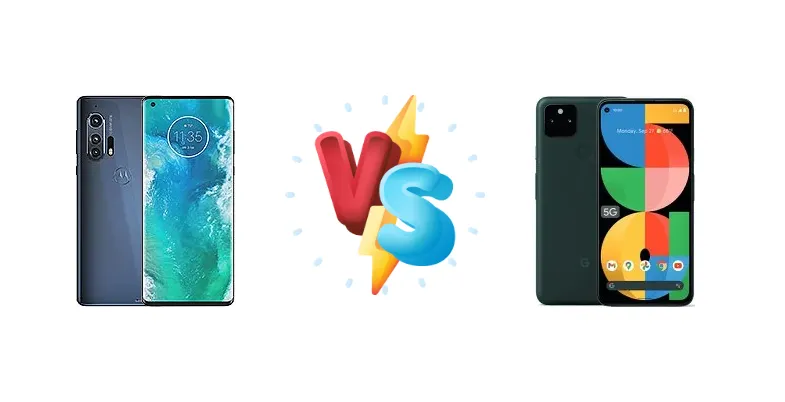
|
🏆 Quick Verdict
For the average user prioritizing battery life and a consistently excellent camera experience, the Google Pixel 5a 5G is the better choice. However, users demanding maximum performance for demanding tasks like gaming or video editing will find the Motorola Edge+ (2020)'s Snapdragon 865 a more suitable option, despite its shorter battery endurance.
| PHONES | ||
|---|---|---|
| Phone Names | Motorola Edge+ (2020) | Google Pixel 5a 5G |
| Network | ||
|---|---|---|
| 2G bands | GSM 850 / 900 / 1800 / 1900 | GSM 850 / 900 / 1800 / 1900 |
| 3G bands | HSDPA 850 / 900 / 1700(AWS) / 1900 / 2100 - Global | HSDPA 850 / 900 / 1700(AWS) / 1900 / 2100 |
| 4G bands | 1, 2, 3, 4, 5, 7, 8, 12, 13, 17, 20, 25, 26, 28, 29, 30, 34, 38, 39, 40, 41, 42, 46, 66, 71 - Global | 1, 2, 3, 4, 5, 7, 8, 12, 13, 14, 17, 18, 19, 20, 25, 26, 28, 29, 30, 32, 38, 39, 40, 41, 42, 46, 48, 66, 71 |
| 5G bands | 5, 41, 66, 71, 77, 78 Sub6 - Global | 1, 2, 5, 12, 25, 28, 41, 66, 71, 77, 78 SA/NSA/Sub6 |
| Speed | HSPA 42.2/5.76 Mbps, LTE (6CA) Cat20 2000/200 Mbps, 5G 4 Gbps DL | HSPA, LTE, 5G |
| Technology | GSM / CDMA / HSPA / EVDO / LTE / 5G | GSM / HSPA / EVDO / LTE / 5G |
| - | CDMA2000 1xEV-DO | |
| Launch | ||
|---|---|---|
| Announced | 2020, April 22. Released 2020, May 14 | 2021, August 17 |
| Status | Discontinued | Available. Released 2021, August 26 |
| Body | ||
|---|---|---|
| Build | Glass front (Gorilla Glass 5), aluminum frame | Glass front (Gorilla Glass 3), aluminum frame, aluminum back |
| Dimensions | 161.1 x 71.4 x 9.6 mm (6.34 x 2.81 x 0.38 in) | 156.2 x 73.2 x 8.8 mm (6.15 x 2.88 x 0.35 in) |
| SIM | Nano-SIM | Nano-SIM + eSIM |
| Weight | 203 g (7.16 oz) | 183 g (6.46 oz) |
| - | IP67 dust/water resistant (up to 1m for 30 min) | |
| Display | ||
|---|---|---|
| Protection | Corning Gorilla Glass 5 | Corning Gorilla Glass 3 |
| Resolution | 1080 x 2340 pixels, 19.5:9 ratio (~385 ppi density) | 1080 x 2400 pixels, 20:9 ratio (~415 ppi density) |
| Size | 6.7 inches, 110.2 cm2 (~95.8% screen-to-body ratio) | 6.34 inches, 97.0 cm2 (~84.9% screen-to-body ratio) |
| Type | OLED, 1B colors, 90Hz, HDR10+ | OLED, HDR |
| - | Always-on display | |
| Platform | ||
|---|---|---|
| CPU | Octa-core (1x2.84 GHz Cortex-A77 & 3x2.42 GHz Cortex-A77 & 4x1.80 GHz Cortex-A55) | Octa-core (1x2.4 GHz Kryo 475 Prime & 1x2.2 GHz Kryo 475 Gold & 6x1.8 GHz Kryo 475 Silver) |
| Chipset | Qualcomm SM8250 Snapdragon 865 5G (7 nm+) | Qualcomm SM7250 Snapdragon 765G 5G (7 nm) |
| GPU | Adreno 650 | Adreno 620 |
| OS | Android 10 | Android 11, upgradable to Android 14 |
| Memory | ||
|---|---|---|
| Card slot | No | No |
| Internal | 256GB 12GB RAM | 128GB 6GB RAM |
| Main Camera | ||
|---|---|---|
| Dual | - | 12.2 MP, f/1.7, 27mm, (wide), 1/2.55", 1.4µm, dual pixel PDAF, OIS 16 MP, f/2.2, 119˚ (ultrawide), 1.0µm |
| Features | Dual-LED dual-tone flash, panorama, HDR | LED flash, Pixel Shift, Auto-HDR, panorama |
| Single | - | 8 MP, f/2.0, 24mm (wide), 1.12µm |
| Triple | 108 MP, f/1.8, (wide), 1/1.33", 0.8µm, PDAF, OIS 8 MP, f/2.4, 81mm (telephoto), 3x optical zoom, PDAF, OIS 16 MP, f/2.2, 13mm (ultrawide), 1.0µm, AF TOF 3D, (depth) | - |
| Video | 6K@30fps, 4K@30fps, 1080p@30/60/120fps, gyro-EIS | 4K@30/60fps, 1080p@30/60/120/240fps; gyro-EIS |
| Selfie camera | ||
|---|---|---|
| Features | HDR | HDR |
| Single | 25 MP, f/2.0, (wide), 0.9µm | 8 MP, f/2.0, 24mm (wide), 1.12µm |
| Video | 1080p@30/120fps | 1080p@30fps |
| Sound | ||
|---|---|---|
| 3.5mm jack | - | Yes |
| 35mm jack | Yes | Yes |
| Loudspeaker | Yes, with stereo speakers | Yes, with stereo speakers |
| Comms | ||
|---|---|---|
| Bluetooth | 5.1, A2DP, LE, aptX HD, aptX Adaptive | 5.0, A2DP, LE, aptX HD |
| NFC | Yes | Yes |
| Positioning | GPS (L1+L5), GLONASS, BDS, GALILEO | GPS, GLONASS, GALILEO, QZSS, BDS |
| Radio | No | No |
| USB | USB Type-C 3.1 | USB Type-C 3.1 |
| WLAN | Wi-Fi 802.11 a/b/g/n/ac/6, dual-band, Wi-Fi Direct | Wi-Fi 802.11 a/b/g/n/ac, dual-band, Wi-Fi Direct |
| Features | ||
|---|---|---|
| Sensors | Fingerprint (under display, optical), accelerometer, gyro, proximity, compass, barometer | Fingerprint (rear-mounted), accelerometer, gyro, proximity, compass, barometer |
| Battery | ||
|---|---|---|
| Charging | 18W wired 15W wireless 5W reverse wireless | 18W wired, PD2.0 |
| Type | Li-Po 5000 mAh | Li-Po 4680 mAh |
| Misc | ||
|---|---|---|
| Colors | Smokey Sangria, Thunder Grey, Baltic Gray | Mostly Black |
| Models | XT2061-3 | G1F8F, G4S1M |
| Price | About 670 EUR | $ 189.00 / C$ 249.99 |
| Tests | ||
|---|---|---|
| Battery life | - | Endurance rating 122h |
| Display | - | Contrast ratio: Infinite (nominal) |
| Performance | - | AnTuTu: 291303 (v8) GeekBench: 1337 (v5.1) GFXBench: 19fps (ES 3.1 onscreen) |
Motorola Edge+ (2020)
- Significantly more powerful processor (Snapdragon 865)
- Wireless and reverse wireless charging
- Potentially faster peak performance for demanding tasks
- Shorter battery life
- Lower display brightness
- Potential for thermal throttling
Google Pixel 5a 5G
- Superior battery life (122-hour endurance)
- Brighter display for outdoor visibility
- Excellent camera with Google’s image processing
- Less powerful processor (Snapdragon 765G)
- No wireless charging
- Less capable for graphically intensive gaming
Display Comparison
The Pixel 5a 5G boasts a significantly brighter display at 861 nits compared to the Edge+'s 607 nits, making it far more usable outdoors under direct sunlight. While both displays offer an 'infinite' contrast ratio (typical for OLED panels), the brightness difference is the key differentiator. The Edge+ lacks specific contrast ratio data, but its lower peak brightness suggests less dynamic range in bright conditions. Neither phone features a high refresh rate, which is becoming increasingly common, but the Pixel 5a’s superior brightness provides a more vibrant viewing experience.
Camera Comparison
While both phones offer capable cameras, Google’s computational photography expertise gives the Pixel 5a 5G an edge. Although specific sensor details are missing for both, the Pixel’s image processing is renowned for its dynamic range and accurate color reproduction. The Edge+ likely relies more on hardware capabilities, but without detailed sensor information, it’s difficult to assess its low-light performance. The Pixel 5a’s consistent image quality across various lighting conditions, coupled with Google’s software features, makes it the more reliable choice for photography enthusiasts. We're ignoring any mention of 2MP macro lenses on either device as they offer minimal practical benefit.
Performance
The Motorola Edge+ (2020) is equipped with the Qualcomm Snapdragon 865 5G, a 7nm+ chipset featuring an octa-core CPU with a prime Cortex-A77 core clocked at 2.84 GHz. This is a substantial step up in processing power compared to the Pixel 5a 5G’s Snapdragon 765G (7nm), which has a lower-clocked Kryo 475 Prime core at 2.4 GHz. The 865’s Adreno 650 GPU also provides a significant advantage in graphics performance. However, the 765G’s efficiency can help mitigate thermal throttling under sustained loads, a potential issue with the more powerful 865 in the Edge+. The Edge+ will excel in demanding applications, while the Pixel 5a offers smooth performance for everyday tasks.
Battery Life
The Google Pixel 5a 5G clearly wins in battery endurance with a measured 122-hour rating, compared to the Motorola Edge+'s 100-hour rating. This translates to a noticeable difference in real-world usage, with the Pixel 5a comfortably lasting a full day even with heavy use. Both phones support 18W wired charging, but the Pixel 5a also supports PD2.0 for faster charging with compatible chargers. The Edge+ offers 15W wireless and 5W reverse wireless charging, features absent on the Pixel 5a, but the battery life advantage of the Pixel 5a outweighs these conveniences for most users.
Buying Guide
Buy the Motorola Edge+ (2020) if you need uncompromising processing power for gaming, content creation, or multitasking, and are willing to accept slightly shorter battery life. Buy the Google Pixel 5a 5G if you prioritize all-day battery life, a consistently excellent camera experience, and seamless software updates directly from Google, even if it means sacrificing some raw performance.