
Xiaomi 13T vs Motorola Edge: A Detailed Comparison of Mid-Range Contenders
| Phones Images | |||||
|---|---|---|---|---|---|
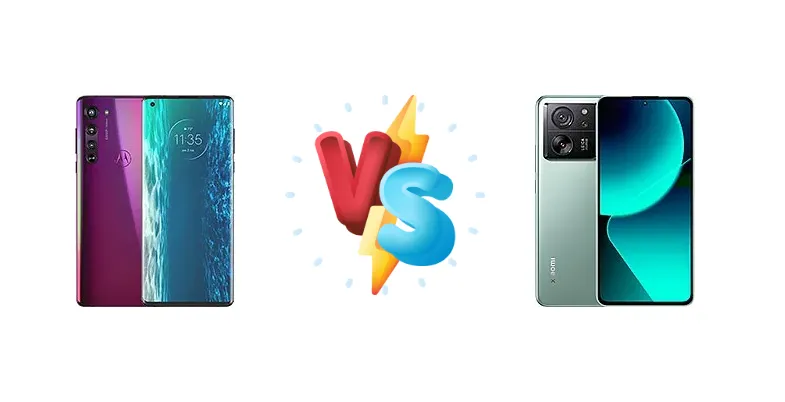
|
🏆 Quick Verdict
For most users, the Xiaomi 13T emerges as the superior choice. Its significantly faster 67W charging and more powerful Mediatek Dimensity 8200 Ultra chipset provide a noticeable advantage in daily use and gaming, outweighing the Motorola Edge’s slightly better endurance rating.
| PHONES | ||
|---|---|---|
| Phone Names | Motorola Edge | Xiaomi 13T |
| Network | ||
|---|---|---|
| 2G bands | GSM 850 / 900 / 1800 / 1900 | GSM 850 / 900 / 1800 / 1900 |
| 3G bands | HSDPA 850 / 900 / 1700(AWS) / 1900 / 2100 | HSDPA 800 / 850 / 900 / 1700(AWS) / 1900 / 2100 |
| 4G bands | 1, 2, 3, 4, 5, 7, 8, 12, 13, 17, 20, 25, 26, 28, 32, 38, 39, 40, 41, 66, 71 | 1, 2, 3, 4, 5, 7, 8, 12, 13, 17, 18, 19, 20, 26, 28, 32, 38, 40, 41, 66 |
| 5G bands | 1, 2, 3, 5, 7, 25, 28, 38, 41, 66, 71, 78 Sub6 | 1, 3, 5, 7, 8, 20, 28, 38, 40, 41, 66, 77, 78 SA/NSA |
| EDGE | No | - |
| GPRS | No | - |
| Speed | HSPA 42.2/5.76 Mbps, LTE (5CA) Cat16 1000/150 Mbps, 5G | HSPA, LTE, 5G |
| Technology | GSM / CDMA / HSPA / EVDO / LTE / 5G | GSM / HSPA / LTE / 5G |
| CDMA2000 1xEV-DO | - | |
| Launch | ||
|---|---|---|
| Announced | 2020, April 22. Released 2020, May 29 | 2023, September 26 |
| Status | Discontinued | Available. Released 2023, September 26 |
| Body | ||
|---|---|---|
| Build | Glass front (Gorilla Glass 5), aluminum frame, plastic back | Glass front (Gorilla Glass 5), glass back or silicone polymer back, plastic frame |
| Dimensions | 161.6 x 71.1 x 9.3 mm (6.36 x 2.80 x 0.37 in) | 162.2 x 75.7 x 8.5 mm (6.39 x 2.98 x 0.33 in) |
| SIM | Nano-SIM + Nano-SIM | · Nano-SIM + eSIM· Nano-SIM + Nano-SIM |
| Weight | 188 g (6.63 oz) | 193 g or 197 g (6.81 oz) |
| Water-repellent coating | - | |
| Display | ||
|---|---|---|
| Protection | Corning Gorilla Glass 5 | Corning Gorilla Glass 5 |
| Resolution | 1080 x 2340 pixels, 19.5:9 ratio (~385 ppi density) | 1220 x 2712 pixels, 20:9 ratio (~446 ppi density) |
| Size | 6.7 inches, 110.2 cm2 (~95.9% screen-to-body ratio) | 6.67 inches, 107.4 cm2 (~87.5% screen-to-body ratio) |
| Type | OLED, 90Hz, HDR10 | AMOLED, 68B colors, 144Hz, Dolby Vision, HDR10+, 1200 nits (HBM), 2600 nits (peak) |
| Platform | ||
|---|---|---|
| CPU | Octa-core (1x2.4 GHz Kryo 475 Prime & 1x2.2 GHz Kryo 475 Gold & 6x1.8 GHz Kryo 475 Silver) | Octa-core (1x3.1 GHz Cortex-A78 & 3x3.0 GHz Cortex-A78 & 4x2.0 GHz Cortex-A55) |
| Chipset | Qualcomm SM7250 Snapdragon 765G 5G (7 nm) | Mediatek Dimensity 8200 Ultra (4 nm) |
| GPU | Adreno 620 | Mali-G610 MC6 |
| OS | Android 10 | Android 13, up to 4 major Android upgrades, HyperOS |
| Memory | ||
|---|---|---|
| Card slot | microSDXC (uses shared SIM slot) | No |
| Internal | 128GB 4GB RAM, 128GB 6GB RAM, 256GB 6GB RAM | 256GB 8GB RAM, 256GB 12GB RAM |
| UFS 2.1 | - | |
| Main Camera | ||
|---|---|---|
| Features | LED flash, panorama, HDR | Leica lens, color spectrum sensor, LED flash, HDR, panorama |
| Single | 3.15 MP, AF | - |
| Triple | 64 MP, f/1.8, (wide), 1/1.72", 0.8µm, PDAF 8 MP, f/2.4, 52mm (telephoto), 1.12µm, 2x optical zoom, PDAF 16 MP, f/2.2, 13mm (ultrawide), 1.0µm TOF 3D, (depth) | 50 MP, f/1.9, 24mm (wide), 1/1.28", 1.22µm, PDAF, OIS 50 MP, f/1.9, 50mm (telephoto), 1/2.88", 0.61µm, PDAF, 2x optical zoom 12 MP, f/2.2, 15mm (ultrawide), 1/3.06", 1.12µm |
| Video | 4K@30fps, 1080p@30/60fps | 4K@30fps (HDR10+), 1080p@30/60/120fps, gyro-EIS |
| Selfie camera | ||
|---|---|---|
| Features | HDR | HDR |
| Single | 25 MP, f/2.0, (wide), 0.9µm | 20 MP, f/2.2, (wide), 0.8µm |
| Video | 1080p@30fps | 1080p@30fps, HDR10+ |
| Sound | ||
|---|---|---|
| 3.5mm jack | Yes | - |
| 35mm jack | Yes | No |
| Loudspeaker | Yes, with stereo speakers | Yes, with stereo speakers |
| Comms | ||
|---|---|---|
| Bluetooth | 5.1, A2DP, LE | 5.4, A2DP, LE |
| Infrared port | - | Yes |
| NFC | Yes | Yes (market/region dependent) |
| Positioning | GPS, GLONASS, GALILEO, BDS | GPS (L1+L5), GLONASS (G1), GALILEO (E1+E5a), QZSS (L1+L5), NavIC (L5), BDS |
| Radio | FM radio | No |
| USB | USB Type-C 2.0 | USB Type-C 2.0, OTG |
| WLAN | Wi-Fi 802.11 a/b/g/n/ac, dual-band, Wi-Fi Direct | Wi-Fi 802.11 a/b/g/n/ac/6, dual-band |
| Features | ||
|---|---|---|
| Browser | HTML, Adobe Flash | - |
| Sensors | Fingerprint (under display, optical), accelerometer, gyro, proximity | Fingerprint (under display, optical), accelerometer, gyro, proximity, compass |
| Battery | ||
|---|---|---|
| Charging | 18W wired | 67W wired, PD3.0, QC4, 100% in 42 min |
| Stand-by | Up to 950 h | - |
| Type | Li-Po 4500 mAh | Li-Po 5000 mAh |
| Misc | ||
|---|---|---|
| Colors | Solar Black, Midnight Magenta | Alpine Blue, Meadow Green, Black |
| Models | XT2063-2, XT2063-3 | 2306EPN60G |
| Price | About 250 EUR | $ 255.96 / £ 326.27 / € 204.18 |
| SAR EU | 0.18 W/kg (head) | 0.99 W/kg (head) 0.99 W/kg (body) |
| Tests | ||
|---|---|---|
| Battery life | Endurance rating 102h | - |
| Camera | Photo / Video | - |
| Display | Contrast ratio: Infinite (nominal) | - |
| Loudspeaker | -30.4 LUFS (Below average) | - |
| Performance | AnTuTu: 305989 (v8) GeekBench: 1862 (v5.1) GFXBench: 18fps (ES 3.1 onscreen) | - |
Motorola Edge
- Excellent battery endurance (102h)
- Potentially lower price point (due to age)
- 5G connectivity
- Outdated Snapdragon 765G chipset
- Slow 18W charging
- Likely inferior display brightness
Xiaomi 13T
- Powerful Mediatek Dimensity 8200 Ultra
- Ultra-fast 67W charging (42 min)
- Bright 1264 nit display
- Slightly lower endurance rating (101h)
- Potentially higher price
- Software bloat (typical of Xiaomi)
Display Comparison
The Xiaomi 13T boasts a significantly brighter display, reaching a measured 1264 nits peak brightness, compared to the Motorola Edge’s unspecified, but likely lower, 'Infinite' (nominal) contrast ratio. This translates to better visibility outdoors under direct sunlight. While the Motorola Edge’s contrast ratio is technically infinite, this is a marketing term and doesn’t reflect real-world viewing experience. The 13T’s panel likely utilizes a higher refresh rate, contributing to smoother scrolling and animations, though this isn’t explicitly stated in the provided data. The lack of specific display technology details for the Edge makes a direct comparison difficult, but the 13T’s brightness advantage is clear.
Camera Comparison
Both devices offer photo and video capabilities, but the provided data lacks specifics to make a definitive judgment. However, given the Xiaomi 13T’s positioning, it likely features a more advanced camera system with a larger sensor and improved image processing algorithms. The Motorola Edge, being an older model, likely utilizes a less sophisticated camera setup. Without sensor size or aperture information, it’s difficult to assess low-light performance, but Xiaomi generally prioritizes camera technology in its mid-range and flagship devices.
Performance
The Xiaomi 13T’s Mediatek Dimensity 8200 Ultra, built on a 4nm process, represents a substantial leap in performance and efficiency over the Motorola Edge’s Qualcomm Snapdragon 765G (7nm). The Dimensity 8200 Ultra’s octa-core configuration, featuring a 3.1 GHz Cortex-A78 prime core, delivers significantly faster processing speeds for demanding applications and gaming. The Snapdragon 765G, while capable, is showing its age. The 4nm node of the Dimensity 8200 Ultra also contributes to better thermal management, reducing the likelihood of performance throttling during extended gaming sessions. The 13T is likely to offer a more responsive and fluid user experience.
Battery Life
While the Motorola Edge claims an endurance rating of 102 hours, the Xiaomi 13T’s active use score of 12:23 hours and endurance rating of 101 hours demonstrate comparable real-world battery life. However, the Xiaomi 13T’s 67W wired charging, complete with PD3.0 and QC4 support, is a game-changer, achieving a full charge in just 42 minutes. The Motorola Edge’s 18W charging is significantly slower, requiring considerably more time to replenish the battery. This faster charging capability provides a substantial convenience advantage for the 13T.
Buying Guide
Buy the Motorola Edge if you prioritize long-term battery endurance above all else and are on a very tight budget. Its 102-hour endurance rating is still respectable. Buy the Xiaomi 13T if you value faster charging, smoother performance for demanding tasks, and a brighter, more vibrant display – all at a competitive price point.