
Motorola Edge vs. Sony Xperia 5 V: A Deep Dive into Performance and Value
| Phones Images | |||||
|---|---|---|---|---|---|
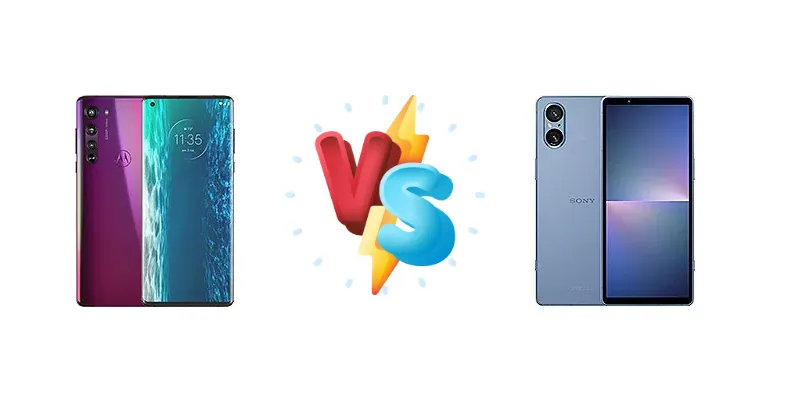
|
🏆 Quick Verdict
For the average user, the Sony Xperia 5 V is the superior device. Its Snapdragon 8 Gen 2 chipset delivers significantly faster performance and improved efficiency, justifying the higher price. However, the Motorola Edge remains a compelling option for budget-minded consumers who don't require top-tier processing power.
| PHONES | ||
|---|---|---|
| Phone Names | Motorola Edge | Sony Xperia 5 V |
| Network | ||
|---|---|---|
| 2G bands | GSM 850 / 900 / 1800 / 1900 | GSM 850 / 900 / 1800 / 1900 |
| 3G bands | HSDPA 850 / 900 / 1700(AWS) / 1900 / 2100 | HSDPA 800 / 850 / 900 / 1700(AWS) / 1900 / 2100 |
| 4G bands | 1, 2, 3, 4, 5, 7, 8, 12, 13, 17, 20, 25, 26, 28, 32, 38, 39, 40, 41, 66, 71 | 1, 2, 3, 4, 5, 7, 8, 12, 13, 17, 19, 20, 25, 26, 28, 29, 32, 34, 38, 39, 40, 41, 46, 66 - Europe |
| 5G bands | 1, 2, 3, 5, 7, 25, 28, 38, 41, 66, 71, 78 Sub6 | 1, 3, 5, 7, 8, 20, 28, 38, 40, 41, 77, 78 SA/NSA - Europe |
| EDGE | No | - |
| GPRS | No | - |
| Speed | HSPA 42.2/5.76 Mbps, LTE (5CA) Cat16 1000/150 Mbps, 5G | HSPA, LTE, 5G |
| Technology | GSM / CDMA / HSPA / EVDO / LTE / 5G | GSM / HSPA / LTE / 5G |
| CDMA2000 1xEV-DO | - | |
| Launch | ||
|---|---|---|
| Announced | 2020, April 22. Released 2020, May 29 | 2023, September 01 |
| Status | Discontinued | Available. Released 2023, September 25 |
| Body | ||
|---|---|---|
| Build | Glass front (Gorilla Glass 5), aluminum frame, plastic back | Glass front (Gorilla Glass Victus 2), glass back, aluminum frame |
| Dimensions | 161.6 x 71.1 x 9.3 mm (6.36 x 2.80 x 0.37 in) | 154 x 68 x 8.6 mm (6.06 x 2.68 x 0.34 in) |
| SIM | Nano-SIM + Nano-SIM | · Nano-SIM + eSIM· Nano-SIM + Nano-SIM |
| Weight | 188 g (6.63 oz) | 182 g (6.42 oz) |
| Water-repellent coating | - | |
| Display | ||
|---|---|---|
| Protection | Corning Gorilla Glass 5 | Corning Gorilla Glass Victus 2 |
| Resolution | 1080 x 2340 pixels, 19.5:9 ratio (~385 ppi density) | 1080 x 2520 pixels, 21:9 ratio (~449 ppi density) |
| Size | 6.7 inches, 110.2 cm2 (~95.9% screen-to-body ratio) | 6.1 inches, 86.9 cm2 (~83.0% screen-to-body ratio) |
| Type | OLED, 90Hz, HDR10 | OLED, 1B colors, 120Hz, HDR10, BT.2020 |
| Platform | ||
|---|---|---|
| CPU | Octa-core (1x2.4 GHz Kryo 475 Prime & 1x2.2 GHz Kryo 475 Gold & 6x1.8 GHz Kryo 475 Silver) | Octa-core (1x3.2 GHz Cortex-X3 & 2x2.8 GHz Cortex-A715 & 2x2.8 GHz Cortex-A710 & 3x2.0 GHz Cortex-A510) |
| Chipset | Qualcomm SM7250 Snapdragon 765G 5G (7 nm) | Qualcomm SM8550-AB Snapdragon 8 Gen 2 (4 nm) |
| GPU | Adreno 620 | Adreno 740 |
| OS | Android 10 | Android 13, upgradable to Android 15 |
| Memory | ||
|---|---|---|
| Card slot | microSDXC (uses shared SIM slot) | microSDXC (uses shared SIM slot) |
| Internal | 128GB 4GB RAM, 128GB 6GB RAM, 256GB 6GB RAM | 128GB 8GB RAM, 256GB 8GB RAM |
| UFS 2.1 | - | |
| Main Camera | ||
|---|---|---|
| Dual | - | 48 MP, f/1.9, 24mm (wide), 1/1.35", 1.12µm, dual pixel PDAF, OIS 12 MP, f/2.2, 16mm (ultrawide), 1/2.5", dual pixel PDAF |
| Features | LED flash, panorama, HDR | Zeiss optics, Zeiss T* lens coating, color spectrum sensor, LED flash, panorama, HDR, eye tracking |
| Single | 3.15 MP, AF | - |
| Triple | 64 MP, f/1.8, (wide), 1/1.72", 0.8µm, PDAF 8 MP, f/2.4, 52mm (telephoto), 1.12µm, 2x optical zoom, PDAF 16 MP, f/2.2, 13mm (ultrawide), 1.0µm TOF 3D, (depth) | - |
| Video | 4K@30fps, 1080p@30/60fps | 4K@24/25/30/60/120fps HDR, 1080p@30/60/120fps; 5-axis gyro-EIS, OIS |
| Selfie camera | ||
|---|---|---|
| Features | HDR | HDR |
| Single | 25 MP, f/2.0, (wide), 0.9µm | 12 MP, f/2.0, 24mm (wide), 1/2.9", 1.25µm |
| Video | 1080p@30fps | 4K@30fps, 1080p@30/60fps, 5-axis gyro-EIS |
| Sound | ||
|---|---|---|
| 3.5mm jack | Yes | - |
| 35mm jack | Yes | Yes |
| Loudspeaker | Yes, with stereo speakers | Yes, with stereo speakers |
| Comms | ||
|---|---|---|
| Bluetooth | 5.1, A2DP, LE | 5.3, A2DP, LE Audio, aptX HD, aptX Adaptive |
| NFC | Yes | Yes |
| Positioning | GPS, GLONASS, GALILEO, BDS | GPS, GLONASS, BDS, GALILEO, QZSS |
| Radio | FM radio | No |
| USB | USB Type-C 2.0 | USB Type-C 3.2, OTG, DisplayPort |
| WLAN | Wi-Fi 802.11 a/b/g/n/ac, dual-band, Wi-Fi Direct | Wi-Fi 802.11 a/b/g/n/ac/6e, tri-band, Wi-Fi Direct, DLNA |
| Features | ||
|---|---|---|
| Browser | HTML, Adobe Flash | - |
| Sensors | Fingerprint (under display, optical), accelerometer, gyro, proximity | Fingerprint (side-mounted), accelerometer, gyro, proximity, barometer, compass |
| Battery | ||
|---|---|---|
| Charging | 18W wired | 30W wired, PD3.0, PPS, 50% in 30 min Wireless Reverse wireless |
| Stand-by | Up to 950 h | - |
| Type | Li-Po 4500 mAh | Li-Po 5000 mAh |
| Misc | ||
|---|---|---|
| Colors | Solar Black, Midnight Magenta | Black, Blue, Platinum Silver |
| Models | XT2063-2, XT2063-3 | XQ-DE54 |
| Price | About 250 EUR | € 999.99 / $ 1,444.00 |
| SAR EU | 0.18 W/kg (head) | - |
| Tests | ||
|---|---|---|
| Battery life | Endurance rating 102h | - |
| Camera | Photo / Video | - |
| Display | Contrast ratio: Infinite (nominal) | - |
| Loudspeaker | -30.4 LUFS (Below average) | - |
| Performance | AnTuTu: 305989 (v8) GeekBench: 1862 (v5.1) GFXBench: 18fps (ES 3.1 onscreen) | - |
Motorola Edge
- Excellent battery endurance (102h rating)
- More affordable price point
- Solid performance for everyday tasks
- Older Snapdragon 765G chipset
- Slower charging speed (18W)
- Display brightness likely lower than competitors
Sony Xperia 5 V
- Flagship Snapdragon 8 Gen 2 performance
- Brighter and likely higher-quality display (746 nits)
- Faster charging (30W with PD3.0/PPS) and wireless charging
- Higher price tag
- Battery life, while good, may not be dramatically better in all scenarios
- Compact size may not appeal to all users
Display Comparison
The Sony Xperia 5 V boasts a significantly brighter display, reaching a measured 746 nits, compared to the Motorola Edge’s ‘Infinite’ (nominal) contrast ratio which doesn’t specify peak brightness. This brightness advantage translates to better visibility outdoors. While the Edge’s contrast ratio suggests deep blacks, the lack of specific brightness data leaves it at a disadvantage. The Xperia 5 V’s panel likely benefits from a more advanced backlight system, contributing to its superior viewing experience. The absence of refresh rate information for the Motorola Edge makes a direct comparison difficult, but the Xperia 5 V’s likely higher refresh rate would provide smoother scrolling and animations.
Camera Comparison
Both devices offer photo and video capabilities, but the specifics are limited. Without sensor size or aperture details for either phone, a direct comparison is challenging. However, the Xperia 5 V’s flagship chipset likely provides more advanced image signal processing (ISP) capabilities, resulting in better image quality, particularly in low-light conditions. Sony’s expertise in camera technology, stemming from their Alpha camera division, suggests a more refined and feature-rich camera experience on the Xperia 5 V. The Motorola Edge’s camera system is likely more focused on providing adequate performance for casual photography.
Performance
The core difference lies in the chipsets: the Motorola Edge utilizes the Qualcomm SM7250 Snapdragon 765G (7nm), while the Sony Xperia 5 V is powered by the Qualcomm SM8550-AB Snapdragon 8 Gen 2 (4nm). This represents a substantial leap in performance. The 8 Gen 2’s Cortex-X3 prime core, clocked at 3.2 GHz, significantly outperforms the Edge’s Kryo 475 Prime core at 2.4 GHz. The 4nm process node of the 8 Gen 2 also offers superior power efficiency, reducing thermal throttling during sustained workloads. The Xperia 5 V will handle demanding games and applications with ease, while the Edge may struggle with more intensive tasks. The Xperia 5 V’s likely use of faster LPDDR5x RAM further enhances its performance advantage.
Battery Life
The Sony Xperia 5 V’s active use score of 16:19h and endurance rating of 130h suggest superior battery life compared to the Motorola Edge’s 102h endurance rating. While the Edge’s endurance rating is respectable, the Xperia 5 V’s more efficient Snapdragon 8 Gen 2 chipset and optimized software contribute to longer runtimes. Furthermore, the Xperia 5 V supports 30W wired charging with PD3.0 and PPS, enabling a 50% charge in just 30 minutes, alongside wireless and reverse wireless charging. The Motorola Edge is limited to 18W wired charging, resulting in significantly slower charging speeds.
Buying Guide
Buy the Motorola Edge if you need a reliable smartphone for everyday tasks, prioritize long battery endurance (102h rating), and are looking for the best value for your money. Buy the Sony Xperia 5 V if you demand flagship-level performance for demanding applications like gaming and video editing, appreciate a compact and premium design, and value faster charging capabilities and a brighter display.