
Motorola Edge vs. Samsung Galaxy S23 FE: A Detailed Comparison of Mid-Range Powerhouses
| Phones Images | |||||
|---|---|---|---|---|---|
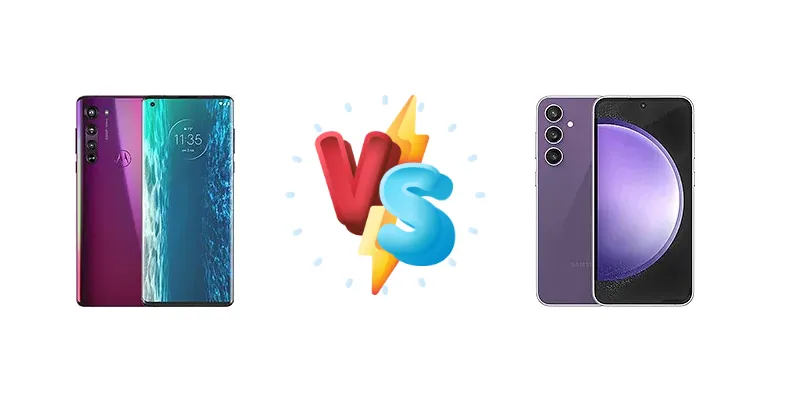
|
🏆 Quick Verdict
For the average user prioritizing longevity and consistent performance, the Motorola Edge offers a compelling package. Its exceptional battery life and stable chipset outweigh the S23 FE’s raw power, especially considering the potential for thermal throttling on the Samsung device. However, the S23 FE’s brighter display and faster charging are significant advantages for media consumers.
| PHONES | ||
|---|---|---|
| Phone Names | Motorola Edge | Samsung Galaxy S23 FE |
| Network | ||
|---|---|---|
| 2G bands | GSM 850 / 900 / 1800 / 1900 | GSM 850 / 900 / 1800 / 1900 |
| 3G bands | HSDPA 850 / 900 / 1700(AWS) / 1900 / 2100 | HSDPA 850 / 900 / 1700(AWS) / 1900 / 2100 |
| 4G bands | 1, 2, 3, 4, 5, 7, 8, 12, 13, 17, 20, 25, 26, 28, 32, 38, 39, 40, 41, 66, 71 | 1, 2, 3, 4, 5, 7, 8, 12, 13, 17, 20, 26, 28, 38, 40, 41, 66 - International |
| 5G bands | 1, 2, 3, 5, 7, 25, 28, 38, 41, 66, 71, 78 Sub6 | 1, 2, 3, 5, 7, 8, 20, 28, 38, 40, 41, 66, 77, 78 SA/NSA/Sub6 - International |
| EDGE | No | - |
| GPRS | No | - |
| Speed | HSPA 42.2/5.76 Mbps, LTE (5CA) Cat16 1000/150 Mbps, 5G | HSPA, LTE, 5G |
| Technology | GSM / CDMA / HSPA / EVDO / LTE / 5G | GSM / HSPA / LTE / 5G |
| CDMA2000 1xEV-DO | - | |
| Launch | ||
|---|---|---|
| Announced | 2020, April 22. Released 2020, May 29 | 2023, October 04 |
| Status | Discontinued | Available. Released 2023, October 05 |
| Body | ||
|---|---|---|
| Build | Glass front (Gorilla Glass 5), aluminum frame, plastic back | Glass front (Gorilla Glass 5), glass back (Gorilla Glass 5), aluminum frame |
| Dimensions | 161.6 x 71.1 x 9.3 mm (6.36 x 2.80 x 0.37 in) | 158 x 76.5 x 8.2 mm (6.22 x 3.01 x 0.32 in) |
| SIM | Nano-SIM + Nano-SIM | · Nano-SIM· Nano-SIM + Nano-SIM· Nano-SIM + Nano-SIM + eSIM (max 2 at a time) |
| Weight | 188 g (6.63 oz) | 209 g (7.37 oz) |
| Water-repellent coating | - | |
| Display | ||
|---|---|---|
| Protection | Corning Gorilla Glass 5 | Corning Gorilla Glass 5 |
| Resolution | 1080 x 2340 pixels, 19.5:9 ratio (~385 ppi density) | 1080 x 2340 pixels, 19.5:9 ratio (~403 ppi density) |
| Size | 6.7 inches, 110.2 cm2 (~95.9% screen-to-body ratio) | 6.4 inches, 100.5 cm2 (~83.2% screen-to-body ratio) |
| Type | OLED, 90Hz, HDR10 | Dynamic AMOLED 2X, 120Hz, HDR10+, 1450 nits (peak) |
| Platform | ||
|---|---|---|
| CPU | Octa-core (1x2.4 GHz Kryo 475 Prime & 1x2.2 GHz Kryo 475 Gold & 6x1.8 GHz Kryo 475 Silver) | Octa-core (1x2.8 GHz Cortex-X2 & 3x2.50 GHz Cortex-A710 & 4x1.8 GHz Cortex-A510) - InternationalOcta-core (1x3.00 GHz Cortex-X2 & 3x2.50 GHz Cortex-A710 & 4x1.80 GHz Cortex-A510) - USA |
| Chipset | Qualcomm SM7250 Snapdragon 765G 5G (7 nm) | Exynos 2200 (4 nm) - InternationalQualcomm SM8450 Snapdragon 8 Gen 1 (4 nm) - USA |
| GPU | Adreno 620 | Xclipse 920 - InternationalAdreno 730 - USA |
| OS | Android 10 | Android 13, up to 4 major Android upgrades, One UI 8 |
| Memory | ||
|---|---|---|
| Card slot | microSDXC (uses shared SIM slot) | No |
| Internal | 128GB 4GB RAM, 128GB 6GB RAM, 256GB 6GB RAM | 128GB 8GB RAM, 256GB 8GB RAM |
| UFS 2.1 | - | |
| Main Camera | ||
|---|---|---|
| Features | LED flash, panorama, HDR | LED flash, HDR, panorama |
| Single | 3.15 MP, AF | - |
| Triple | 64 MP, f/1.8, (wide), 1/1.72", 0.8µm, PDAF 8 MP, f/2.4, 52mm (telephoto), 1.12µm, 2x optical zoom, PDAF 16 MP, f/2.2, 13mm (ultrawide), 1.0µm TOF 3D, (depth) | 50 MP, f/1.8, 23mm (wide), 1/1.57", 1.0µm, dual pixel PDAF, OIS 8 MP, f/2.4, 76mm (telephoto), 1/4.5", 1.0µm, PDAF, OIS, 3x optical zoom 12 MP, f/2.2, 13mm, 123˚ (ultrawide), 1/3.0", 1.12µm |
| Video | 4K@30fps, 1080p@30/60fps | 8K@24fps, 4K@30/60fps, 1080p@30/60/120/240fps |
| Selfie camera | ||
|---|---|---|
| Features | HDR | - |
| Single | 25 MP, f/2.0, (wide), 0.9µm | 10 MP, f/2.4, 25mm (wide), 1/3.0", 1.22µm |
| Video | 1080p@30fps | 4K@30/60fps, 1080p@30/60fps; gyro-EIS |
| Sound | ||
|---|---|---|
| 3.5mm jack | Yes | - |
| 35mm jack | Yes | No |
| Loudspeaker | Yes, with stereo speakers | Yes, with stereo speakers |
| Comms | ||
|---|---|---|
| Bluetooth | 5.1, A2DP, LE | 5.3, A2DP, LE |
| NFC | Yes | Yes |
| Positioning | GPS, GLONASS, GALILEO, BDS | GPS, GLONASS, GALILEO, BDS |
| Radio | FM radio | Unspecified |
| USB | USB Type-C 2.0 | USB Type-C, OTG |
| WLAN | Wi-Fi 802.11 a/b/g/n/ac, dual-band, Wi-Fi Direct | Wi-Fi 802.11 a/b/g/n/ac/6e, dual-band, Wi-Fi Direct |
| Features | ||
|---|---|---|
| Browser | HTML, Adobe Flash | - |
| Sensors | Fingerprint (under display, optical), accelerometer, gyro, proximity | Fingerprint (under display, optical), accelerometer, gyro, compass |
| Battery | ||
|---|---|---|
| Charging | 18W wired | 25W wired, PD3.0, 50% in 30 min 15W wireless Reverse wireless |
| Stand-by | Up to 950 h | - |
| Type | Li-Po 4500 mAh | Li-Ion 4500 mAh |
| Misc | ||
|---|---|---|
| Colors | Solar Black, Midnight Magenta | Mint, Cream, Graphite, Purple, Indigo, Tangerine |
| Models | XT2063-2, XT2063-3 | SM-S711B, SM-S711B/DS, SM-S711U1, SM-S711U, SM-S711W, SM-S7110, SM-S711N |
| Price | About 250 EUR | $ 219.95 / C$ 327.90 / £ 248.99 / € 272.00 / ₹ 34,999 |
| SAR | - | 0.80 W/kg (head) 0.72 W/kg (body) |
| SAR EU | 0.18 W/kg (head) | 0.76 W/kg (head) 1.04 W/kg (body) |
| Tests | ||
|---|---|---|
| Battery life | Endurance rating 102h | - |
| Camera | Photo / Video | - |
| Display | Contrast ratio: Infinite (nominal) | - |
| Loudspeaker | -30.4 LUFS (Below average) | - |
| Performance | AnTuTu: 305989 (v8) GeekBench: 1862 (v5.1) GFXBench: 18fps (ES 3.1 onscreen) | - |
Motorola Edge
- Exceptional battery life (102h endurance)
- More affordable price point
- Stable and efficient Snapdragon 765G processor
- Limited camera information
- Slower charging speed (18W)
Samsung Galaxy S23 FE
- Brighter display (985 nits)
- Faster charging (25W wired, 15W wireless)
- More powerful processor (Exynos 2200/Snapdragon 8 Gen 1)
- Potential for thermal throttling
- Shorter battery life (8:28h active use)
- Higher price
Display Comparison
The Samsung Galaxy S23 FE boasts a significantly brighter display, reaching a measured 985 nits, compared to the Motorola Edge’s ‘Infinite’ (nominal) contrast ratio, which doesn’t specify peak brightness. This brightness advantage makes the S23 FE far more usable outdoors in direct sunlight. While the Edge’s contrast ratio suggests deep blacks, the lack of specific brightness data leaves it at a disadvantage. Neither specification details refresh rate or panel technology (LTPO), but the S23 FE’s superior peak brightness is a clear win for visual clarity.
Camera Comparison
Both phones offer photo and video capabilities, but detailed sensor information is lacking for the Motorola Edge. The S23 FE’s camera system likely features a more advanced image signal processor (ISP) due to its flagship-level chipset. While the absence of specific sensor sizes prevents a definitive comparison, the S23 FE’s processor allows for more sophisticated computational photography, potentially resulting in better low-light performance and dynamic range. The lack of detail regarding the Edge’s camera makes it difficult to assess its capabilities beyond basic functionality.
Performance
The chipset is where the most significant difference lies. The Motorola Edge utilizes the Qualcomm Snapdragon 765G, a 7nm processor, while the S23 FE comes in two variants: the Exynos 2200 (International) and Snapdragon 8 Gen 1 (USA), both built on a more efficient 4nm process. The Exynos 2200, despite its higher clock speeds (2.8 GHz Cortex-X2), has a history of thermal throttling, potentially limiting sustained performance. The Snapdragon 8 Gen 1 in the US variant offers better thermal management but still consumes more power than the 765G. The Edge’s 765G prioritizes efficiency, while the S23 FE aims for peak performance, potentially at the cost of consistent performance under load.
Battery Life
The Motorola Edge claims an impressive endurance rating of 102 hours, suggesting exceptional battery life. However, this is a lab-based metric. The Samsung Galaxy S23 FE achieves 8:28 hours of active use, a more realistic measure. The S23 FE also offers faster charging at 25W with PD3.0 and 50% charge in 30 minutes, alongside 15W wireless and reverse wireless charging – features absent on the Edge’s 18W wired charging. While the Edge’s endurance rating is higher, the S23 FE’s faster charging and wireless capabilities provide greater convenience.
Buying Guide
Buy the Motorola Edge if you need exceptional battery life, a stable and reliable processor for everyday tasks, and a more affordable price. It’s ideal for users who prioritize practicality and don’t demand the absolute highest performance. Buy the Samsung Galaxy S23 FE if you prefer a brighter, more vibrant display, faster charging speeds, and are willing to accept potentially shorter battery life and the risk of thermal throttling during intensive tasks like gaming or video editing.