
Motorola Edge vs OnePlus 11R: A Deep Dive into Performance and Value
| Phones Images | |||||
|---|---|---|---|---|---|
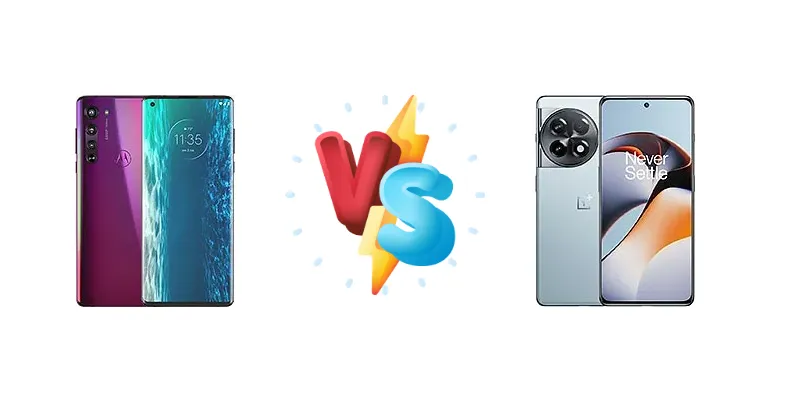
|
🏆 Quick Verdict
For most users, the OnePlus 11R is the superior choice. Its Snapdragon 8+ Gen 1 chipset delivers significantly faster performance, making it ideal for demanding tasks and gaming. While the Motorola Edge boasts impressive battery endurance, the 11R’s 100W charging mitigates battery concerns, and the performance uplift is substantial.
| PHONES | ||
|---|---|---|
| Phone Names | Motorola Edge | OnePlus 11R |
| Network | ||
|---|---|---|
| 2G bands | GSM 850 / 900 / 1800 / 1900 | GSM 850 / 900 / 1800 / 1900 |
| 3G bands | HSDPA 850 / 900 / 1700(AWS) / 1900 / 2100 | HSDPA 850 / 900 / 1700(AWS) / 2100 |
| 4G bands | 1, 2, 3, 4, 5, 7, 8, 12, 13, 17, 20, 25, 26, 28, 32, 38, 39, 40, 41, 66, 71 | 1, 3, 4, 5, 8, 28, 34, 38, 39, 40, 41 |
| 5G bands | 1, 2, 3, 5, 7, 25, 28, 38, 41, 66, 71, 78 Sub6 | 1, 3, 5, 8, 28, 40, 41, 77, 78 SA/NSA |
| EDGE | No | - |
| GPRS | No | - |
| Speed | HSPA 42.2/5.76 Mbps, LTE (5CA) Cat16 1000/150 Mbps, 5G | HSPA, LTE (3CA), 5G |
| Technology | GSM / CDMA / HSPA / EVDO / LTE / 5G | GSM / CDMA / HSPA / LTE / 5G |
| CDMA2000 1xEV-DO | CDMA 800 | |
| Launch | ||
|---|---|---|
| Announced | 2020, April 22. Released 2020, May 29 | 2023, February 07 |
| Status | Discontinued | Available. Released 2023, February 21 |
| Body | ||
|---|---|---|
| Build | Glass front (Gorilla Glass 5), aluminum frame, plastic back | Glass front, glass back (Gorilla Glass 5), plastic frame |
| Dimensions | 161.6 x 71.1 x 9.3 mm (6.36 x 2.80 x 0.37 in) | 163.4 x 74.3 x 8.7 mm (6.43 x 2.93 x 0.34 in) |
| SIM | Nano-SIM + Nano-SIM | Nano-SIM + Nano-SIM |
| Weight | 188 g (6.63 oz) | 204 g (7.20 oz) |
| Water-repellent coating | - | |
| Display | ||
|---|---|---|
| Protection | Corning Gorilla Glass 5 | - |
| Resolution | 1080 x 2340 pixels, 19.5:9 ratio (~385 ppi density) | 1240 x 2772 pixels, 20:9 ratio (~451 ppi density) |
| Size | 6.7 inches, 110.2 cm2 (~95.9% screen-to-body ratio) | 6.74 inches, 109.2 cm2 (~90.0% screen-to-body ratio) |
| Type | OLED, 90Hz, HDR10 | Fluid AMOLED, 1B colors, 120Hz, HDR10+, 1450 nits (peak) |
| Platform | ||
|---|---|---|
| CPU | Octa-core (1x2.4 GHz Kryo 475 Prime & 1x2.2 GHz Kryo 475 Gold & 6x1.8 GHz Kryo 475 Silver) | Octa-core (1x3.0 GHz Cortex-X2 & 3x2.5 GHz Cortex-A710 & 4x1.80 GHz Cortex-A510) |
| Chipset | Qualcomm SM7250 Snapdragon 765G 5G (7 nm) | Qualcomm SM8475 Snapdragon 8+ Gen 1 (4 nm) |
| GPU | Adreno 620 | Adreno 730 |
| OS | Android 10 | Android 13, upgradable to Android 15, OxygenOS 15 |
| Memory | ||
|---|---|---|
| Card slot | microSDXC (uses shared SIM slot) | No |
| Internal | 128GB 4GB RAM, 128GB 6GB RAM, 256GB 6GB RAM | 128GB 8GB RAM, 256GB 16GB RAM, 512GB 18GB RAM |
| UFS 2.1 | UFS 3.1 | |
| Main Camera | ||
|---|---|---|
| Features | LED flash, panorama, HDR | Color spectrum sensor, LED flash, HDR, panorama |
| Single | 3.15 MP, AF | 16 MP, f/2.4, 24mm (wide), 1/3.09", 1.0µm |
| Triple | 64 MP, f/1.8, (wide), 1/1.72", 0.8µm, PDAF 8 MP, f/2.4, 52mm (telephoto), 1.12µm, 2x optical zoom, PDAF 16 MP, f/2.2, 13mm (ultrawide), 1.0µm TOF 3D, (depth) | 50 MP, f/1.8, 24mm (wide), 1/1.56", 1.0µm, multi-directional PDAF, OIS 8 MP, f/2.2, 120˚ (ultrawide), 1/4.0", 1.12µm 2 MP (macro) |
| Video | 4K@30fps, 1080p@30/60fps | 4K@30/60fps, 1080p@30/60/240fps, gyro-EIS |
| Selfie camera | ||
|---|---|---|
| Features | HDR | HDR |
| Single | 25 MP, f/2.0, (wide), 0.9µm | 16 MP, f/2.4, 24mm (wide), 1/3.09", 1.0µm |
| Video | 1080p@30fps | 1080p@30fps |
| Sound | ||
|---|---|---|
| 3.5mm jack | Yes | No |
| 35mm jack | Yes | No |
| Loudspeaker | Yes, with stereo speakers | Yes, with stereo speakers |
| - | 24-bit/192kHz audio | |
| Comms | ||
|---|---|---|
| Bluetooth | 5.1, A2DP, LE | 5.3, A2DP, LE, aptX HD |
| Infrared port | - | Yes |
| NFC | Yes | Yes |
| Positioning | GPS, GLONASS, GALILEO, BDS | GPS (L1+L5), GLONASS (G1), BDS (B1I+B1c+B2a), GALILEO (E1+E5a), QZSS (L1+L5) |
| Radio | FM radio | No |
| USB | USB Type-C 2.0 | USB Type-C 2.0 |
| WLAN | Wi-Fi 802.11 a/b/g/n/ac, dual-band, Wi-Fi Direct | Wi-Fi 802.11 a/b/g/n/ac/6, dual-band |
| Features | ||
|---|---|---|
| Browser | HTML, Adobe Flash | - |
| Sensors | Fingerprint (under display, optical), accelerometer, gyro, proximity | Fingerprint (under display, optical), accelerometer, gyro, proximity, compass |
| Battery | ||
|---|---|---|
| Charging | 18W wired | 100W wired |
| Stand-by | Up to 950 h | - |
| Type | Li-Po 4500 mAh | Li-Po 5000 mAh |
| Misc | ||
|---|---|---|
| Colors | Solar Black, Midnight Magenta | Galactic Silver, Sonic Black, Solar Red |
| Models | XT2063-2, XT2063-3 | CPH2487 |
| Price | About 250 EUR | About 600 EUR |
| SAR | - | 1.16 W/kg (head) 0.61 W/kg (body) |
| SAR EU | 0.18 W/kg (head) | - |
| Tests | ||
|---|---|---|
| Battery life | Endurance rating 102h | - |
| Camera | Photo / Video | - |
| Display | Contrast ratio: Infinite (nominal) | - |
| Loudspeaker | -30.4 LUFS (Below average) | - |
| Performance | AnTuTu: 305989 (v8) GeekBench: 1862 (v5.1) GFXBench: 18fps (ES 3.1 onscreen) | - |
Motorola Edge
- Exceptional battery endurance (102h)
- Potentially lower price point
- Efficient Snapdragon 765G chipset
- Significantly slower performance
- Older chipset may limit future software updates
- Likely less capable camera system
OnePlus 11R
- Flagship-level performance with Snapdragon 8+ Gen 1
- Ultra-fast 100W wired charging
- Likely superior camera capabilities
- Higher price tag
- Potentially shorter battery life (though mitigated by charging)
- May run warmer under heavy load
Display Comparison
Both devices lack detailed display specifications in the provided data, but we can infer differences based on their market positioning. The Motorola Edge’s ‘Infinite’ contrast ratio suggests an OLED panel, common for its price range. The OnePlus 11R, being a more premium device, likely features a higher peak brightness and potentially a more color-accurate display. The absence of refresh rate data is notable; the 11R likely boasts a 120Hz panel, offering smoother scrolling and animations compared to a standard 60Hz panel potentially found on the Edge.
Camera Comparison
Both phones are listed with simply 'Photo / Video' capabilities, offering little to analyze. However, given the 11R’s higher market segment, it’s reasonable to expect a more sophisticated camera system with a larger sensor and improved image processing. The Edge likely relies on software optimizations to compensate for its less powerful chipset. Without specific sensor details, it’s difficult to make a definitive judgment, but the 11R likely excels in low-light photography and video stabilization.
Performance
The performance gap is the most significant differentiator. The OnePlus 11R’s Snapdragon 8+ Gen 1 (4nm) is a substantial upgrade over the Motorola Edge’s Snapdragon 765G (7nm). The 8+ Gen 1 features a Cortex-X2 prime core clocked at 3.0 GHz, alongside three Cortex-A710 performance cores at 2.5 GHz, and four Cortex-A510 efficiency cores at 1.8 GHz. This contrasts sharply with the Edge’s Kryo 475 configuration. The 4nm process node of the 8+ Gen 1 also provides superior thermal efficiency, reducing throttling during sustained workloads. Gamers and power users will experience a dramatically smoother experience on the 11R.
Battery Life
The Motorola Edge’s 102-hour endurance rating is its strongest asset. This suggests a highly optimized software and efficient chipset combination. However, the OnePlus 11R compensates for a potentially smaller battery with its blazing-fast 100W wired charging. This allows for a full charge in under 30 minutes, mitigating concerns about battery life. While the Edge may last longer on a single charge, the 11R’s charging speed offers convenience and reduces downtime.
Buying Guide
Buy the Motorola Edge if you prioritize exceptional battery life above all else and are on a very tight budget. Its 102-hour endurance rating is a standout feature for users who frequently find themselves away from a charger. Buy the OnePlus 11R if you demand smooth performance for gaming, multitasking, and future-proofing, and are willing to spend more for a significantly faster and more capable device. It’s the better option for power users and those who want a phone that will remain responsive for years to come.