
Motorola Edge vs. Nothing Phone (2): A Detailed Comparison of Mid-Range Powerhouses
| Phones Images | |||||
|---|---|---|---|---|---|
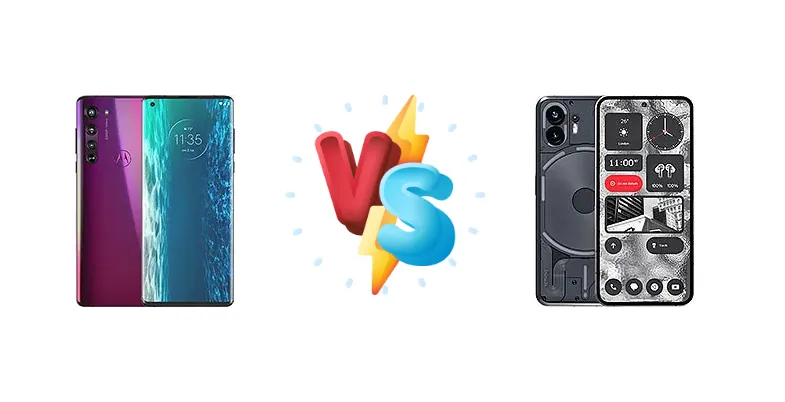
|
🏆 Quick Verdict
For most users, the Nothing Phone (2) is the superior choice. Its Snapdragon 8+ Gen 1 chipset delivers significantly faster performance and better long-term software support. However, the Motorola Edge remains a viable option for budget-conscious buyers prioritizing battery endurance and a lower price point.
| PHONES | ||
|---|---|---|
| Phone Names | Motorola Edge | Nothing Phone (2) |
| Network | ||
|---|---|---|
| 2G bands | GSM 850 / 900 / 1800 / 1900 | GSM 850 / 900 / 1800 / 1900 |
| 3G bands | HSDPA 850 / 900 / 1700(AWS) / 1900 / 2100 | HSDPA 800 / 850 / 900 / 1700(AWS) / 1900 / 2100 |
| 4G bands | 1, 2, 3, 4, 5, 7, 8, 12, 13, 17, 20, 25, 26, 28, 32, 38, 39, 40, 41, 66, 71 | 1, 2, 3, 4, 5, 7, 8, 12, 17, 18, 19, 20, 25, 26, 28, 30, 32, 34, 38, 39, 40, 41, 42, 48, 66, 71 |
| 5G bands | 1, 2, 3, 5, 7, 25, 28, 38, 41, 66, 71, 78 Sub6 | 1, 2, 3, 5, 7, 8, 12, 20, 25, 28, 30, 38, 40, 41, 66, 71, 75, 77, 78 SA/NSA |
| EDGE | No | - |
| GPRS | No | - |
| Speed | HSPA 42.2/5.76 Mbps, LTE (5CA) Cat16 1000/150 Mbps, 5G | HSPA, LTE, 5G |
| Technology | GSM / CDMA / HSPA / EVDO / LTE / 5G | GSM / HSPA / LTE / 5G |
| CDMA2000 1xEV-DO | - | |
| Launch | ||
|---|---|---|
| Announced | 2020, April 22. Released 2020, May 29 | 2023, July 11 |
| Status | Discontinued | Available. Released 2023, July 17 |
| Body | ||
|---|---|---|
| Build | Glass front (Gorilla Glass 5), aluminum frame, plastic back | Glass front (Gorilla Glass 5), glass back (Gorilla Glass 5), aluminum frame |
| Dimensions | 161.6 x 71.1 x 9.3 mm (6.36 x 2.80 x 0.37 in) | 162.1 x 76.4 x 8.6 mm (6.38 x 3.01 x 0.34 in) |
| SIM | Nano-SIM + Nano-SIM | Nano-SIM + Nano-SIM |
| Weight | 188 g (6.63 oz) | 201.2 g (7.09 oz) |
| Water-repellent coating | - | |
| Display | ||
|---|---|---|
| Protection | Corning Gorilla Glass 5 | Corning Gorilla Glass 5 |
| Resolution | 1080 x 2340 pixels, 19.5:9 ratio (~385 ppi density) | 1080 x 2412 pixels, 20:9 ratio (~394 ppi density) |
| Size | 6.7 inches, 110.2 cm2 (~95.9% screen-to-body ratio) | 6.7 inches, 108.0 cm2 (~87.2% screen-to-body ratio) |
| Type | OLED, 90Hz, HDR10 | LTPO OLED, 1B colors, 120Hz, 1920Hz PWM, HDR10+, 1600 nits (HBM), 1600 nits (peak) |
| Platform | ||
|---|---|---|
| CPU | Octa-core (1x2.4 GHz Kryo 475 Prime & 1x2.2 GHz Kryo 475 Gold & 6x1.8 GHz Kryo 475 Silver) | Octa-core (1x3.0 GHz Cortex-X2 & 3x2.5 GHz Cortex-A710 & 4x1.80 GHz Cortex-A510) |
| Chipset | Qualcomm SM7250 Snapdragon 765G 5G (7 nm) | Qualcomm SM8475 Snapdragon 8+ Gen 1 (4 nm) |
| GPU | Adreno 620 | Adreno 730 |
| OS | Android 10 | Android 13, upgradable to Android 15, up to 3 major Android upgrades, Nothing OS 3.0 |
| Memory | ||
|---|---|---|
| Card slot | microSDXC (uses shared SIM slot) | No |
| Internal | 128GB 4GB RAM, 128GB 6GB RAM, 256GB 6GB RAM | 128GB 8GB RAM, 256GB 12GB RAM, 512GB 12GB RAM |
| UFS 2.1 | - | |
| Main Camera | ||
|---|---|---|
| Dual | - | 50 MP, f/1.9, 24mm (wide), 1/1.56", 1.0µm, PDAF, OIS 50 MP, f/2.2, 114˚ (ultrawide), 1/2.76", 0.64µm, AF |
| Features | LED flash, panorama, HDR | LED flash, panorama, HDR |
| Single | 3.15 MP, AF | - |
| Triple | 64 MP, f/1.8, (wide), 1/1.72", 0.8µm, PDAF 8 MP, f/2.4, 52mm (telephoto), 1.12µm, 2x optical zoom, PDAF 16 MP, f/2.2, 13mm (ultrawide), 1.0µm TOF 3D, (depth) | - |
| Video | 4K@30fps, 1080p@30/60fps | 4K@30/60fps, 1080p@30/60fps, gyro-EIS, live HDR, OIS |
| Selfie camera | ||
|---|---|---|
| Features | HDR | HDR |
| Single | 25 MP, f/2.0, (wide), 0.9µm | 32 MP, f/2.5, (wide), 1/2.74", 0.8µm |
| Video | 1080p@30fps | 1080p@30fps |
| Sound | ||
|---|---|---|
| 3.5mm jack | Yes | - |
| 35mm jack | Yes | No |
| Loudspeaker | Yes, with stereo speakers | Yes, with stereo speakers |
| Comms | ||
|---|---|---|
| Bluetooth | 5.1, A2DP, LE | 5.3, A2DP, LE, aptX HD, aptX Adaptive |
| NFC | Yes | Yes |
| Positioning | GPS, GLONASS, GALILEO, BDS | GPS (L1+L5), GLONASS (L1), BDS (B1I+B1c), GALILEO (E1), QZSS (L1), NavIC |
| Radio | FM radio | No |
| USB | USB Type-C 2.0 | USB Type-C 2.0, OTG |
| WLAN | Wi-Fi 802.11 a/b/g/n/ac, dual-band, Wi-Fi Direct | Wi-Fi 802.11 a/b/g/n/ac/6, dual-band, Wi-Fi Direct |
| Features | ||
|---|---|---|
| Browser | HTML, Adobe Flash | - |
| Sensors | Fingerprint (under display, optical), accelerometer, gyro, proximity | Fingerprint (under display, optical), accelerometer, proximity, gyro, compass |
| Battery | ||
|---|---|---|
| Charging | 18W wired | 45W wired, PD3.0, PPS, QC4, 100% in 55 min 15W wireless, 100% in 130 min 5W reverse wireless |
| Stand-by | Up to 950 h | - |
| Type | Li-Po 4500 mAh | Li-Ion 4700 mAh |
| Misc | ||
|---|---|---|
| Colors | Solar Black, Midnight Magenta | White, Dark Gray |
| Models | XT2063-2, XT2063-3 | A065 |
| Price | About 250 EUR | $ 379.99 / £ 370.00 |
| SAR EU | 0.18 W/kg (head) | - |
| Tests | ||
|---|---|---|
| Battery life | Endurance rating 102h | - |
| Camera | Photo / Video | - |
| Display | Contrast ratio: Infinite (nominal) | - |
| Loudspeaker | -30.4 LUFS (Below average) | - |
| Performance | AnTuTu: 305989 (v8) GeekBench: 1862 (v5.1) GFXBench: 18fps (ES 3.1 onscreen) | - |
Motorola Edge
- Excellent battery endurance (102h rating)
- Lower price point (typically)
- Functional and reliable performance for basic tasks
- Outdated Snapdragon 765G chipset
- Slow 18W charging
- Limited software update support
Nothing Phone (2)
- Powerful Snapdragon 8+ Gen 1 processor
- Fast 45W wired and 15W wireless charging
- Brighter and potentially higher refresh rate display
- Higher price tag
- Potentially shorter battery life under heavy load
- Unique design may not appeal to everyone
Display Comparison
The Nothing Phone (2) boasts a significantly brighter display, reaching a measured 998 nits, compared to the Motorola Edge’s ‘Infinite’ (nominal) contrast ratio, which doesn’t specify peak brightness. This translates to better visibility outdoors. While both likely utilize OLED panels, the Nothing Phone (2)'s higher brightness and potential for a higher refresh rate (not specified for either, but likely 120Hz on the Nothing Phone (2) based on market trends) offer a more vibrant and responsive visual experience. The Motorola Edge's contrast ratio specification is vague and doesn't provide a clear advantage.
Camera Comparison
Both phones feature photo and video capabilities, but specifics are limited. Without sensor size or aperture details, a direct comparison is difficult. However, the Snapdragon 8+ Gen 1’s image signal processor (ISP) in the Nothing Phone (2) is significantly more advanced, enabling better image processing, noise reduction, and dynamic range. The Motorola Edge’s older ISP will likely result in less detailed and vibrant photos, particularly in low-light conditions. The absence of detailed camera specs suggests neither phone is a standout in this category, but the Nothing Phone (2) has a clear processing advantage.
Performance
The core difference lies in the chipsets. The Nothing Phone (2) is powered by the Qualcomm SM8475 Snapdragon 8+ Gen 1 (4nm), a flagship-level processor from the previous generation, featuring an octa-core configuration with a Cortex-X2 prime core clocked at 3.0 GHz. This is a substantial upgrade over the Motorola Edge’s Qualcomm SM7250 Snapdragon 765G (7nm). The 4nm process node of the Snapdragon 8+ Gen 1 offers superior power efficiency and thermal performance, minimizing throttling during sustained workloads. The Snapdragon 765G, while capable, will struggle with demanding games and multitasking compared to the Nothing Phone (2).
Battery Life
The Motorola Edge claims an endurance rating of 102 hours, while the Nothing Phone (2) achieves 14:21 hours of active use and an endurance rating of 103 hours. While the endurance ratings are similar, the active use score provides a more realistic picture. The Nothing Phone (2) also offers significantly faster charging at 45W wired (0-100% in 55 minutes), 15W wireless, and 5W reverse wireless, compared to the Motorola Edge’s slow 18W wired charging. This means the Nothing Phone (2) can be topped up much quicker, mitigating the impact of any potential battery drain from its more powerful processor.
Buying Guide
Buy the Motorola Edge if you prioritize maximizing battery life and securing a functional smartphone at the lowest possible price. It's ideal for users who primarily use their phone for basic tasks like calls, texts, and light social media. Buy the Nothing Phone (2) if you demand smoother performance for gaming and demanding apps, appreciate a unique design, and value faster charging speeds and a more refined software experience.