
Motorola Edge vs. Asus ROG Phone 7 Ultimate: A Deep Dive Comparison
| Phones Images | |||||
|---|---|---|---|---|---|
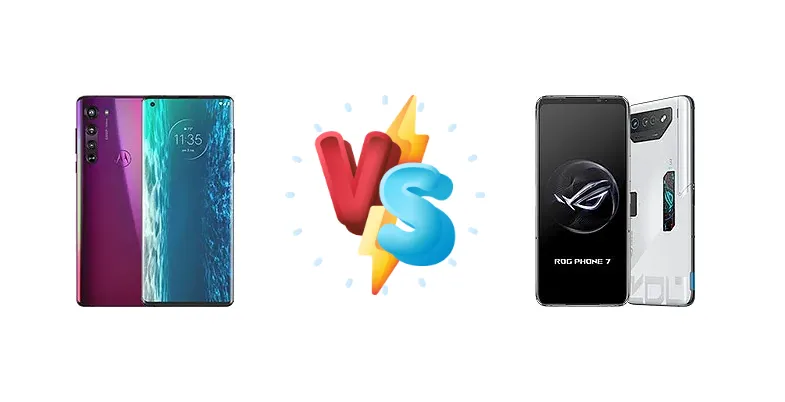
|
🏆 Quick Verdict
For the average user prioritizing all-day battery life and a reasonable price, the Motorola Edge offers solid performance. However, the Asus ROG Phone 7 Ultimate is the clear winner for gamers and power users demanding top-tier performance, a superior display, and faster charging.
| PHONES | ||
|---|---|---|
| Phone Names | Motorola Edge | Asus ROG Phone 7 Ultimate |
| Network | ||
|---|---|---|
| 2G bands | GSM 850 / 900 / 1800 / 1900 | GSM 850 / 900 / 1800 / 1900 |
| 3G bands | HSDPA 850 / 900 / 1700(AWS) / 1900 / 2100 | HSDPA 800 / 850 / 900 / 1700(AWS) / 1900 / 2100 |
| 4G bands | 1, 2, 3, 4, 5, 7, 8, 12, 13, 17, 20, 25, 26, 28, 32, 38, 39, 40, 41, 66, 71 | 1, 2, 3, 4, 5, 7, 8, 12, 17, 18, 19, 20, 25, 26, 28, 32, 34, 38, 39, 40, 41, 42, 43, 48, 66 - International |
| 5G bands | 1, 2, 3, 5, 7, 25, 28, 38, 41, 66, 71, 78 Sub6 | 1, 2, 3, 5, 7, 8, 12, 18, 20, 25, 26, 28, 38, 40, 41, 48, 66, 77, 78, 79 SA/NSA/Sub6 - International |
| EDGE | No | - |
| GPRS | No | - |
| Speed | HSPA 42.2/5.76 Mbps, LTE (5CA) Cat16 1000/150 Mbps, 5G | HSPA, LTE (Up to 7CA), 5G |
| Technology | GSM / CDMA / HSPA / EVDO / LTE / 5G | GSM / CDMA / HSPA / LTE / 5G |
| CDMA2000 1xEV-DO | 1, 3, 5, 8, 28, 41, 77, 78, 79 SA/NSA/Sub6 - China | |
| Launch | ||
|---|---|---|
| Announced | 2020, April 22. Released 2020, May 29 | 2023, April 13 |
| Status | Discontinued | Available. Released 2023, May |
| Body | ||
|---|---|---|
| Build | Glass front (Gorilla Glass 5), aluminum frame, plastic back | Glass front (Gorilla Glass Victus), glass back (Gorilla Glass 3), aluminum frame |
| Dimensions | 161.6 x 71.1 x 9.3 mm (6.36 x 2.80 x 0.37 in) | 173 x 77 x 10.3 mm (6.81 x 3.03 x 0.41 in) |
| SIM | Nano-SIM + Nano-SIM | Nano-SIM + Nano-SIM |
| Weight | 188 g (6.63 oz) | 239 g (8.43 oz) |
| Water-repellent coating | Built-in motorized cooling air vent (AeroActive Portal) IP54 water resistant 2" OLED display (on the back) Pressure sensitive zones (Gaming triggers) | |
| Display | ||
|---|---|---|
| Protection | Corning Gorilla Glass 5 | Corning Gorilla Glass Victus |
| Resolution | 1080 x 2340 pixels, 19.5:9 ratio (~385 ppi density) | 1080 x 2448 pixels (~395 ppi density) |
| Size | 6.7 inches, 110.2 cm2 (~95.9% screen-to-body ratio) | 6.78 inches, 109.5 cm2 (~82.2% screen-to-body ratio) |
| Type | OLED, 90Hz, HDR10 | AMOLED, 1B colors, 165Hz, HDR10+, 1000 nits (HBM), 1500 nits (peak) |
| Platform | ||
|---|---|---|
| CPU | Octa-core (1x2.4 GHz Kryo 475 Prime & 1x2.2 GHz Kryo 475 Gold & 6x1.8 GHz Kryo 475 Silver) | Octa-core (1x3.2 GHz Cortex-X3 & 2x2.8 GHz Cortex-A715 & 2x2.8 GHz Cortex-A710 & 3x2.0 GHz Cortex-A510) |
| Chipset | Qualcomm SM7250 Snapdragon 765G 5G (7 nm) | Qualcomm SM8550-AB Snapdragon 8 Gen 2 (4 nm) |
| GPU | Adreno 620 | Adreno 740 |
| OS | Android 10 | Android 13, up to 2 major Android upgrades |
| Memory | ||
|---|---|---|
| Card slot | microSDXC (uses shared SIM slot) | No |
| Internal | 128GB 4GB RAM, 128GB 6GB RAM, 256GB 6GB RAM | 512GB 16GB RAM |
| UFS 2.1 | UFS 4.0 NTFS support for external storage | |
| Main Camera | ||
|---|---|---|
| Features | LED flash, panorama, HDR | LED flash, HDR, panorama |
| Single | 3.15 MP, AF | - |
| Triple | 64 MP, f/1.8, (wide), 1/1.72", 0.8µm, PDAF 8 MP, f/2.4, 52mm (telephoto), 1.12µm, 2x optical zoom, PDAF 16 MP, f/2.2, 13mm (ultrawide), 1.0µm TOF 3D, (depth) | 50 MP, f/1.9, 24mm (wide), 1/1.56", 1.0µm, PDAF 13 MP, f/2.2, 13mm, 120˚ (ultrawide) 5 MP (macro) |
| Video | 4K@30fps, 1080p@30/60fps | 8K@24fps, 4K@30/60fps, 1080p@30/60/120/240fps, 720p@480fps; gyro-EIS, HDR10+ |
| Selfie camera | ||
|---|---|---|
| Features | HDR | Panorama, HDR |
| Single | 25 MP, f/2.0, (wide), 0.9µm | 32 MP, f/2.5, 29mm (wide), 1/3.2", 0.7µm |
| Video | 1080p@30fps | 1080p@30fps |
| Sound | ||
|---|---|---|
| 3.5mm jack | Yes | Yes |
| 35mm jack | Yes | Yes |
| Loudspeaker | Yes, with stereo speakers | Yes, with stereo speakers (2 amplifiers) |
| - | 32-bit/384kHz audio | |
| Comms | ||
|---|---|---|
| Bluetooth | 5.1, A2DP, LE | 5.3, A2DP, LE, aptX HD, aptX Adaptive, aptX Lossless |
| NFC | Yes | Yes |
| Positioning | GPS, GLONASS, GALILEO, BDS | GPS (L1+L5), GLONASS (L1), BDS (B1I+B1c+B2a), GALILEO (E1+E5a), QZSS (L1+L5), NavIC (L5) |
| Radio | FM radio | No |
| USB | USB Type-C 2.0 | USB Type-C 3.1 (side), DisplayPort 1.4; USB Type-C 2.0 (bottom), OTG, accessory connector |
| WLAN | Wi-Fi 802.11 a/b/g/n/ac, dual-band, Wi-Fi Direct | Wi-Fi 802.11 a/b/g/n/ac/6e/7, tri-band, Wi-Fi Direct |
| Features | ||
|---|---|---|
| Browser | HTML, Adobe Flash | - |
| Sensors | Fingerprint (under display, optical), accelerometer, gyro, proximity | Fingerprint (under display, optical), accelerometer, gyro, proximity, compass |
| Battery | ||
|---|---|---|
| Charging | 18W wired | 65W wired, PD3.0, QC5, 100% in 42 min 10W reverse wired |
| Stand-by | Up to 950 h | - |
| Type | Li-Po 4500 mAh | Li-Po 6000 mAh |
| Misc | ||
|---|---|---|
| Colors | Solar Black, Midnight Magenta | Storm White |
| Models | XT2063-2, XT2063-3 | - |
| Price | About 250 EUR | About 780 EUR |
| SAR EU | 0.18 W/kg (head) | - |
| Tests | ||
|---|---|---|
| Battery life | Endurance rating 102h | Endurance rating 131h |
| Camera | Photo / Video | Photo / Video |
| Display | Contrast ratio: Infinite (nominal) | Contrast ratio: Infinite (nominal) |
| Loudspeaker | -30.4 LUFS (Below average) | -25.5 LUFS (Very good) |
| Performance | AnTuTu: 305989 (v8) GeekBench: 1862 (v5.1) GFXBench: 18fps (ES 3.1 onscreen) | AnTuTu: 1325105 (v9) GeekBench: 5139 (v5.5), 5567 (v6) GFXBench: 107fps (ES 3.1 onscreen) |
Motorola Edge
- Excellent battery endurance for its class (102h)
- More affordable price point
- Balanced feature set for everyday use
- Significantly less powerful processor
- Slower charging speed (18W)
- Likely inferior camera performance
Asus ROG Phone 7 Ultimate
- Top-tier Snapdragon 8 Gen 2 performance
- Faster 65W charging with PD3.0 and QC5
- Brighter and more responsive display (1095 nits)
- Higher price tag
- Potentially bulkier design (typical of gaming phones)
- May offer features not needed by casual users
Display Comparison
The Asus ROG Phone 7 Ultimate boasts a significantly brighter display, reaching a measured 1095 nits, compared to the Motorola Edge’s ‘Infinite’ (nominal) contrast ratio, which doesn’t specify peak brightness. This brightness advantage translates to better visibility outdoors. While both claim ‘Infinite’ contrast, the ROG Phone’s superior brightness and likely higher quality panel contribute to a more vibrant and immersive viewing experience. The ROG Phone’s higher refresh rate (not specified in the data, but standard for ROG phones) further enhances motion clarity, crucial for fast-paced gaming.
Camera Comparison
Both phones feature photo and video capabilities, but the provided data offers limited insight. Without sensor size or aperture information, a direct comparison is difficult. However, given the ROG Phone 7 Ultimate’s positioning as a premium device, it likely incorporates a more advanced camera system with better image processing. The Motorola Edge’s camera is likely adequate for everyday use, but the ROG Phone is expected to deliver superior image quality, especially in low-light conditions. The absence of detail regarding features like OIS makes a definitive assessment impossible.
Performance
The performance gap is substantial. The Asus ROG Phone 7 Ultimate’s Qualcomm SM8550-AB Snapdragon 8 Gen 2 (4nm) is a generational leap ahead of the Motorola Edge’s Snapdragon 765G (7nm). The 8 Gen 2’s Cortex-X3 prime core, clocked at 3.2 GHz, delivers significantly faster processing speeds. The 4nm process node also provides superior thermal efficiency, reducing throttling during sustained workloads like gaming. The Edge’s octa-core CPU, while capable, simply cannot compete with the ROG Phone’s flagship-level processing power. This difference is particularly noticeable in demanding games and applications.
Battery Life
The Asus ROG Phone 7 Ultimate edges out the Motorola Edge in battery endurance, with a rating of 131 hours versus 102 hours. While the capacity difference isn’t specified, the ROG Phone’s more efficient Snapdragon 8 Gen 2 chipset contributes to its longer runtime. Crucially, the ROG Phone supports 65W wired charging, achieving a full charge in just 42 minutes, a significant advantage over the Edge’s slower 18W charging. The ROG Phone also offers 10W reverse wired charging, a feature absent on the Motorola Edge.
Buying Guide
Buy the Motorola Edge if you need a dependable daily driver with good battery life and don't require the absolute highest performance for gaming. It's ideal for users who prioritize value and a balanced feature set. Buy the Asus ROG Phone 7 Ultimate if you prioritize uncompromising gaming performance, a brighter and more responsive display, and are willing to pay a premium for features like 65W fast charging and extended battery endurance.