
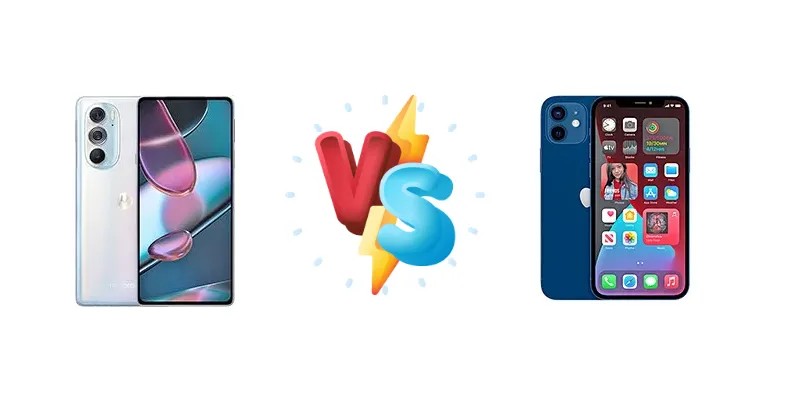
Motorola Edge X30 vs. Apple iPhone 12: A Head-to-Head Showdown
| Phones Images | |||||
|---|---|---|---|---|---|
|
🏆 Quick Verdict
The Motorola Edge X30 delivers significantly faster processing power and quicker charging. However, the iPhone 12 boasts exceptional battery life and the seamless integration of the Apple ecosystem. Ultimately, the Edge X30 wins on performance and value, while the iPhone 12 excels in longevity and user experience.
| PHONES | ||
|---|---|---|
| Phone Names | Motorola Edge X30 | Apple iPhone 12 |
| Network | ||
|---|---|---|
| 2G bands | GSM 850 / 900 / 1800 / 1900 | GSM 850 / 900 / 1800 / 1900 |
| 3G bands | HSDPA 850 / 900 / 1800 / 1900 / 2100 | HSDPA 850 / 900 / 1700(AWS) / 1900 / 2100 |
| 4G bands | 1, 2, 3, 4, 5, 7, 8, 12, 17, 34, 38, 39, 40, 41 | 1, 2, 3, 4, 5, 7, 8, 12, 13, 14, 17, 18, 19, 20, 25, 26, 28, 29, 30, 32, 34, 38, 39, 40, 41, 42, 46, 48, 66, 71 - A2172 |
| 5G bands | 1, 3, 5, 7, 8, 20, 28, 38, 41, 78 SA/NSA/Sub6 | 1, 2, 3, 5, 7, 8, 12, 20, 25, 28, 38, 40, 41, 66, 71, 77, 78, 79, 260, 261 Sub6/mmWave - A2172 |
| Speed | HSPA, LTE, 5G | HSPA, LTE, 5G, EV-DO Rev.A 3.1 Mbps |
| Technology | GSM / HSPA / LTE / 5G | GSM / CDMA / HSPA / EVDO / LTE / 5G |
| Launch | ||
|---|---|---|
| Announced | 2021, December 09 | 2020, October 13 |
| Status | Available. Released 2021, December 15 | Available. Released 2020, October 23 |
| Body | ||
|---|---|---|
| Build | Glass front, glass back (Gorilla Glass 5) | Glass front, glass back, aluminum frame |
| Dimensions | 163.6 x 75.6 x 8.5 mm (6.44 x 2.98 x 0.33 in) | 146.7 x 71.5 x 7.4 mm (5.78 x 2.81 x 0.29 in) |
| SIM | Nano-SIM + Nano-SIM | · Nano-SIM + eSIM· Nano-SIM + Nano-SIM (China) |
| Weight | 194 g (6.84 oz) | 164 g (5.78 oz) |
| Water-repellent design | - | |
| Display | ||
|---|---|---|
| Protection | - | Ceramic Shield glass |
| Resolution | 1080 x 2400 pixels, 20:9 ratio (~393 ppi density) | 1170 x 2532 pixels, 19.5:9 ratio (~460 ppi density) |
| Size | 6.7 inches, 108.4 cm2 (~87.6% screen-to-body ratio) | 6.1 inches, 90.2 cm2 (~86.0% screen-to-body ratio) |
| Type | OLED, 1B colors, 144Hz, HDR10+, 500 nits (typ), 700 nits (HBM) | Super Retina XDR OLED, HDR10, Dolby Vision, 625 nits (HBM), 1200 nits (peak) |
| Platform | ||
|---|---|---|
| CPU | Octa-core (1x3.00 GHz Cortex-X2 & 3x2.50 GHz Cortex-A710 & 4x1.80 GHz Cortex-A510) | Hexa-core (2x3.1 GHz Firestorm + 4x1.8 GHz Icestorm) |
| Chipset | Qualcomm SM8450 Snapdragon 8 Gen 1 (4 nm) | Apple A14 Bionic (5 nm) |
| GPU | Adreno 730 | Apple GPU (4-core graphics) |
| OS | Android 12, MYUI 3.0 | iOS 14.1, upgradable to iOS 26.1 |
| Memory | ||
|---|---|---|
| Card slot | No | No |
| Internal | 128GB 8GB RAM, 256GB 8GB RAM, 256GB 12GB RAM | 64GB 4GB RAM, 128GB 4GB RAM, 256GB 4GB RAM |
| UFS 3.1 | - | |
| Main Camera | ||
|---|---|---|
| Dual | - | 12 MP, f/1.6, 26mm (wide), 1.4µm, dual pixel PDAF, OIS 12 MP, f/2.4, 13mm, 120˚ (ultrawide), 1/3.6" |
| Features | Dual-LED flash, panorama, HDR | Dual-LED dual-tone flash, HDR (photo/panorama) |
| Triple | 50 MP, f/1.9, (wide), 1/1.55", 1.0µm, dual pixel PDAF, OIS 50 MP, f/2.2, 114˚ (ultrawide), 1/2.76", 0.64µm Auxiliary lens | - |
| Video | 4K@30fps, 1080p@30/60/120/240fps, 720p@960fps, 10-bit HDR10+, gyro-EIS | 4K@24/25/30/60fps, 1080p@25/30/60/120/240fps, HDR, Dolby Vision HDR (up to 30fps), stereo sound rec. |
| Selfie camera | ||
|---|---|---|
| Features | HDR | HDR |
| Single | 60 MP, f/2.2, (wide), 1/2.8", 0.61µm or 60 MP, f/2.2, (wide), 1/2.8", 0.61µm, under display | 12 MP, f/2.2, 23mm (wide), 1/3.6", 1.0µm SL 3D, (depth/biometrics sensor) |
| Video | 4K@30fps, 1080p@30/120fps | 4K@24/25/30/60fps, 1080p@25/30/60/120fps, gyro-EIS |
| Sound | ||
|---|---|---|
| 3.5mm jack | No | No |
| 35mm jack | No | No |
| Loudspeaker | Yes, with stereo speakers | Yes, with stereo speakers |
| Comms | ||
|---|---|---|
| Bluetooth | 5.2, A2DP, LE, aptX HD, aptX Adaptive | 5.0, A2DP, LE |
| NFC | Yes | Yes |
| Positioning | GPS (L1+L5), GLONASS, BDS, GALILEO | GPS, GLONASS, GALILEO, QZSS |
| Radio | No | No |
| USB | USB Type-C | Lightning, USB 2.0 |
| WLAN | Wi-Fi 802.11 a/b/g/n/ac/6e, dual-band, Wi-Fi Direct | Wi-Fi 802.11 a/b/g/n/ac/6, dual-band, hotspot |
| Features | ||
|---|---|---|
| Sensors | Fingerprint (side-mounted), accelerometer, gyro, proximity, compass | Face ID, accelerometer, gyro, proximity, compass, barometer |
| Ready For support | - | |
| Battery | ||
|---|---|---|
| Charging | 68W wired, 100% in 35 min | Wired, PD2.0, 50% in 30 min 15W wireless (MagSafe) 15W wireless (Qi2) - requires iOS 17.4 update |
| Type | Market-dependent versions:· Li-Po 5000 mAh (regular version)· Li-Po 4800 mAh (under screen camera version) | Li-Ion 2815 mAh (10.78 Wh) |
| Misc | ||
|---|---|---|
| Colors | White, Black | Black, White, Red, Green, Blue, Purple |
| Models | XT2201-2, XT2201-6 | A2403, A2172, A2402, A2404, iPhone13,2 |
| Price | About 420 EUR | $ 190.00 / C$ 307.99 / £ 190.00 / € 219.00 / ₹ 54,900 |
| SAR EU | - | 0.99 W/kg (head) 0.99 W/kg (body) |
| Tests | ||
|---|---|---|
| Battery life | - | Endurance rating 84h |
| Camera | - | Photo / Video |
| Display | - | Contrast ratio: Infinite (nominal) |
| Loudspeaker | - | -24.4 LUFS (Very good) |
| Performance | - | AnTuTu: 568674 (v8) GeekBench: 4067 (v5.1) GFXBench: 58fps (ES 3.1 onscreen) |
Motorola Edge X30
- Blazing-fast Snapdragon 8 Gen 1 processor
- 68W fast charging
- Competitive price
- High refresh rate display
- Modern design
- iOS ecosystem not available
- Camera not as consistently excellent as iPhone 12
- Battery life not as impressive as iPhone 12
Apple iPhone 12
- Exceptional battery life
- Seamless iOS ecosystem integration
- Excellent camera quality, especially video
- MagSafe wireless charging
- Strong resale value
- Slower charging speeds
- Higher price point
- Older chipset compared to Edge X30
- Less customizable than Android
Display Comparison
Both phones feature excellent displays. The iPhone 12's OLED panel offers vibrant colors and deep blacks, while the Edge X30's display is generally very good, though potentially not quite as color-accurate out of the box. The 'Infinite' contrast ratio claim is nominal for both, but both offer excellent viewing experiences.
Camera Comparison
The iPhone 12 consistently delivers excellent image quality, particularly in video recording. The Edge X30's camera is capable, but may not match the iPhone 12's overall consistency and computational photography prowess. Low-light performance is generally better on the iPhone 12.
Performance
The Snapdragon 8 Gen 1 in the Edge X30 is significantly more powerful than the A14 Bionic in the iPhone 12, especially in raw processing power and graphics performance. Expect smoother multitasking and faster app loading on the Edge X30. However, iOS optimization often allows the iPhone 12 to feel responsive despite the hardware difference.
Battery Life
The iPhone 12's endurance rating of 84h is exceptional, significantly outperforming the Edge X30. While the Edge X30's 68W charging is incredibly fast, the iPhone 12's battery life advantage is substantial.
Buying Guide
The Motorola Edge X30 is ideal for power users, gamers, and those seeking top-tier performance without breaking the bank. The Apple iPhone 12 is a great choice for users deeply invested in the Apple ecosystem, prioritizing long battery life, and valuing a polished, user-friendly experience.