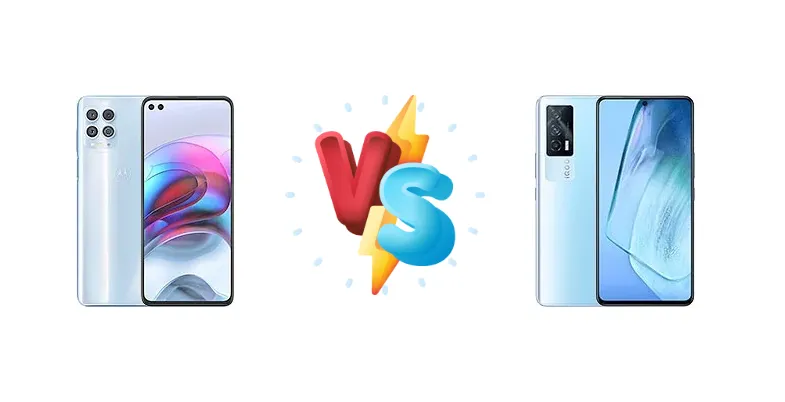
The Motorola Edge S and the vivo iQOO 7 (India) represent compelling options in the increasingly competitive mid-range flagship space. Both devices center around the Qualcomm Snapdragon 870 5G, offering a significant performance leap over lower-tier chipsets. However, their approaches to battery technology and overall user experience diverge significantly, making a direct comparison crucial for discerning buyers.
🏆 Quick Verdict
For the average user prioritizing convenience and minimal downtime, the vivo iQOO 7 (India) is the clear winner. Its 66W fast charging, capable of a full charge in just 22 minutes, drastically outperforms the Motorola Edge S’s 20W charging. While performance is nearly identical, the iQOO 7’s charging speed is a game-changer.
| Network |
|---|
| 2G bands | GSM 850 / 900 / 1800 / 1900 | GSM 850 / 900 / 1800 / 1900 |
| 3G bands | HSDPA 850 / 900 / 1700(AWS) / 1900 / 2100 | HSDPA 850 / 900 / 2100 |
| 4G bands | 1, 2, 3, 4, 5, 7, 8, 12, 13, 17, 20, 26, 28, 32, 34, 38, 39, 40, 41, 42, 43, 66 | 1, 3, 5, 8, 38, 40, 41 |
| 5G bands | 1, 3, 5, 7, 8, 28, 38, 41, 66, 77, 78 SA/NSA | SA/NSA |
| Speed | HSPA 42.2/5.76 Mbps, LTE Cat20 2000/200 Mbps, 5G | HSPA, LTE, 5G |
| Technology | GSM / CDMA / HSPA / CDMA2000 / LTE / 5G | GSM / HSPA / LTE / 5G |
| | CDMA2000 1x | - |
| Launch |
|---|
| Announced | 2021, January 26 | 2021, April 26 |
| Status | Available. Released 2021, February 03 | Available. Released 2021, May 01 |
| Body |
|---|
| Dimensions | 168.4 x 74 x 9.7 mm (6.63 x 2.91 x 0.38 in) | 163.3 x 76.4 x 8.4 mm (6.43 x 3.01 x 0.33 in) |
| SIM | Nano-SIM + Nano-SIM | Nano-SIM + Nano-SIM |
| Weight | 215 g (7.58 oz) | 196 g (6.91 oz) |
| | Water repellent design | - |
| Display |
|---|
| Resolution | 1080 x 2520 pixels, 21:9 ratio (~409 ppi density) | 1080 x 2400 pixels, 20:9 ratio (~398 ppi density) |
| Size | 6.7 inches, 104.9 cm2 (~84.1% screen-to-body ratio) | 6.62 inches, 105.8 cm2 (~84.8% screen-to-body ratio) |
| Type | IPS LCD, 90Hz, HDR10, 560 nits (HBM) | AMOLED, 120Hz, HDR10+, 1300 nits (peak) |
| Platform |
|---|
| CPU | Octa-core (1x3.2 GHz Kryo 585 & 3x2.42 GHz Kryo 585 & 4x1.80 GHz Kryo 585) | Octa-core (1x3.2 GHz Kryo 585 & 3x2.42 GHz Kryo 585 & 4x1.80 GHz Kryo 585) |
| Chipset | Qualcomm SM8250-AC Snapdragon 870 5G (7 nm) | Qualcomm SM8250-AC Snapdragon 870 5G (7 nm) |
| GPU | Adreno 650 | Adreno 650 |
| OS | Android 11, upgradable to Android 12 | Android 11, Funtouch 11.1 |
| Memory |
|---|
| Card slot | microSDXC (uses shared SIM slot) | No |
| Internal | 128GB 6GB RAM, 128GB 8GB RAM, 256GB 8GB RAM | 128GB 8GB RAM, 256GB 8GB RAM, 256GB 12GB RAM |
| | UFS 3.1 | - |
| Main Camera |
|---|
| Dual | - | 48 MP, f/1.8, 25mm (wide), 1/2.0", 0.8µm, PDAF, OIS
13 MP, f/2.2, 16mm, 120˚ (ultrawide)
Auxiliary lens |
| Features | Laser AF, Dual-LED flash, ring flash (macro mode), panorama, HDR | Dual-LED dual-tone flash, HDR, panorama |
| Single | - | 16 MP, f/2.0, (wide) |
| Triple | 64 MP, f/1.7, (wide), 1/2.0", 0.7µm, PDAF
16 MP, f/2.2, 121˚ (ultrawide), 1.0µm, PDAF
TOF 3D
Auxiliary lens | - |
| Video | 6K@30fps, 4K@30/60fps, 1080p@30/60/120fps, gyro-EIS | 4K@30fps, 1080p@30fps |
| Selfie camera |
|---|
| Dual | 16 MP, f/2.2, (wide), 1.0µm
8 MP, f/2.4, 100˚ (ultrawide), 1.12µm | - |
| Features | HDR | HDR |
| Single | - | 16 MP, f/2.0, (wide) |
| Video | 1080p@30fps | 1080p@30fps |
| Sound |
|---|
| 3.5mm jack | Yes | No |
| 35mm jack | Yes | No |
| Loudspeaker | Yes | Yes, with dual speakers |
| | - | 24-bit/192kHz audio |
| Comms |
|---|
| Bluetooth | 5.1, A2DP, LE | 5.1, A2DP, LE, aptX HD, aptX Adaptive |
| NFC | Yes | Yes |
| Positioning | GPS (L1+L5), GLONASS, BDS, GALILEO | GPS |
| Radio | No | No |
| USB | USB Type-C 3.1, OTG | USB Type-C 2.0, OTG |
| WLAN | Wi-Fi 802.11 a/b/g/n/ac/6, dual-band, Wi-Fi Direct | Wi-Fi 802.11 a/b/g/n/ac, dual-band, Wi-Fi Direct |
| Features |
|---|
| Sensors | Fingerprint (side-mounted), accelerometer, gyro, proximity, compass | Fingerprint (under display, optical), accelerometer, gyro, proximity, compass |
| | Ready For support | - |
| Battery |
|---|
| Charging | 20W wired | 66W wired, 100% in 22 min |
| Type | Li-Po 5000 mAh | 4400 mAh |
| Misc |
|---|
| Colors | Blue, Silver | Solid Ice, Storm Black, Monster Orange |
| Price | About 250 EUR | About 350 EUR |
Motorola Edge S
- Potentially lower price point
- Solid Snapdragon 870 performance
- Clean Android experience (likely)
- Slow 20W charging
- Likely LCD display
- Limited camera information
vivo iQOO 7 (India)
- Ultra-fast 66W charging (22 minutes to 100%)
- Strong Snapdragon 870 performance
- Potentially optimized gaming experience (iQOO branding)
- May be slightly more expensive
- Likely LCD display
- Software customization (vivo's Funtouch OS)
Display Comparison
Both devices share a similar reliance on LCD panel technology, a cost-saving measure common in this price bracket. While specific display specs like resolution and refresh rate aren't provided, the focus shifts to charging. The absence of AMOLED or LTPO technology means neither phone will deliver the deep blacks or variable refresh rate efficiency found in higher-end models. Bezels are likely comparable, given the similar overall design philosophies of maximizing screen real estate within a budget.
Camera Comparison
Without detailed camera specifications, a direct comparison is limited. Both phones likely feature multi-camera setups, but the quality will depend heavily on sensor size, lens aperture, and image processing algorithms. The absence of information regarding OIS (Optical Image Stabilization) suggests neither phone prioritizes advanced stabilization. The focus should be on real-world image samples to assess the quality of photos and videos, as megapixel counts alone are not indicative of performance.
Performance
The core of both phones is the Qualcomm SM8250-AC Snapdragon 870 5G (7 nm) chipset, featuring an identical CPU configuration: 1x3.2 GHz Kryo 585, 3x2.42 GHz Kryo 585, and 4x1.80 GHz Kryo 585. This means CPU-bound tasks like app loading and multitasking will perform virtually identically. The GPU performance will also be nearly indistinguishable. However, sustained performance could vary slightly depending on thermal management solutions, a detail not provided in the specifications. Both likely utilize LPDDR4X RAM, given the chipset generation, which provides ample bandwidth for demanding applications.
Battery Life
This is where the iQOO 7 (India) truly shines. While battery capacity isn’t specified, the 66W wired charging capability, achieving 100% charge in just 22 minutes, is a significant advantage over the Motorola Edge S’s 20W charging. This difference translates to drastically reduced downtime, allowing users to quickly top up their battery and resume usage. The iQOO 7’s charging speed effectively mitigates any potential disadvantage from a slightly smaller battery capacity, making it ideal for users who frequently drain their battery.
Buying Guide
Buy the Motorola Edge S if you prioritize a potentially lower price point and are comfortable with slower charging speeds. It’s a solid performer for everyday tasks and light gaming. Buy the vivo iQOO 7 (India) if you are a power user, gamer, or anyone who values rapid charging and minimizing time tethered to a wall outlet. The 66W charging is a substantial advantage for those on the go.
Frequently Asked Questions
❓ Does the iQOO 7's 66W charging generate excessive heat during charging?
While 66W charging is fast, vivo incorporates intelligent charging algorithms and thermal management systems to minimize heat generation. The charging process is optimized to balance speed and safety, preventing overheating and preserving battery health. However, some warmth during charging is normal.
❓ Is the Motorola Edge S a good choice for playing graphically demanding games like Genshin Impact?
The Snapdragon 870 chipset in the Motorola Edge S is capable of running Genshin Impact and other demanding games at medium to high settings. However, sustained performance may be limited by thermal throttling, depending on the phone's cooling solution. The iQOO 7, with its gaming-focused branding, *may* have a slight edge in sustained performance, but this requires further testing.
❓ What type of display technology does each phone use, and how does that affect the viewing experience?
Both phones are expected to utilize LCD display technology. This means they won't offer the vibrant colors, deep blacks, and energy efficiency of AMOLED displays. Viewing angles and contrast ratios will be less impressive compared to AMOLED panels.