
Motorola Edge S vs Asus ROG Phone 5s: Which Snapdragon Phone Reigns Supreme?
| Phones Images | |||||
|---|---|---|---|---|---|
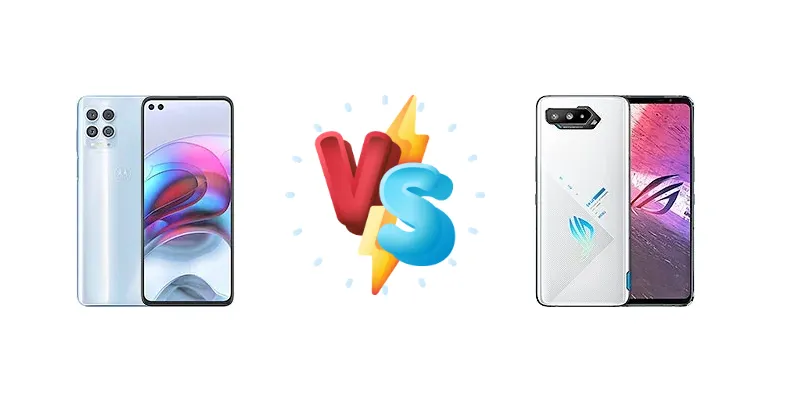
|
🏆 Quick Verdict
For the average user prioritizing value and all-around performance, the Motorola Edge S is the stronger choice. While the Asus ROG Phone 5s boasts a more powerful chipset, its focus on gaming and higher price tag make it less appealing for everyday tasks. The Edge S delivers a smooth experience without the premium cost.
| PHONES | ||
|---|---|---|
| Phone Names | Motorola Edge S | Asus ROG Phone 5s |
| Network | ||
|---|---|---|
| 2G bands | GSM 850 / 900 / 1800 / 1900 | GSM 850 / 900 / 1800 / 1900 |
| 3G bands | HSDPA 850 / 900 / 1700(AWS) / 1900 / 2100 | HSDPA 800 / 850 / 900 / 1700(AWS) / 1800 / 1900 / 2100 - Version 1 |
| 4G bands | 1, 2, 3, 4, 5, 7, 8, 12, 13, 17, 20, 26, 28, 32, 34, 38, 39, 40, 41, 42, 43, 66 | 1, 2, 3, 4, 5, 7, 8, 12, 13, 17, 18, 19, 20, 25, 26, 28, 29, 30, 32, 34, 38, 39, 40, 41, 42, 48, 66, 71 - Version 1 |
| 5G bands | 1, 3, 5, 7, 8, 28, 38, 41, 66, 77, 78 SA/NSA | 1, 2, 3, 5, 7, 8, 12, 20, 25, 28, 38, 40, 41, 66, 71, 77, 78, 79 SA/NSA - Version 1 |
| Speed | HSPA 42.2/5.76 Mbps, LTE Cat20 2000/200 Mbps, 5G | HSPA 42.2/5.76 Mbps, LTE (7CA) Cat20 1400/150 Mbps, 5G 4 Gbps DL |
| Technology | GSM / CDMA / HSPA / CDMA2000 / LTE / 5G | GSM / HSPA / LTE / 5G |
| CDMA2000 1x | 2, 3, 5, 7, 12, 20, 25, 28, 38, 40, 66, 71, 77, 78, 79 SA/NSA - Version 4 | |
| Launch | ||
|---|---|---|
| Announced | 2021, January 26 | 2021, August 16 |
| Status | Available. Released 2021, February 03 | Available. Released 2021, August 26 |
| Body | ||
|---|---|---|
| Build | - | Glass front (Gorilla Glass Victus), glass back (Gorilla Glass 3), aluminum frame |
| Dimensions | 168.4 x 74 x 9.7 mm (6.63 x 2.91 x 0.38 in) | 172.8 x 77.3 x 9.9 mm (6.80 x 3.04 x 0.39 in) |
| SIM | Nano-SIM + Nano-SIM | Nano-SIM + Nano-SIM |
| Weight | 215 g (7.58 oz) | 238 g (8.40 oz) |
| Water repellent design | RGB light panel (on the back) Pressure sensitive zones (Gaming triggers) | |
| Display | ||
|---|---|---|
| Protection | - | Corning Gorilla Glass Victus |
| Resolution | 1080 x 2520 pixels, 21:9 ratio (~409 ppi density) | 1080 x 2448 pixels (~395 ppi density) |
| Size | 6.7 inches, 104.9 cm2 (~84.1% screen-to-body ratio) | 6.78 inches, 109.5 cm2 (~82.0% screen-to-body ratio) |
| Type | IPS LCD, 90Hz, HDR10, 560 nits (HBM) | AMOLED, 1B colors, 144Hz, HDR10+, 800 nits (typ), 1200 nits (peak) |
| Platform | ||
|---|---|---|
| CPU | Octa-core (1x3.2 GHz Kryo 585 & 3x2.42 GHz Kryo 585 & 4x1.80 GHz Kryo 585) | Octa-core (1x2.99 GHz Cortex-X1 & 3x2.42 GHz Cortex-A78 & 4x1.80 GHz Cortex-A55) |
| Chipset | Qualcomm SM8250-AC Snapdragon 870 5G (7 nm) | Qualcomm SM8350 Snapdragon 888+ 5G (5 nm) |
| GPU | Adreno 650 | Adreno 660 |
| OS | Android 11, upgradable to Android 12 | Android 11, upgradable to Android 13, ROG UI |
| Memory | ||
|---|---|---|
| Card slot | microSDXC (uses shared SIM slot) | No |
| Internal | 128GB 6GB RAM, 128GB 8GB RAM, 256GB 8GB RAM | 128GB 8GB RAM, 128GB 12GB RAM, 256GB 12GB RAM, 256GB 16GB RAM, 512GB 16GB RAM, 512GB 18GB RAM |
| UFS 3.1 | UFS 3.1 | |
| Main Camera | ||
|---|---|---|
| Features | Laser AF, Dual-LED flash, ring flash (macro mode), panorama, HDR | LED flash, HDR, panorama |
| Triple | 64 MP, f/1.7, (wide), 1/2.0", 0.7µm, PDAF 16 MP, f/2.2, 121˚ (ultrawide), 1.0µm, PDAF TOF 3D Auxiliary lens | 64 MP, f/1.8, 26mm (wide), 1/1.73", 0.8µm, PDAF 13 MP, f/2.4, 11mm, 125˚ (ultrawide) 5 MP (macro) |
| Video | 6K@30fps, 4K@30/60fps, 1080p@30/60/120fps, gyro-EIS | 8K@30fps, 4K@30/60/120fps, 1080p@30/60/120/240fps, 720p@480fps; gyro-EIS |
| Selfie camera | ||
|---|---|---|
| Dual | 16 MP, f/2.2, (wide), 1.0µm 8 MP, f/2.4, 100˚ (ultrawide), 1.12µm | - |
| Features | HDR | Panorama, HDR |
| Single | - | 24 MP, f/2.5, 27mm (wide), 0.9µm |
| Video | 1080p@30fps | 1080p@30fps |
| Sound | ||
|---|---|---|
| 3.5mm jack | Yes | Yes |
| 35mm jack | Yes | Yes |
| Loudspeaker | Yes | Yes, with stereo speakers (2 amplifiers) |
| - | 24-bit/192kHz audio | |
| Comms | ||
|---|---|---|
| Bluetooth | 5.1, A2DP, LE | 5.2, A2DP, LE, aptX HD, aptX Adaptive |
| NFC | Yes | Yes |
| Positioning | GPS (L1+L5), GLONASS, BDS, GALILEO | GPS (L1+L5), GLONASS (L1), BDS (B1I+B1c+B2a), GALILEO (E1+E5a), QZSS (L1+L5), NavIC (L5) |
| Radio | No | No |
| USB | USB Type-C 3.1, OTG | USB Type-C 3.1 (side), USB Type-C 2.0 (bottom), OTG, accessory connector |
| WLAN | Wi-Fi 802.11 a/b/g/n/ac/6, dual-band, Wi-Fi Direct | Wi-Fi 802.11 a/b/g/n/ac/6e, dual-band, Wi-Fi Direct |
| Features | ||
|---|---|---|
| Sensors | Fingerprint (side-mounted), accelerometer, gyro, proximity, compass | Fingerprint (under display, optical), accelerometer, gyro, proximity, compass |
| Ready For support | - | |
| Battery | ||
|---|---|---|
| Charging | 20W wired | 65W wired, PD3.0, QC5, 70% in 30 min, 100% in 52 min 10W reverse wired |
| Type | Li-Po 5000 mAh | Li-Po 6000 mAh |
| Misc | ||
|---|---|---|
| Colors | Blue, Silver | Phantom Black, Storm White |
| Models | - | ZS676KS |
| Price | About 250 EUR | About 1030 EUR |
Motorola Edge S
- More affordable price point
- Excellent overall performance for the price
- Solid Snapdragon 870 chipset
- Slower charging speed (20W)
- Less powerful chipset compared to the 888+
- Likely lacks dedicated gaming features
Asus ROG Phone 5s
- Significantly faster 65W charging
- More powerful Snapdragon 888+ chipset
- Dedicated gaming features (AirTriggers, etc.)
- Higher price tag
- May prioritize gaming performance over battery life
- Potentially more thermal throttling under sustained load
Display Comparison
Neither device's display specifications are provided, so a direct comparison is limited. However, given the ROG Phone 5s's gaming focus, it likely features a higher refresh rate panel (120Hz or 144Hz) compared to the Edge S, potentially offering smoother visuals in fast-paced games. The ROG Phone 5s likely prioritizes color accuracy and low latency for competitive gaming, while the Edge S may lean towards more saturated colors for media consumption. Bezels are likely similar, given both are flagship-adjacent devices.
Camera Comparison
Without specific camera sensor details, a detailed comparison is challenging. However, the ROG Phone 5s, being a higher-priced device, likely incorporates a more sophisticated camera system with a larger main sensor and potentially optical image stabilization (OIS). The Snapdragon 888+ also features a more advanced image signal processor (ISP) for improved image processing. While the Edge S will likely produce good quality images, the ROG Phone 5s is expected to deliver superior low-light performance and dynamic range. We can assume both phones will have multiple lenses, but the ROG Phone 5s will likely have a more refined overall camera experience.
Performance
The Asus ROG Phone 5s’s Snapdragon 888+ (5nm) represents a significant architectural leap over the Motorola Edge S’s Snapdragon 870 (7nm). The 888+ features the Cortex-X1 prime core clocked at 2.99 GHz, offering a performance advantage over the Kryo 585 in the 870. While both are octa-core CPUs, the 888+’s more efficient 5nm process allows for sustained performance under heavy load, reducing thermal throttling. The ROG Phone 5s will demonstrably outperform the Edge S in demanding tasks like video editing and graphically intensive games. The Edge S, however, remains a very capable performer, and the difference won't be noticeable in typical daily usage.
Battery Life
The Asus ROG Phone 5s’s 65W wired charging is a game-changer, achieving 70% charge in 30 minutes and 100% in 52 minutes. This significantly surpasses the Motorola Edge S’s 20W charging, which will take considerably longer to fully charge. While battery capacity isn't specified, the ROG Phone 5s’s faster charging mitigates any potential disadvantage from a smaller battery. The 10W reverse wired charging on the ROG Phone 5s is also a useful feature for topping up accessories, absent on the Edge S.
Buying Guide
Buy the Motorola Edge S if you need a balanced smartphone experience with excellent performance for everyday tasks, media consumption, and light gaming, all at a competitive price. Buy the Asus ROG Phone 5s if you are a dedicated mobile gamer who demands the highest possible frame rates, advanced cooling solutions, and specialized gaming features like AirTriggers, and are willing to pay a premium for it.