
Motorola Edge 70 vs Xiaomi 13 Lite: A Deep Dive into Mid-Range Champions
| Phones Images | |||||
|---|---|---|---|---|---|
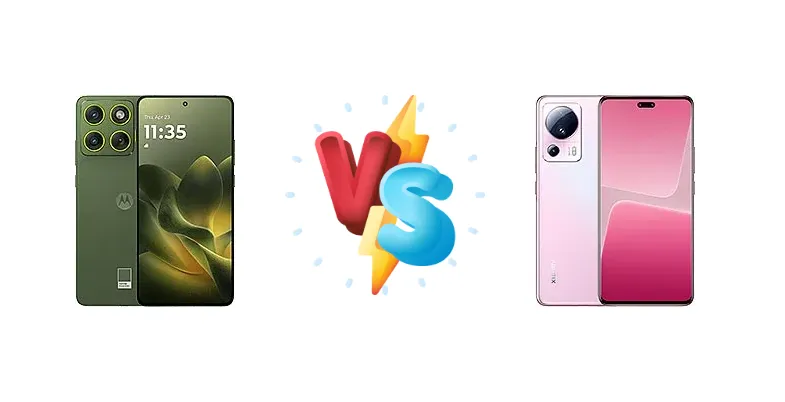
|
🏆 Quick Verdict
For most users, the Motorola Edge 70 emerges as the stronger choice. Its Snapdragon 7 Gen 4 offers a noticeable performance uplift over the 7 Gen 1 in the Xiaomi 13 Lite, coupled with superior battery endurance (50:14h vs 93h endurance rating). While the Xiaomi 13 Lite’s display is brighter, the Edge 70’s overall package delivers a more balanced experience.
| PHONES | ||
|---|---|---|
| Phone Names | Motorola Edge 70 | Xiaomi 13 Lite |
| Network | ||
|---|---|---|
| 2G bands | GSM 850 / 900 / 1800 / 1900 | GSM 850 / 900 / 1800 / 1900 |
| 3G bands | HSDPA 850 / 900 / 1700(AWS) / 1900 / 2100 | HSDPA 800 / 850 / 900 / 1700(AWS) / 1900 / 2100 |
| 4G bands | 1, 2, 3, 4, 5, 7, 8, 12, 13, 17, 18, 19, 20, 25, 26, 28, 32, 34, 38, 39, 40, 41, 42, 43, 48, 66 | 1, 2, 3, 4, 5, 7, 8, 12, 13, 17, 18, 19, 20, 26, 28, 32, 38, 40, 41, 42, 66 |
| 5G bands | 1, 2, 3, 5, 7, 8, 20, 26, 28, 38, 40, 41, 66, 75, 77, 78 SA/NSA/Sub6 | 1, 3, 5, 7, 8, 20, 28, 38, 40, 41, 66, 77, 78 SA/NSA |
| Speed | HSPA, LTE, 5G | HSPA, LTE, 5G |
| Technology | GSM / CDMA / HSPA / LTE / 5G | GSM / HSPA / LTE / 5G |
| Launch | ||
|---|---|---|
| Announced | 2025, October 29 | 2023, February 26 |
| Status | Available. Released 2025, October 29 | Available. Released 2023, March 08 |
| Body | ||
|---|---|---|
| Build | Glass front (Gorilla Glass 7i), aluminum frame | Glass front (Gorilla Glass 5), glass back, plastic frame |
| Dimensions | 159.9 x 74 x 6 mm (6.30 x 2.91 x 0.24 in) | 159.2 x 72.7 x 7.2 mm (6.27 x 2.86 x 0.28 in) |
| SIM | · Nano-SIM + eSIM - International· Nano-SIM + Nano-SIM - China | · Nano-SIM + eSIM· Nano-SIM + Nano-SIM |
| Weight | 159 g (5.61 oz) | 171 g (6.03 oz) |
| - | IP53, dust and splash resistant | |
| Display | ||
|---|---|---|
| Protection | Corning Gorilla Glass 7i, Mohs level 4 | Corning Gorilla Glass 5 |
| Resolution | 1220 x 2712 pixels, 20:9 ratio (~446 ppi density) | 1080 x 2400 pixels, 20:9 ratio (~402 ppi density) |
| Size | 6.7 inches, 107.4 cm2 (~90.8% screen-to-body ratio) | 6.55 inches, 103.6 cm2 (~89.5% screen-to-body ratio) |
| Type | P-OLED, 1B colors, 120Hz, PWM, HDR10+, 4500 nits (peak) | AMOLED, 68B colors, Dolby Vision, HDR10+, 120Hz, 500 nits (typ), 1000 nits (peak) |
| Platform | ||
|---|---|---|
| CPU | Octa-core (1x2.8 GHz Cortex-720 & 4x2.4 GHz Cortex-720 & 3x1.8 GHz Cortex-520) | Octa-core (1x2.4 GHz Cortex-A710 & 3x2.36 GHz Cortex-A710 & 4x1.8 GHz Cortex-A510) |
| Chipset | Qualcomm SM7750-AB Snapdragon 7 Gen 4 (4 nm) | Qualcomm SM7450-AB Snapdragon 7 Gen 1 (4 nm) |
| GPU | Adreno 722 | Adreno 644 |
| OS | Android 16, up to 4 major Android upgrades | Android 12, MIUI 14 |
| Memory | ||
|---|---|---|
| Card slot | No | No |
| Internal | 256GB 12GB RAM, 512GB 12GB RAM | 64GB 8GB RAM, 128GB 8GB RAM, 256GB 8GB RAM |
| - | UFS 2.2 | |
| Main Camera | ||
|---|---|---|
| Dual | 50 MP, f/1.8, 24mm (wide), 1/1.56", 1.0µm, multi-directional PDAF, OIS 50 MP, f/2.0, 12mm, 120˚ (ultrawide), 1/2.76", 0.64µm, PDAF | - |
| Features | LED flash, HDR, panorama | Dual-LED dual-tone flash, HDR, panorama |
| Triple | - | 50 MP, f/1.8, 23mm (wide), 1/1.56", 1.0µm, PDAF 8 MP, f/2.2, 119˚ (ultrawide), 1/4.0", 1.12µm 2 MP (macro) |
| Video | 4K@30/60fps, 1080p@30/60/120/240fps, gyro-EIS | 4K@30fps, 1080p@30/60/120fps, 720p@960fps |
| Selfie camera | ||
|---|---|---|
| Dual | - | 32 MP, f/2.4, 100˚ (ultrawide), 1/2.74", 0.8µm 8 MP, f/2.3, (depth) |
| Features | HDR | Dual-LED flash, HDR |
| Single | 50 MP, f/2.0, (wide), 0.64µm | - |
| Video | 4K@30fps, 1080p@30/120fps | 1080p@30/60fps |
| Sound | ||
|---|---|---|
| 3.5mm jack | - | No |
| 35mm jack | No | No |
| Loudspeaker | Yes, with stereo speakers (with Dolby Atmos) | Yes |
| - | 24-bit/192kHz audio | |
| Comms | ||
|---|---|---|
| Bluetooth | 5.4, A2DP, LE | 5.2, A2DP, LE |
| Infrared port | - | Yes |
| NFC | Yes | Yes (market/region dependent) |
| Positioning | GPS, GALILEO, GLONASS, BDS, QZSS | GPS (L1), GLONASS (G1), BDS (B1I+B1c), GALILEO (E1), QZSS (L1) |
| Radio | No | No |
| USB | USB Type-C 2.0, OTG | USB Type-C 2.0, OTG |
| WLAN | Wi-Fi 802.11 a/b/g/n/ac/6e, dual-band or tri-band | Wi-Fi 802.11 a/b/g/n/ac/6, dual-band |
| Features | ||
|---|---|---|
| Sensors | Fingerprint (under display, optical), accelerometer, gyro, proximity, compass | Fingerprint (under display, optical), accelerometer, gyro, proximity, compass |
| Battery | ||
|---|---|---|
| Charging | 68W wired 15W wireless | 67W wired, 100% in 40 min |
| Type | Si/C Li-Ion 4800 mAh | Li-Po 4500 mAh |
| Misc | ||
|---|---|---|
| Colors | Pantone: Gadget Gray, Lily Pad, Bronze Green | Black, Lite Blue, Lite Pink |
| Models | XT2601-2, XT2603-2 | - |
| Price | £ 799.00 | About 180 EUR |
| Tests | ||
|---|---|---|
| Battery life | - | Endurance rating 93h |
| Camera | - | Photo / Video |
| Display | - | Contrast ratio: Infinite (nominal) |
| Loudspeaker | - | -28.5 LUFS (Average) |
| Performance | - | AnTuTu: 534143 (v9) GeekBench: 2936 (v5.1), 2434 (v6) GFXBench: 33fps (ES 3.1 onscreen) |
| EU LABEL | ||
|---|---|---|
| Battery | 50:14h endurance, 1000 cycles | - |
| Energy | Class A | - |
| Free fall | Class A (270 falls) | - |
| Repairability | Class B | - |
Motorola Edge 70
- Newer, more powerful Snapdragon 7 Gen 4 chipset
- Superior battery endurance and active use time
- Wireless charging support
- Display brightness data unavailable
- Camera specifications largely unknown
Xiaomi 13 Lite
- High peak display brightness (938 nits)
- Sleek and lightweight design
- Fast 67W wired charging
- Older Snapdragon 7 Gen 1 chipset
- Lower battery endurance compared to Edge 70
- No wireless charging
Display Comparison
The Xiaomi 13 Lite immediately stands out with its measured peak brightness of 938 nits, making it significantly more visible in direct sunlight than the Motorola Edge 70 (brightness data unavailable). However, the Edge 70’s panel characteristics are unknown, and the 13 Lite’s ‘infinite’ contrast ratio is a nominal specification. The absence of refresh rate data for the Edge 70 is a key omission, while the 13 Lite’s display is geared towards visual pop, the Edge 70’s display quality remains a question mark without further data.
Camera Comparison
Both phones feature photo and video capabilities, but detailed camera specifications are lacking. Without sensor size, aperture, or OIS information, a direct comparison is difficult. The Xiaomi 13 Lite’s marketing often highlights its selfie camera, suggesting a focus on front-facing image quality. However, the Edge 70’s image processing algorithms and potential for larger sensors (data unavailable) could offer a competitive advantage in overall image quality. The absence of details regarding video recording capabilities on both devices hinders a comprehensive assessment.
Performance
The Motorola Edge 70’s Qualcomm SM7750-AB Snapdragon 7 Gen 4 (4nm) represents a generational leap over the Xiaomi 13 Lite’s Snapdragon 7 Gen 1 (SM7450-AB, 4nm). The Edge 70’s CPU configuration – a 2.8 GHz Cortex-720 prime core alongside four 2.4 GHz Cortex-720 cores and three 1.8 GHz Cortex-520 cores – promises faster processing speeds compared to the 13 Lite’s 2.4 GHz Cortex-A710 prime core, three 2.36 GHz Cortex-A710 cores, and four 1.8 GHz Cortex-A510 cores. This translates to snappier app launches and smoother multitasking. The newer architecture of the 7 Gen 4 also implies improved thermal efficiency, potentially reducing throttling during extended gaming sessions.
Battery Life
The Motorola Edge 70 boasts a significantly more impressive endurance rating of 50:14h, and a 13:36h active use score, compared to the Xiaomi 13 Lite’s 93h endurance rating. While the 93h rating sounds impressive, it's likely based on older testing methodologies. The Edge 70’s 68W wired charging is comparable to the 13 Lite’s 67W charging (100% in 40 minutes), but the Edge 70 also adds the convenience of 15W wireless charging, a feature absent on the Xiaomi 13 Lite. The Edge 70’s stated 1000 charge cycles also suggest a longer lifespan for the battery.
Buying Guide
Buy the Motorola Edge 70 if you prioritize sustained performance for gaming and multitasking, and value long-lasting battery life. It’s ideal for users who actively use their phones throughout the day. Buy the Xiaomi 13 Lite if you are heavily focused on content consumption and prefer a brighter display for outdoor visibility, and prioritize a lighter, more aesthetically focused design.