
Motorola Edge 70 vs. Google Pixel 7a: A Deep Dive into Mid-Range Champions
| Phones Images | |||||
|---|---|---|---|---|---|
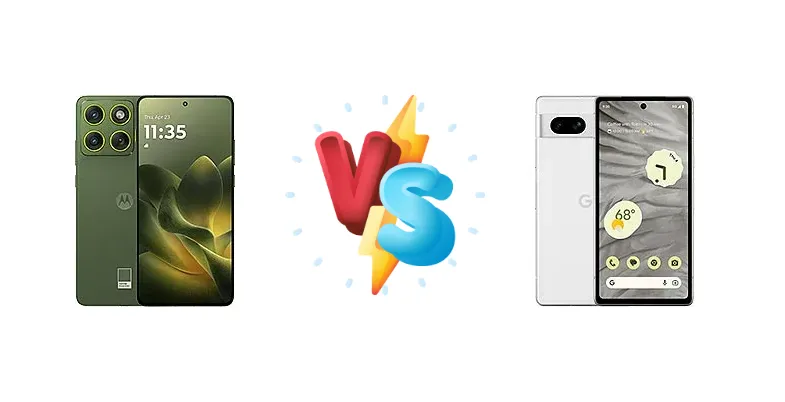
|
🏆 Quick Verdict
For the average user prioritizing camera versatility and software experience, the Google Pixel 7a is the stronger choice. However, the Motorola Edge 70 excels in charging speed and offers a more efficient chipset, making it ideal for those who value battery longevity and quick top-ups.
| PHONES | ||
|---|---|---|
| Phone Names | Motorola Edge 70 | Google Pixel 7a |
| Network | ||
|---|---|---|
| 2G bands | GSM 850 / 900 / 1800 / 1900 | GSM 850 / 900 / 1800 / 1900 |
| 3G bands | HSDPA 850 / 900 / 1700(AWS) / 1900 / 2100 | HSDPA 800 / 850 / 900 / 1700(AWS) / 1900 / 2100 |
| 4G bands | 1, 2, 3, 4, 5, 7, 8, 12, 13, 17, 18, 19, 20, 25, 26, 28, 32, 34, 38, 39, 40, 41, 42, 43, 48, 66 | 1, 2, 3, 4, 5, 7, 8, 12, 13, 14, 17, 20, 25, 26, 28, 29, 30, 38, 40, 41, 48, 66, 71 - GWKK3, G0DZQ |
| 5G bands | 1, 2, 3, 5, 7, 8, 20, 26, 28, 38, 40, 41, 66, 75, 77, 78 SA/NSA/Sub6 | 1, 2, 3, 5, 7, 8, 12, 14, 20, 25, 28, 30, 38, 41, 48, 66, 71, 77, 78 SA/NSA/Sub6 - GWKK3 |
| Speed | HSPA, LTE, 5G | HSPA, LTE, 5G |
| Technology | GSM / CDMA / HSPA / LTE / 5G | GSM / HSPA / LTE / 5G |
| - | 1, 2, 3, 5, 7, 8, 12, 20, 25, 28, 38, 40, 41, 66, 75, 76, 77, 78, 79 SA/NSA/Sub6 - GHL1X, G82U8 | |
| Launch | ||
|---|---|---|
| Announced | 2025, October 29 | 2023, May 10 |
| Status | Available. Released 2025, October 29 | Available. Released 2023, May 10 |
| Body | ||
|---|---|---|
| Build | Glass front (Gorilla Glass 7i), aluminum frame | Glass front (Gorilla Glass 3), aluminum frame, plastic back |
| Dimensions | 159.9 x 74 x 6 mm (6.30 x 2.91 x 0.24 in) | 152 x 72.9 x 9 mm (5.98 x 2.87 x 0.35 in) |
| SIM | · Nano-SIM + eSIM - International· Nano-SIM + Nano-SIM - China | Nano-SIM + eSIM |
| Weight | 159 g (5.61 oz) | 193.5 g (6.84 oz) |
| - | IP67 dust/water resistant (up to 1m for 30 min) | |
| Display | ||
|---|---|---|
| Protection | Corning Gorilla Glass 7i, Mohs level 4 | Corning Gorilla Glass 3 |
| Resolution | 1220 x 2712 pixels, 20:9 ratio (~446 ppi density) | 1080 x 2400 pixels, 20:9 ratio (~429 ppi density) |
| Size | 6.7 inches, 107.4 cm2 (~90.8% screen-to-body ratio) | 6.1 inches, 90.7 cm2 (~81.8% screen-to-body ratio) |
| Type | P-OLED, 1B colors, 120Hz, PWM, HDR10+, 4500 nits (peak) | OLED, HDR, 90Hz |
| - | Always-on display | |
| Platform | ||
|---|---|---|
| CPU | Octa-core (1x2.8 GHz Cortex-720 & 4x2.4 GHz Cortex-720 & 3x1.8 GHz Cortex-520) | Octa-core (2x2.85 GHz Cortex-X1 & 2x2.35 GHz Cortex-A78 & 4x1.80 GHz Cortex-A55) |
| Chipset | Qualcomm SM7750-AB Snapdragon 7 Gen 4 (4 nm) | Google Tensor G2 (5 nm) |
| GPU | Adreno 722 | Mali-G710 MP7 |
| OS | Android 16, up to 4 major Android upgrades | Android 13, upgradable to Android 15, up to 5 major Android upgrades |
| Memory | ||
|---|---|---|
| Card slot | No | No |
| Internal | 256GB 12GB RAM, 512GB 12GB RAM | 128GB 8GB RAM |
| - | UFS 3.1 | |
| Main Camera | ||
|---|---|---|
| Dual | 50 MP, f/1.8, 24mm (wide), 1/1.56", 1.0µm, multi-directional PDAF, OIS 50 MP, f/2.0, 12mm, 120˚ (ultrawide), 1/2.76", 0.64µm, PDAF | 64 MP, f/1.9, 26mm (wide), 1/1.73", 0.8µm, dual pixel PDAF, OIS 13 MP, f/2.2, 120˚ (ultrawide), 1.12µm |
| Features | LED flash, HDR, panorama | Dual-LED flash, Pixel Shift, Auto-HDR, panorama |
| Video | 4K@30/60fps, 1080p@30/60/120/240fps, gyro-EIS | 4K@30/60fps, 1080p@30/60/120/240fps, OIS |
| Selfie camera | ||
|---|---|---|
| Features | HDR | HDR, panorama |
| Single | 50 MP, f/2.0, (wide), 0.64µm | 13 MP, f/2.2, 20mm (ultrawide), 1.12µm |
| Video | 4K@30fps, 1080p@30/120fps | 4K@30fps, 1080p@30fps |
| Sound | ||
|---|---|---|
| 3.5mm jack | - | No |
| 35mm jack | No | No |
| Loudspeaker | Yes, with stereo speakers (with Dolby Atmos) | Yes, with stereo speakers |
| Comms | ||
|---|---|---|
| Bluetooth | 5.4, A2DP, LE | 5.3, A2DP, LE |
| NFC | Yes | Yes |
| Positioning | GPS, GALILEO, GLONASS, BDS, QZSS | GPS, GLONASS, GALILEO, BDS, QZSS, NavIC |
| Radio | No | No |
| USB | USB Type-C 2.0, OTG | USB Type-C 3.2 |
| WLAN | Wi-Fi 802.11 a/b/g/n/ac/6e, dual-band or tri-band | Wi-Fi 802.11 a/b/g/n/ac/6e, tri-band |
| Features | ||
|---|---|---|
| Sensors | Fingerprint (under display, optical), accelerometer, gyro, proximity, compass | Fingerprint (under display, optical), accelerometer, gyro, proximity, compass, barometer |
| Battery | ||
|---|---|---|
| Charging | 68W wired 15W wireless | 18W wired, PD3.0 7.5W wireless |
| Type | Si/C Li-Ion 4800 mAh | Li-Po 4385 mAh |
| Misc | ||
|---|---|---|
| Colors | Pantone: Gadget Gray, Lily Pad, Bronze Green | Charcoal, Snow, Sea, Coral |
| Models | XT2601-2, XT2603-2 | GWKK3, GHL1X, G0DZQ, G82U8 |
| Price | £ 799.00 | € 179.90 / $ 150.00 / £ 170.00 / ₹ 25,980 |
| EU LABEL | ||
|---|---|---|
| Battery | 50:14h endurance, 1000 cycles | - |
| Energy | Class A | - |
| Free fall | Class A (270 falls) | - |
| Repairability | Class B | - |
Motorola Edge 70
- Significantly faster 68W wired charging
- More efficient Snapdragon 7 Gen 4 chipset
- Potentially longer battery lifespan (1000 cycles)
- Camera performance likely trails the Pixel 7a
- Software updates may be less frequent than Pixel
Google Pixel 7a
- Superior camera quality and computational photography
- Clean Android experience with guaranteed updates
- Brighter display for outdoor visibility
- Slower 18W wired charging
- Tensor G2 may throttle under sustained load
Display Comparison
The Pixel 7a boasts a brighter display, reaching a measured 1070 nits, which translates to better visibility under direct sunlight compared to the Edge 70 (brightness data unavailable). While the Edge 70’s panel specifics are unknown, the Pixel 7a’s OLED panel delivers vibrant colors and deep blacks. The Pixel 7a’s 90Hz refresh rate, while not specified for the Edge 70, is standard for this price point and contributes to smoother scrolling and animations. Bezels appear comparable, but the Pixel 7a’s flat display may offer a slightly more immersive experience.
Camera Comparison
The Pixel 7a’s camera system is its standout feature, leveraging Google’s renowned computational photography. While specific sensor details are missing for both, the Pixel 7a’s image processing algorithms consistently deliver excellent dynamic range and detail. The Edge 70’s camera capabilities are less emphasized in the provided data, suggesting a more conventional approach. The Pixel 7a’s video capabilities are also likely superior, benefiting from the Tensor G2’s image signal processor. Ignoring the likely present but unimportant 2MP macro sensors on both devices, the Pixel 7a’s focus on software optimization gives it a clear edge.
Performance
The core difference lies in the chipsets. The Google Pixel 7a’s Tensor G2 (5nm) prioritizes AI and machine learning tasks, excelling in features like voice recognition and image processing. However, the Motorola Edge 70’s Snapdragon 7 Gen 4 (4nm) offers a more balanced approach, with a Cortex-720 based CPU configuration designed for sustained performance and efficiency. The Snapdragon’s 4nm process node provides a thermal advantage, potentially leading to less throttling during extended gaming sessions. The Pixel 7a’s CPU, featuring Cortex-X1 cores, offers peak performance advantages, but the Edge 70’s architecture may provide more consistent performance over time. Both utilize octa-core CPUs, but the core arrangement and clock speeds differ significantly.
Battery Life
The Motorola Edge 70 claims a 50:14h endurance rating and 13:36h of active use, while the Pixel 7a’s older 76h endurance rating is less directly comparable. The Edge 70’s 68W wired charging is significantly faster than the Pixel 7a’s 18W charging, allowing for a full charge in under an hour. The Edge 70 also supports 15W wireless charging, while the Pixel 7a offers 7.5W wireless charging. The Edge 70’s 1000 cycle battery claim suggests a longer lifespan, but real-world battery life will depend on usage patterns. The faster charging of the Edge 70 mitigates any potential capacity disadvantage.
Buying Guide
Buy the Motorola Edge 70 if you need exceptional charging speeds (68W) and prioritize battery endurance with its efficient Snapdragon 7 Gen 4 chipset. It’s the phone for power users who frequently top up throughout the day and demand long-lasting performance. Buy the Google Pixel 7a if you prefer a superior camera experience powered by Google’s computational photography, a clean Android experience with guaranteed updates, and seamless integration with Google’s ecosystem.