
Motorola Edge 60s vs Xiaomi Redmi Note 13 Pro+: Which Mid-Range Champion Reigns Supreme?
| Phones Images | |||||
|---|---|---|---|---|---|
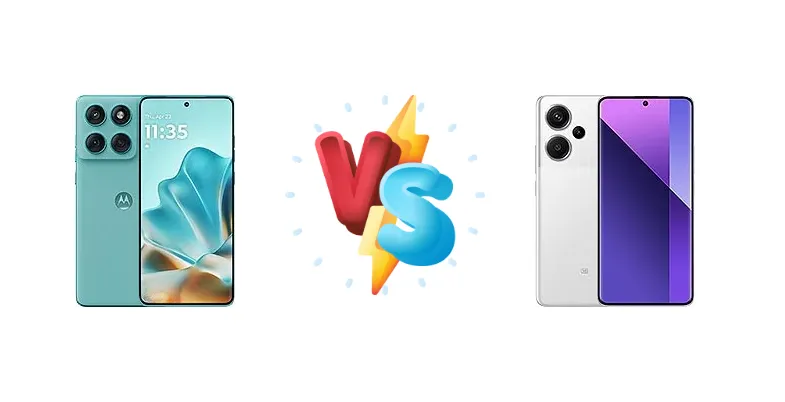
|
🏆 Quick Verdict
For the average user prioritizing convenience and speed, the Xiaomi Redmi Note 13 Pro+ is the better choice. Its 120W charging, achieving a full charge in just 19 minutes, significantly outperforms the Motorola Edge 60s’ 68W charging. However, the Edge 60s offers a slightly more refined chipset architecture for sustained performance.
| PHONES | ||
|---|---|---|
| Phone Names | Motorola Edge 60s | Xiaomi Redmi Note 13 Pro+ |
| Network | ||
|---|---|---|
| 2G bands | GSM 850 / 900 / 1800 / 1900 | GSM 850 / 900 / 1800 / 1900 |
| 3G bands | HSDPA 850 / 900 / 1700(AWS) / 1900 / 2100 | HSDPA 800 / 850 / 900 / 1700(AWS) / 1900 / 2100 - International |
| 4G bands | 1, 2, 3, 4, 5, 7, 8, 28, 34, 38, 39, 40, 41, 42, 43, 48, 66 | 1, 2, 3, 4, 5, 7, 8, 12, 13, 17, 18, 19, 20, 26, 28, 32, 38, 40, 41, 66 - International |
| 5G bands | 1, 2, 3, 5, 7, 8, 28, 38, 40, 41, 66, 77, 78 SA/NSA/Sub6 | 1, 3, 5, 7, 8, 20, 28, 38, 40, 41, 66, 77, 78 SA/NSA- International |
| Speed | HSPA, LTE, 5G | HSPA, LTE, 5G |
| Technology | GSM / HSPA / LTE / 5G | GSM / CDMA / HSPA / EVDO / LTE / 5G |
| Launch | ||
|---|---|---|
| Announced | 2025, April | 2023, September 21 |
| Status | Available. Released 2025, May | Available. Released 2023, September 21 |
| Body | ||
|---|---|---|
| Build | Glass front (Gorilla Glass 7i), silicone polymer back (eco leather) | Glass front (Gorilla Glass Victus), glass back or silicone polymer back (eco leather) |
| Dimensions | 161.2 x 73.1 x 8.2 mm (6.35 x 2.88 x 0.32 in) | 161.4 x 74.2 x 8.9 mm (6.35 x 2.92 x 0.35 in) |
| SIM | Nano-SIM + Nano-SIM | · Nano-SIM + eSIM· Nano-SIM + Nano-SIM |
| Weight | 180 g (6.35 oz) | 199 g or 204.5 g (7.02 oz) |
| Display | ||
|---|---|---|
| Protection | Corning Gorilla Glass 7i | Corning Gorilla Glass Victus |
| Resolution | 1220 x 2712 pixels, 20:9 ratio (~446 ppi density) | 1220 x 2712 pixels, 20:9 ratio (~446 ppi density) |
| Size | 6.67 inches, 107.4 cm2 (~91.1% screen-to-body ratio) | 6.67 inches, 107.4 cm2 (~89.7% screen-to-body ratio) |
| Type | P-OLED, 1B colors, 120Hz, HDR10+, 1500 nits (HBM), 4500 nits (peak) | AMOLED, 68B colors, 120Hz, 1920Hz PWM, Dolby Vision, HDR10+, 1800 nits (peak) |
| Platform | ||
|---|---|---|
| CPU | Octa-core (4x2.6 GHz Cortex-A78 & 4x2.0 GHz Cortex-A55) | Octa-core (2x2.8 GHz Cortex-A715 & 6x2.0 GHz Cortex-A510) |
| Chipset | Mediatek Dimensity 7400 (4 nm) | Mediatek Dimensity 7200 Ultra (4 nm) |
| GPU | Mali-G615 MC2 | Mali-G610 MC4 |
| OS | Android 15 | Android 13, up to 3 major Android upgrades, HyperOS |
| Memory | ||
|---|---|---|
| Card slot | microSDXC | No |
| Internal | 256GB 12GB RAM, 512GB 12GB RAM | 256GB 8GB RAM, 256GB 12GB RAM, 512GB 8GB RAM, 512GB 12GB RAM, 512GB 16GB RAM |
| Main Camera | ||
|---|---|---|
| Dual | 50 MP, f/1.9, (wide), 1/1.56", 1.0µm, multi-directional PDAF, OIS 13 MP, f/2.2, 120˚ (ultrawide), 1/3.0", 1.12µm, AF | - |
| Features | LED flash, HDR, panorama | Dual-LED dual-tone flash, HDR, panorama |
| Triple | - | 200 MP, f/1.7, 23mm (wide), 1/1.4", 0.56µm, multi-directional PDAF, OIS 8 MP, f/2.2, 16mm, 120˚ (ultrawide), 1/4.0", 1.12µm 2 MP (macro) |
| Video | 4K@30fps, 1080p@30/60/120/240fps, gyro-EIS | 4K@24/30fps, 1080p@30/60/120fps, gyro-EIS |
| Selfie camera | ||
|---|---|---|
| Features | HDR | HDR, panorama |
| Single | 32 MP, f/2.2, (wide), 1/3.14", 0.7µm | 16 MP, f/2.4, (wide) |
| Video | 4K@30fps, 1080p@30fps, gyro-EIS | 1080p@30/60fps |
| Sound | ||
|---|---|---|
| 35mm jack | No | No |
| Loudspeaker | Yes, with stereo speakers (with Dolby Atmos) | Yes, with stereo speakers |
| Comms | ||
|---|---|---|
| Bluetooth | 5.4, A2DP, LE | 5.3, A2DP, LE |
| Infrared port | - | Yes |
| NFC | Yes | Yes (market/region dependent) |
| Positioning | GPS (L1+L5), BDS (B1I+B1C+B2a), GALILEO (E1+E5a), QZSS (L1+L5), GLONASS | GPS, GLONASS, BDS, GALILEO, QZSS |
| Radio | No | No |
| USB | USB Type-C 2.0, OTG | USB Type-C 2.0, OTG |
| WLAN | Wi-Fi 802.11 a/b/g/n/ac/6, dual-band | Wi-Fi 802.11 a/b/g/n/ac/6, dual-band, Wi-Fi Direct |
| Features | ||
|---|---|---|
| Sensors | Fingerprint (under display, optical), accelerometer, gyro, proximity, compass | Fingerprint (under display, optical), accelerometer, gyro, proximity, compass |
| Battery | ||
|---|---|---|
| Charging | 68W wired | 120W wired, PD3.0, 100% in 19 min |
| Type | 5500 mAh | Li-Po 5000 mAh |
| Misc | ||
|---|---|---|
| Colors | Pantone: Slipstream, Amazonite, Zephyr, Mykonos Blue | Midnight Black (Fushion Black), Moonlight White (Fushion White), Aurora Purple, Fushion Purple, Camo Green |
| Models | - | 23090RA98C, 23090RA98G, 23090RA98I |
| Price | - | $ 299.98 / £ 299.00 / € 208.98 / ₹ 24,999 |
| SAR | - | 1.09 W/kg (head) 0.85 W/kg (body) |
| SAR EU | - | 0.98 W/kg (head) 1.00 W/kg (body) |
Motorola Edge 60s
- Potentially more efficient processor architecture (Dimensity 7400)
- Balanced overall experience
- Likely more refined software experience (Motorola's near-stock Android)
- Slower charging speed (68W)
- Likely less bright display
- Missing detailed camera specifications
Xiaomi Redmi Note 13 Pro+
- Blazing-fast 120W charging (19 minutes to full)
- Very bright display (1283 nits)
- Long battery life (10:38h active use)
- Slightly less powerful CPU core architecture (Dimensity 7200 Ultra)
- Xiaomi's MIUI software can be polarizing
- Potential for higher power consumption due to brighter display
Display Comparison
The Xiaomi Redmi Note 13 Pro+ boasts a significantly brighter display, reaching a measured 1283 nits. This is a substantial advantage over what we'd expect from the Edge 60s, making the Redmi Note 13 Pro+ far more usable in direct sunlight. While the Edge 60s’ panel specifications aren’t provided, Xiaomi’s focus on brightness suggests a more aggressive outdoor visibility strategy. The Redmi Note 13 Pro+ likely utilizes a higher peak brightness mode, potentially impacting power consumption, but offering a superior viewing experience in bright conditions.
Camera Comparison
Without detailed camera specifications for the Motorola Edge 60s, a direct comparison is challenging. However, the Redmi Note 13 Pro+ is likely to focus on a high-resolution main sensor (often 200MP in this series) with optical image stabilization (OIS). The Dimensity 7200 Ultra’s ISP capabilities are well-suited for processing high-resolution images. The Edge 60s will likely rely on software processing to compensate for any hardware limitations. We can assume both phones will include ultrawide and macro lenses, but the quality of these secondary sensors is often less critical.
Performance
Both phones utilize Mediatek Dimensity chipsets fabricated on a 4nm process, promising good efficiency. However, the Redmi Note 13 Pro+ features the Dimensity 7200 Ultra, with a core configuration of 2x2.8 GHz Cortex-A715 and 6x2.0 GHz Cortex-A510. The Motorola Edge 60s employs the Dimensity 7400, using 4x2.6 GHz Cortex-A78 and 4x2.0 GHz Cortex-A55 cores. The Cortex-A78 cores in the Edge 60s are generally considered more performant than the A715 cores in the Redmi Note 13 Pro+, suggesting a slight edge in single-core tasks and potentially sustained gaming performance. However, the Redmi Note 13 Pro+’s higher clock speeds on its prime cores could close the gap in burst performance.
Battery Life
The Redmi Note 13 Pro+ shines in battery charging, offering 120W wired charging, capable of a full charge in just 19 minutes, and supporting PD3.0. This is double the 68W charging speed of the Motorola Edge 60s. While the Redmi Note 13 Pro+ achieves an impressive 10:38h active use score, the Edge 60s’ battery capacity isn’t specified. The faster charging of the Redmi Note 13 Pro+ mitigates any potential disadvantage from a slightly smaller battery capacity, offering greater convenience for users who frequently need to recharge.
Buying Guide
Buy the Motorola Edge 60s if you need a phone with a slightly more efficient processor for consistent performance during extended use, and aren't overly concerned with the absolute fastest charging speeds. Buy the Xiaomi Redmi Note 13 Pro+ if you prioritize incredibly fast charging, a very bright display for outdoor visibility, and long battery life during typical daily use. The Redmi Note 13 Pro+ is ideal for users who frequently find themselves needing to top up their battery quickly.